What paper weight is best for business cards
Last updated: September 2026
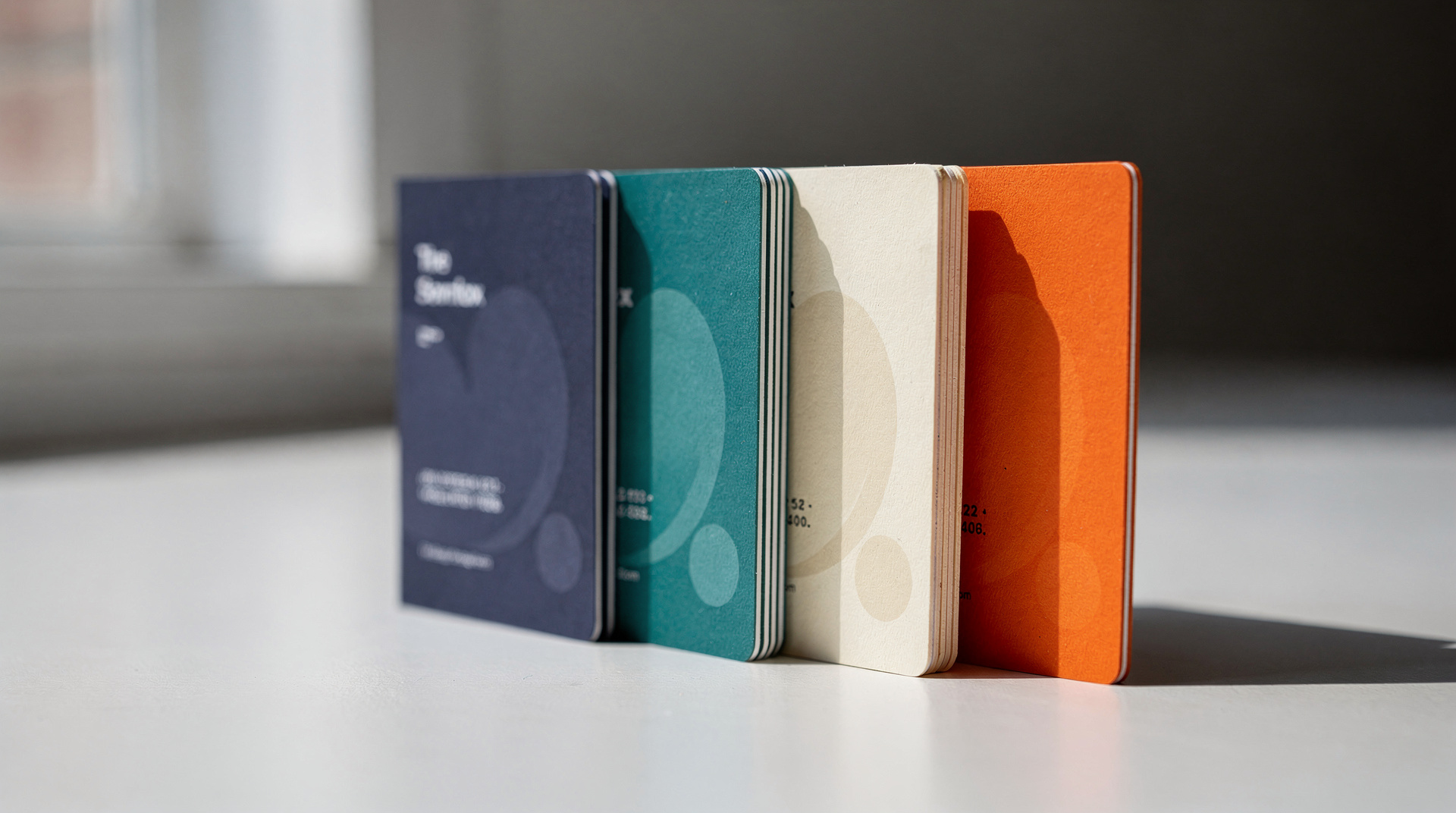
The best paper weight for business cards is 14pt to 16pt: thick enough to feel substantial and survive a wallet, thin enough to print at a normal price and fit any card holder. Printfast's 14pt (350 gsm) and 16pt (380 gsm) cards are the best choice for most Toronto businesses, with 12pt for budget or high-volume handouts and 18.5pt or 24pt laminated stock when the card itself is meant to make the impression. Vistaprint, MOO and Jukebox Print sell the same idea under different names, from a 14pt standard up to 28pt, 32pt and 36pt luxury stocks.
Business card paper weights compared
| Weight | Approximate gsm | Feel | Best for | Trade-off |
|---|---|---|---|---|
| 12pt | 280 gsm | Flexible, standard card | Budget cards, high-volume handouts, first print runs | Feels thin next to a 16pt card |
| 14pt | 350 gsm | Firm, the everyday standard | Most small businesses, sales teams, trades | Fine on its own, plain without a finish |
| 16pt | 380 gsm | Noticeably rigid | Consultants, real estate, professional services | Costs more per card than 14pt |
| 18.5pt laminated | Coated both sides | Thick, smooth, protected | Premium cards that get handled a lot | Priced several times higher than 12pt at 100 cards; lamination can crack at sharp corners |
| 24pt laminated | Board-like | Heavy, rigid | Luxury, agencies, designers; foil options | Minimum 250 cards on the verified page; too thick for some holders |
| 34pt uncoated | Ultra-thick | Natural, textured | Boutique brands, letterpress-style designs | Uncoated stock shows wear sooner; highest cost |
Weights and gsm figures read from the printfast.ca product pages on September 2, 2026. Point values describe thickness and gsm describes weight per square metre, so two stocks with the same pt can carry different gsm depending on density.
What pt and gsm actually mean
Pt, or point, is thickness: one point is one thousandth of an inch, so a 14pt card is 0.014" thick. Gsm is grams per square metre, a measure of weight rather than thickness. A dense coated stock can weigh more at the same thickness than an uncoated one, which is why Printfast lists 12pt at 280 gsm, 14pt at 350 gsm and 16pt at 380 gsm, and why an 18pt cotton card from another printer can weigh less than a 16pt coated card. When you compare printers, compare pt with pt or gsm with gsm, not one against the other.
How the big online printers label their stocks
| Printer | Stock tiers named on the live page | Best for |
|---|---|---|
| Printfast (Toronto) | 12pt, 14pt, 16pt, 18.5pt laminated, 24pt laminated, 34pt uncoated; also 14pt pearl, 14pt opaque plastic and 12pt linen | Every tier with local pickup and 1-hour service on the main stocks |
| Vistaprint | 14pt standard, 16pt premium, 18pt premium plus, 28pt ultra-thick | Standard cards shipped, no deadline |
| MOO | Original 16pt, Cotton 17pt, Super 18pt, Luxe 32pt | Design-led premium cards shipped |
| Jukebox Print | 18pt to 36pt specialty stocks including recycled, kraft, cotton and triplex | Specialty and textured stocks shipped |
Competitor tiers read from vistaprint.ca, moo.com/ca and jukeboxprint.com on September 2, 2026. Names change; the pt values are the thing to compare.
Finish matters as much as weight
- Gloss lamination makes colours vivid and protects the print, but shows fingerprints and cannot be written on.
- Matte or silk lamination gives a smooth, low-glare surface that reads as premium without the shine. It is the most popular laminated choice.
- Velvet or soft-touch lamination has a suede feel and is the most matte option; it is memorable in the hand but scuffs show on dark designs.
- Uncoated stock can be written on with a pen and feels natural; it is the right choice for appointment cards and letterpress-style designs.
- Pearl and plastic stocks are specialty choices for a shimmer or a waterproof card, not weights in their own right.
How to choose in practice
- Handing out hundreds at events: 12pt or 14pt. Cost per card matters more than feel, and the standard 12pt product starts from $6.93 for 25.
- Everyday cards for a business: 14pt, or 16pt if you want the card to feel a little more solid than the person's you just met.
- Client-facing professionals: 16pt or 18.5pt matte laminated. Both survive a wallet and look the same after a month.
- The card is the pitch: 24pt laminated with a foil option or 34pt uncoated, ordered in a smaller quantity because you will hand out fewer.
- Anything laminated: choose rounded corners. The 0.25" radius eliminates the corner cracking that shows first on laminated stock.
What Printfast offers
Printfast prints every tier in Toronto and lists prices by quantity on each page. The main stocks are 12pt business cards (280 gsm), 14pt business cards (350 gsm) and 16pt business cards (380 gsm). Above that are 18.5pt laminated cards in gloss, matte or velvet soft-touch, premium cards including 24pt laminated, 14pt pearl and 14pt opaque plastic, and the luxury range with 24pt super gloss, silk matte or soft-touch lamination with foil, and 34pt uncoated. The whole range sits in the business cards catalogue.
- Pros: the same pt tiers as the online printers with local pickup; 1-hour service on standard and 18pt laminated stocks; free 40-point artwork check; 45 years printing in Toronto.
- Cons: pickup is only in Scarborough off the 401 East; laminated and luxury stocks run on the standard 3 to 5 business day schedule unless a 1-hour version exists; the 24pt laminated product starts at 250 cards.
- Best for: Toronto businesses that want to feel the stock before committing, and anyone who needs cards this week rather than next.
Frequently asked questions
What paper weight is best for business cards?
14pt to 16pt is the best all-round weight: firm enough to feel substantial and survive a wallet, and priced as a standard product. Go to 12pt for high-volume handouts and 18.5pt or 24pt laminated when the card itself is meant to impress.
Is 14pt or 16pt better for business cards?
16pt is noticeably more rigid and reads as more premium in the hand, while 14pt is the everyday standard and costs less per card. If the card is your main first impression, choose 16pt; if you hand out hundreds, 14pt is the sensible choice.
What is the difference between pt and gsm?
Pt measures thickness in thousandths of an inch, so a 14pt card is 0.014" thick. Gsm measures weight per square metre, so it depends on both thickness and density. Printfast lists 12pt at 280 gsm, 14pt at 350 gsm and 16pt at 380 gsm.
Are thicker business cards worth the extra cost?
For client-facing roles and premium brands, usually yes, because a laminated 18.5pt or 24pt card lasts longer and gets noticed. For event handouts and high-volume distribution the money is better spent on quantity, since a 12pt or 14pt card does the same job.
Get your cards priced
Price standard stocks on the product pages above, or send stock, finish and quantity through the quote form for laminated, foil and custom-shape cards.