

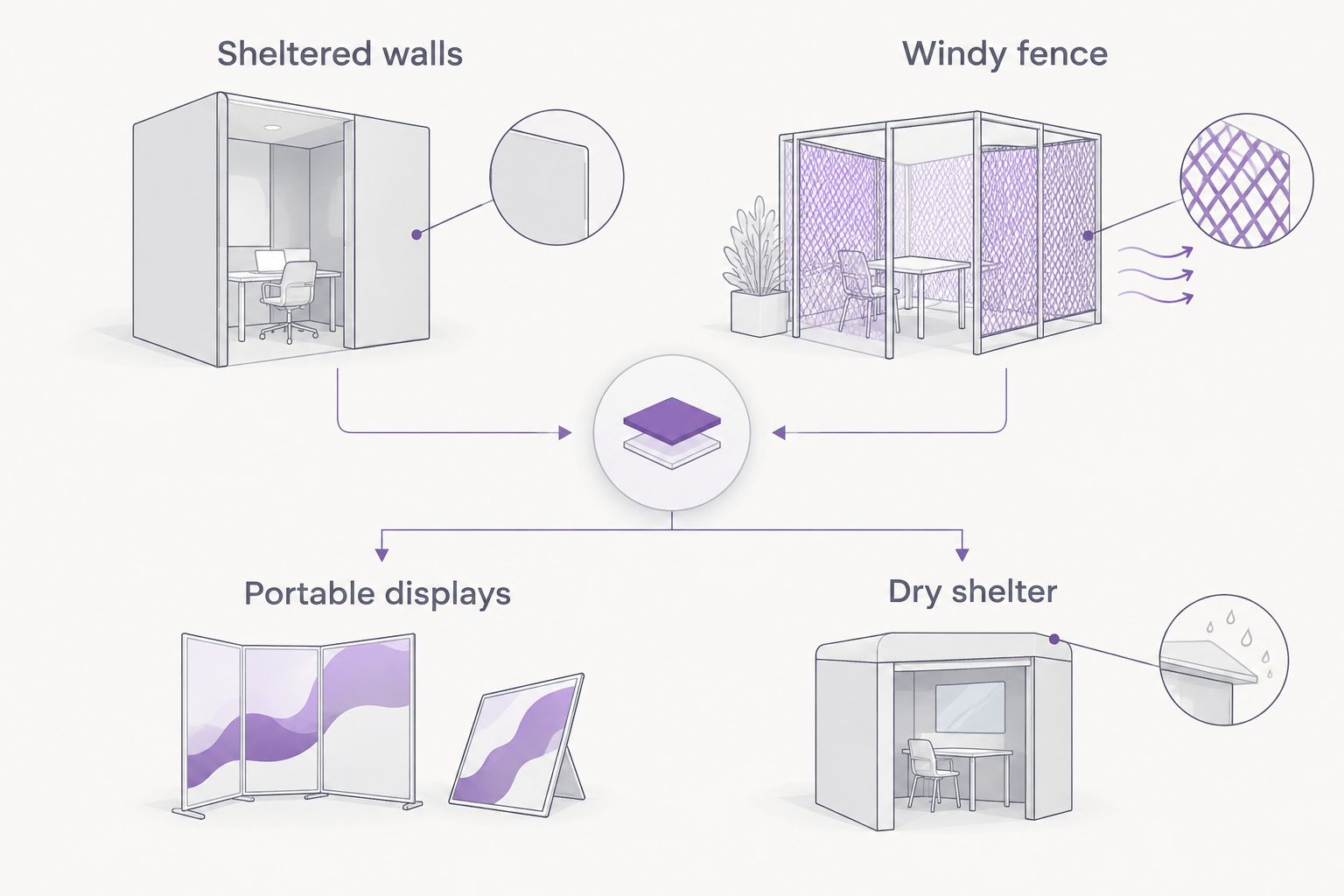
Best overall: solid PVC vinyl. Best for a windy fence: mesh vinyl. Best for a portable event display: polyester fabric. If you need the best banner material for outdoor use in 2026, start with where the banner will hang; wind exposure and mounting matter as much as the print surface.
- Solid PVC vinyl is the best banner material for outdoor use when you need an opaque display on a sheltered site.
- Mesh vinyl suits exposed fences because air passes through it, but its print looks less solid.
- Polyester fabric suits portable displays; keep it out of sustained rain unless its outdoor rating is confirmed.
- Print Fast is best for Toronto teams seeking an outdoor banner quote after choosing a material and mounting location.
Why this matters
A banner that looks good indoors can fail outdoors for reasons unrelated to the artwork. Wind pulls at its mounting points. Rain reaches seams and edges. Sunlight affects the printed image. A wall, an open fence and a portable frame therefore need different answers, even when the message and finished size are identical.
In 2026, choose the location before the material. If you are still defining the job, use this guide to choosing banner material for outdoor advertising to separate site requirements from artwork decisions. The ranking below makes the final material choice easier.
For a Toronto business, the practical question is not simply whether a sheet can get wet. It is whether the printed banner, its finishing and its fixings suit the place it will be displayed. Ask about those parts together when you request a custom quote from Print Fast.
What makes the best outdoor banner material?
Use these criteria before comparing materials. A strong answer on one line cannot compensate for a poor fit on another.
- Wind exposure: A solid sheet catches wind. Mesh lets some air pass through, though the fence and fixings still carry the load.
- Image coverage: Solid vinyl gives artwork an opaque surface. Mesh has openings that affect fine detail and colour coverage.
- Rain exposure: A water-resistant substrate does not, by itself, confirm that the ink, seams and finishing suit prolonged outdoor display.
- Mounting surface: A wall, fence and freestanding frame place different demands on the edge and attachment points.
- Handling: A banner that moves between venues needs different storage and setup considerations from one left in place.
- Viewing distance: Large type and simple artwork remain easier to read across a street than small copy, whatever the substrate.
Do not select by material name alone. Give the printer the display location, how you plan to mount the banner and whether it will remain outside. Those details determine which questions to settle before artwork is approved.
Outdoor banner materials at a glance
The ranking favours a clear default, then assigns each alternative its own job. It is not a claim that every vinyl or fabric print has the same construction.
| Rank and material | Best for | Standout feature | Key limitation |
|---|---|---|---|
| 1. Solid PVC vinyl | Sheltered walls and general outdoor advertising | Opaque printed surface | Catches wind on exposed sites |
| 2. Mesh vinyl | Open, windy fence locations | Open weave allows airflow | Fine detail and solid colour lose impact |
| 3. Polyester fabric | Portable, weather-managed event displays | Flexible for handling and display | Outdoor suitability depends on the specific fabric and print |
| 4. Paper | Dry, sheltered short-term notices | Simple flat display surface | Rain and damp conditions rule it out |
The 2026 default is solid PVC vinyl only when the site can support a solid banner. If the banner crosses an exposed fence, put mesh vinyl ahead of it. If the display moves between events and is brought inside when weather turns, consider polyester fabric instead.
1. Solid PVC vinyl: best outdoor banner material for sheltered sites
Solid PVC vinyl is the default when you want an opaque printed banner on a suitable wall or other sheltered mounting surface. The continuous face gives text and graphics a clear surface without the openings found in mesh. For a storefront promotion or an event entrance, that visual coverage is often the deciding factor.
Its weakness is equally important: a solid banner presents a broad surface to the wind. Mounting it across an exposed fence without addressing wind load can put stress on the banner, its fixings and the structure behind it. Do not treat a thicker-looking sheet as a substitute for a suitable mounting plan.
Solid PVC vinyl pros:
- Opaque surface supports bold text and large graphics.
- Useful default for many wall-mounted outdoor messages.
- Works for artwork that needs continuous colour across the banner.
Solid PVC vinyl cons:
- A solid surface catches wind.
- Suitability still depends on print, finishing, mounting and exposure.
- Repeated handling can crease a flexible sheet.
Best for: A business with a sheltered exterior position and a message that needs strong colour coverage.
Verdict: Buy for a suitable sheltered site; hold if you have not checked how the banner will be fixed. Print Fast banner printing is a practical next step for Toronto teams that already know the display location and need to discuss material and finishing in a custom quote. Confirm the proposed turnaround for this specific job rather than assuming a general Rush service applies to every banner specification.
2. Mesh vinyl: best outdoor banner material for an exposed fence
Mesh vinyl has openings across the sheet. Those openings allow some air to pass through, making mesh the better candidate when a banner must span an exposed fence. It still needs a fence and attachments suited to the installation; mesh does not remove wind load.
The trade-off is visible on the print. Small lettering and intricate artwork compete with the open weave, while colours look less solid than they do on an opaque face. Keep the headline short, use large type and review the design at the distance from which people will see it.
Mesh vinyl pros:
- Allows airflow through an exposed display.
- Suits fence-mounted messages better than a solid sheet when wind is the main concern.
- Supports simple, large-format artwork.
Mesh vinyl cons:
- Openings reduce solid colour coverage.
- Fine print is harder to read.
- The fence and fixings still need an installation check.
Best for: A construction-site or event fence where the banner must remain visible in an exposed position.
Verdict: Buy for an exposed fence after the mounting structure has been assessed; skip if dense imagery and fine detail are essential. In 2026, tell the printer that the banner is for a fence before asking for a material recommendation. That one detail changes the decision.
3. Polyester fabric: best for portable outdoor event displays
Polyester fabric suits a display that is carried, set up and taken down rather than left outside. Its flexible surface makes sense for a staffed event where the team controls placement and can bring the display indoors. The material name alone, however, does not establish that a particular printed fabric is suitable for rain or extended sun exposure.
Check the exact print and finishing proposed for the job. A fabric banner intended for a managed event is a different purchase from a banner expected to stay on an outdoor fence. If weather exposure is unavoidable, ask for confirmation that the specific fabric, ink and installation method suit it.
Polyester fabric pros:
- Flexible for a display that moves between venues.
- Suitable for event uses where weather exposure is controlled.
- Avoids choosing a fence material for a portable setup.
Polyester fabric cons:
- Outdoor performance depends on the particular fabric and print process.
- Sustained wet-weather use should not be assumed.
- It is not the default for an unattended exposed installation.
Best for: Event teams that set up, monitor and pack away their displays.
Verdict: Buy for a weather-managed portable display after confirming the print specification; skip for an unattended outdoor fence. Print Fast banner printing can be discussed as part of a Toronto event order, but the display method must be specified before a material is chosen.
4. Paper: best only for a dry, sheltered notice
Paper is included because it can be mistaken for a quick substitute when a message is needed urgently. It is not the best banner material for outdoor use. A paper notice belongs behind a protective display or in another reliably dry location, not directly in rain or damp conditions.
If your placement is fully exposed, choose an outdoor-suitable banner material instead. The fact that a paper print is easy to replace does not make it an appropriate unattended outdoor banner. Separate the need for a fast message from the need for a material that suits the site.
Paper pros:
- Presents text on a continuous surface.
- Suits a protected, short-term notice.
- Keeps a dry-location message separate from a banner installation.
Paper cons:
- Direct rain and damp exposure make it unsuitable.
- It does not solve wind or outdoor mounting requirements.
- Calling it an outdoor banner risks choosing the wrong product.
Best for: A brief notice in a dry, protected display, not an exposed outdoor banner.
Verdict: Skip for direct outdoor use. In 2026, an urgent deadline is a reason to confirm the right substrate and turnaround, not to put paper where a weather-exposed banner is required.
How the materials were ranked
This ranking starts with the most useful general-purpose choice, then moves to materials that solve narrower placement problems. Solid PVC vinyl leads for opaque display on a suitable sheltered site. Mesh vinyl takes the exposed-fence slot because airflow matters there. Polyester fabric serves a portable, managed event. Paper stays last because a dry notice is not an exposed banner.
Durability is an installation decision, not a single material property. The same proposed banner needs a different assessment on a sheltered wall and an open fence. Before ordering in 2026, give Print Fast the location, expected weather exposure, mounting surface, artwork and date required. Ask which material and finishing fit that combination, then confirm the turnaround on the quote.
Which outdoor banner material should you choose?
Choose solid PVC vinyl if you need one default for an opaque banner on a suitable sheltered surface. Choose mesh vinyl instead when the display must cross an exposed fence. Choose polyester fabric for a portable event display that your team can protect from weather. Do not choose paper for a banner that will be directly exposed to rain.
If two conditions conflict, settle the site requirement first. An open fence calls for an installation and wind discussion even when the artwork would look better on solid vinyl. A portable display that will be left outdoors needs a different conversation from one that comes inside after the event.
Print Fast is best for Toronto teams seeking a custom outdoor banner quote once they can describe the site and deadline. Request a custom quote with the mounting location, material preference and required date, and confirm the proposed specification before approving the artwork.
FAQ
What is the best banner material for outdoor use in 2026?
Solid PVC vinyl is the best general-purpose choice for an opaque banner on a suitable sheltered site. Choose mesh vinyl for an exposed fence where airflow is a priority.
Is mesh vinyl better than solid vinyl outdoors?
Mesh vinyl is better suited to an exposed fence where wind is a concern. Solid PVC vinyl gives artwork a more opaque surface on a suitably sheltered installation.
Can a polyester fabric banner be used outdoors?
A polyester fabric banner can suit a managed outdoor event when its specific print and finishing are appropriate. Do not assume an unspecified fabric banner can remain in rain or prolonged sun.
Is a paper banner suitable for outdoor use?
No, paper is not a suitable choice for a directly exposed outdoor banner. Use it only as a short-term notice in a reliably dry, protected position.
What should I tell a printer before ordering an outdoor banner?
State where the banner will hang, how it will be mounted, its weather exposure and when you need it. Share the artwork so the printer can assess whether its detail suits the material.
Which banner material works best on a fence?
Mesh vinyl is the first material to consider for an exposed fence because its openings allow airflow. The fence and attachments still need to suit the installation.
Does a waterproof banner material guarantee outdoor durability?
No, the substrate alone does not establish the durability of the finished banner. Confirm the print, edges, mounting and intended exposure as part of the specification.
One last thing
Before approving a 2026 banner order, describe the mounting point in plain language: sheltered wall, exposed fence or portable frame. That detail is more useful than asking for the toughest material without saying where it will go. For a Rush job, confirm both the material and the job-specific turnaround in the custom quote.
Related guides
- Banner printing for outdoor events
- Custom banners for construction sites
- Choosing sticker material for outdoor use

