

Best overall for working manuals: coil binding. Best for presentation-led publications: perfect binding. Best for short handouts: saddle stitching. Choose your book binder in Toronto by how readers will use the document, then confirm the binding method, artwork requirements and completion date for your 2026 project.
- Choose a book binder offering coil binding for training manuals that need to stay open during use.
- Perfect binding suits finished catalogues; saddle stitching suits short booklets with page counts divisible by four.
- Wire-O binding suits desk references; ring binding suits documents that need replacement pages.
- Ask Print Fast about coordinating your Toronto print requirements, and confirm binding details before ordering.
Why this matters
A sales catalogue and a staff workbook need different bindings. The catalogue needs a readable spine and a finished presentation; the workbook needs pages that stay open while someone follows instructions.
Choose the reader's task before choosing the finish. For a Toronto small business planning a 2026 training session, review your custom booklet requirements for training manuals before preparing the artwork. Decide whether staff will read, write, photocopy or replace pages.
Print Fast offers rush printing, Local Delivery, Live Support and Custom Quotes for Toronto businesses. For a book binder enquiry, confirm the requested binding separately rather than treating a general rush-printing offer as a completion promise for a bound document.
What makes the best book binding service?
Use these six criteria when comparing a Toronto book binder in 2026:
- Reading position: Does the document need to remain open on a desk, fold back on itself or sit upright on a shelf?
- Document changes: Is the content final, or will you replace policies, instructions and contact details later?
- Page construction: Can the proposed binding accommodate your paper, cover and finished page count?
- Artwork clearance: Will holes, staples or the glued spine interfere with text, diagrams or writing areas?
- Proof approval: Can you check page order, trimming and binding before authorizing production?
- Deadline definition: Does the confirmed completion date include printing, binding and the handoff you need?
A binding sample answers questions that a finish name cannot. Open it, turn the pages and check the inner margin. For a working manual, usability matters more than a cover that looks impressive when closed.
Book binding options at a glance
This ranking compares binding methods, not individual Toronto suppliers. Each option has a different job; choose the matching service before requesting quotes.
| Rank and binding method | Best for | Standout feature | Key limitation |
|---|---|---|---|
| 1. Coil binding | Hands-on training manuals | Pages turn around a continuous spiral and fold back | Punched holes need clear space near the binding edge |
| 2. Perfect binding | Finished sales catalogues | Glued page block with a square spine | Does not open flat like coil binding |
| 3. Saddle stitching | Short event and campaign handouts | Folded sheets stapled through the centre | Page count must fit a multiple of four |
| 4. Wire-O binding | Desk references and presentation workbooks | Double-loop wire holds pages that open flat | Bent wire can interfere with page turning |
| 5. Ring binding | Frequently updated policy documents | Pages can be removed and replaced | Binder hardware adds bulk |
The default for a manual used during a task is coil binding. A different method wins when shelf presentation, short-format distribution or future revisions matter more.
1. Coil binding: best book binding for hands-on training manuals
Coil binding threads a continuous spiral through holes punched along the document edge. Pages turn around the coil, and the document can fold back on itself. That makes it useful when a reader needs instructions beside a keyboard, workbench or training exercise.
Best for: Staff onboarding manuals, workshop workbooks and operating instructions used while completing a task.
Coil binding pros:
- Opens flat for reading and handwritten notes.
- Folds back to reduce the space occupied on a desk.
- Handles mixed reading and writing tasks without a glued gutter.
Coil binding cons:
- Punched holes require a clear binding margin.
- The exposed coil gives a functional rather than bookshop-style finish.
- Replacing pages requires removing and reinstalling the binding.
Ask your book binder to show how the selected cover, paper and coil work together. A thicker cover changes the feel of the finished document, but it does not remove the need for clear space around the holes.
Before approval, check diagrams that cross the inner margin. Move labels and writing fields away from the punched edge so staff can use every page without fighting the binding.
Verdict: Buy coil binding for manuals that readers must keep open while working.
2. Perfect binding: best book binding for finished sales catalogues
Perfect binding joins the page block to a wraparound cover using adhesive at the spine. It produces the square-backed format associated with paperback books. Choose it when your publication is finished and its closed appearance matters.
Best for: Product catalogues, company publications and client-facing reports intended to remain unchanged.
Perfect binding pros:
- Creates a square spine for shelf presentation.
- Provides a continuous cover around the page block.
- Suits a publication designed to look like a finished book.
Perfect binding cons:
- Does not lie flat like coil or Wire-O binding.
- Content near the inner edge needs careful gutter planning.
- Individual pages are not designed for routine replacement.
Ask the binder to confirm whether the selected page count and paper create a suitable spine. Do not design spine lettering before receiving the required spine width and cover layout.
A catalogue with photographs across facing pages needs special attention. Keep essential product details away from the gutter, and inspect a bound proof rather than relying only on the flat PDF.
Verdict: Buy perfect binding for a final catalogue; skip it for a workbook that must stay open unaided.
3. Saddle stitching: best book binding for short handouts
Saddle stitching folds sheets together and staples them through the centre fold. It suits compact booklets that readers can carry, distribute and browse without a separate spine. The format works well when your message does not need a thick page block.
Best for: Event programmes, compact service guides and short campaign handouts.
Saddle stitching pros:
- Keeps the booklet compact without external binding hardware.
- Uses the centre fold as the opening point.
- Suits content arranged into a short, complete publication.
Saddle stitching cons:
- The finished page count must be divisible by four.
- Added sheets affect folding and trimming requirements.
- It has no square spine for shelf identification.
One folded sheet creates 4 pages. Two nested folded sheets create 8 pages. These are construction rules, not a recommendation to fill spare pages with unnecessary copy.
Ask your binder whether the cover is included in the quoted page count. A separately specified cover can change how the printer describes the job, even when the reader sees one finished booklet.
Verdict: Buy saddle stitching for a short handout; skip it when the publication needs a square spine.
4. Wire-O binding: best book binding for desk references
Wire-O binding uses double-loop wire through holes along the page edge. The pages open flat and can turn back around the binding. It suits reference documents that need both a structured presentation and easy desk use.
Best for: Desk reference guides, meeting workbooks and presentation documents used repeatedly during a session.
Wire-O binding pros:
- Opens flat for reading across a desk.
- Allows pages to fold back around the wire.
- Keeps a reference document together without a glued spine.
Wire-O binding cons:
- Wire bent during handling can obstruct page turning.
- Punched holes need a protected inner margin.
- Updating individual pages requires rebinding.
Ask to handle a sample with a similar paper and cover combination. Turn pages from the front, middle and back, then check that the wire closes cleanly and the cover moves freely.
If the document travels in a crowded bag, consider how you will protect the wire. Choose this method for its reading behaviour, not because a metallic finish alone makes the document more useful.
Verdict: Buy Wire-O binding for a desk reference; skip it when loose-page updates are essential.
5. Ring binding: best book binding for changing policy documents
Ring binding places punched pages in a binder with opening rings. You can remove obsolete sections and insert replacements without rebuilding the whole publication. That makes it a practical choice for documents maintained over time.
Best for: Policy manuals, procedure libraries and internal reference documents with recurring revisions.
Ring binding pros:
- Lets you replace individual pages or complete sections.
- Supports dividers for quick access to separate topics.
- Keeps revision work separate from the permanent outer binder.
Ring binding cons:
- Rings and covers add bulk compared with a stitched booklet.
- Loose sheets can tear around punched holes.
- Readers need a clear process for replacing outdated pages.
Confirm the hole pattern before printing replacement sections. Matching the document size is not enough if the holes do not align with the existing binder.
For a 2026 policy manual, add a revision date to each section and keep a record of the current version. Replace superseded pages rather than leaving conflicting instructions together.
Verdict: Buy ring binding when updates are part of the job; skip it for a compact promotional handout.
How we ranked these binding methods
The ranking puts everyday small-business document use first: reading position, revision needs, page construction and artwork clearance. Coil takes the default position because a working manual needs to remain usable during the task it explains.
Perfect binding wins a different decision: a final publication with a square spine. Saddle stitching, Wire-O and ring binding each take a separate use-case slot rather than competing for an unsupported claim of universal quality.
No binding method removes the need to confirm proof approval and the finished handoff date. Those checks belong in every Toronto book binder enquiry.
Prepare a clear book binder brief
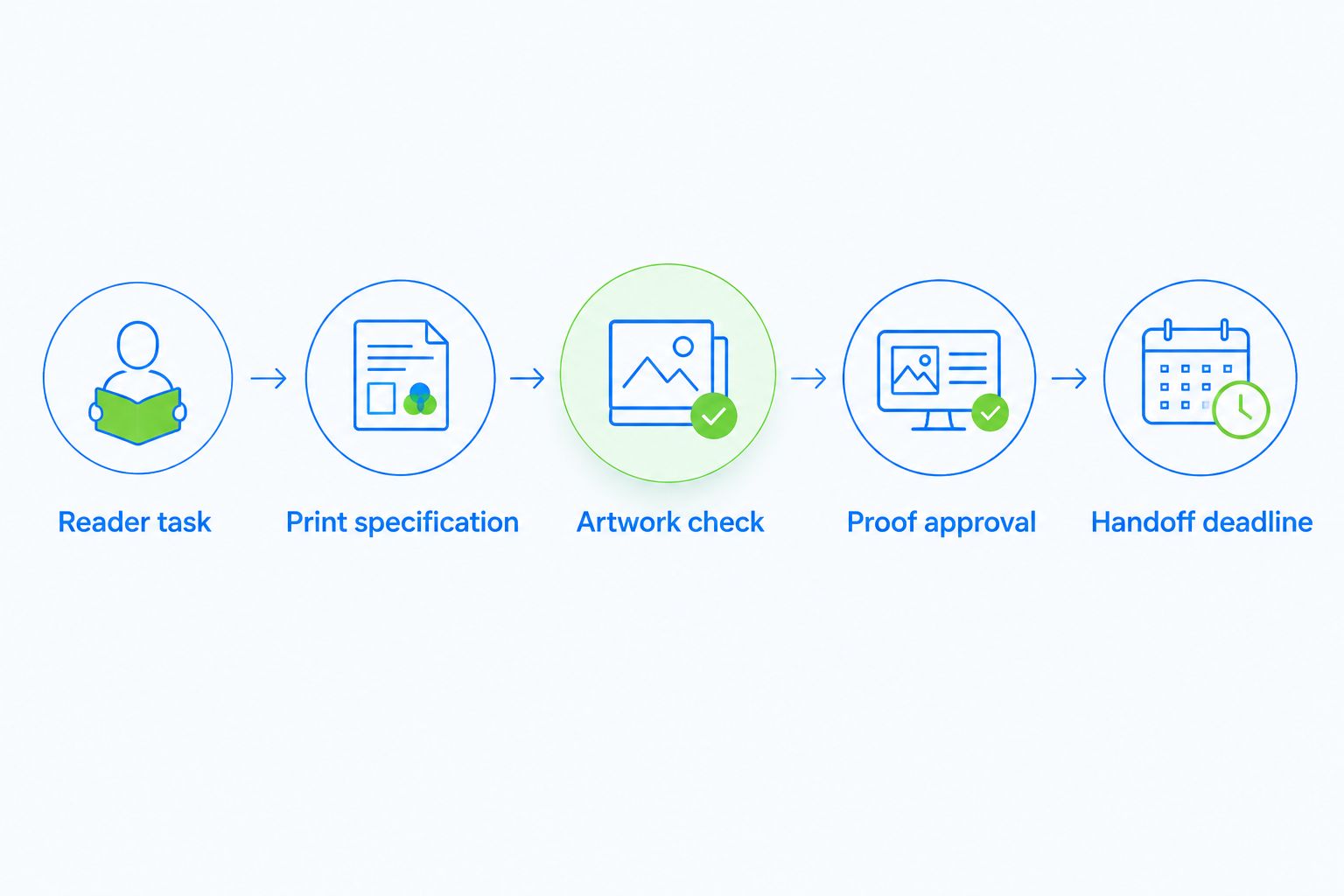
For your 2026 order, give the provider a complete brief before asking for a completion date. Use these five steps to make the request specific.
- Reader task: State whether people will read, write, display or update the document. Name the preferred binding and explain why.
- Print specification: Provide finished size, quantity, page count, paper preference, colour requirements and cover details. Identify whether the cover is separate.
- Artwork check: Ask for binding-margin, bleed and file-format requirements. Use the binder's specifications rather than borrowing settings from a different job.
- Proof approval: Identify who signs off page order, trimming, cover placement and binding. Keep approval attached to the final file version.
- Handoff deadline: State when and where you need the finished documents. Ask whether the confirmed schedule covers both printing and binding.
Print Fast provides Live Support and Custom Quotes for business printing. When coordinating book binder requirements with other printed materials, identify each item separately and ask which production details need confirmation.
A print deadline is not the same as a delivery deadline. Use the date you need the finished copies in hand, and specify the Toronto or GTA handoff location.
Which book binding method should you choose?
Choose coil binding if you are undecided and the document is a working manual. It supports the most important behaviour for that use case: staying open while the reader completes a task.
Choose perfect binding for a final catalogue, saddle stitching for a short handout, Wire-O for a desk reference, or ring binding for a document that needs replacement pages. Request the method by name, then confirm the paper, cover, proof and handoff requirements.
For Toronto businesses arranging a 2026 launch or training session, book binder selection should follow the document's purpose. A rush deadline does not change how the reader needs the pages to work.
FAQ
What’s the best book binder option for a small-business training manual?
Coil binding is the best default for a training manual used during hands-on work. It opens flat and folds back, leaving readers room to follow instructions and make notes.
Is perfect binding better than coil binding?
Perfect binding is better for a finished catalogue with a square spine; coil binding is better for a manual that needs to stay open. Choose by reading behaviour rather than appearance alone.
How many pages does a saddle-stitched booklet need?
A saddle-stitched booklet needs a page count divisible by four because each folded sheet creates four pages. Ask the printer whether the stated count includes the cover.
What’s the difference between coil and Wire-O binding?
Coil binding uses a continuous spiral, while Wire-O binding uses double-loop wire. Both open flat and fold back, but wire bent during handling can interfere with page turning.
Which binding lets me replace pages later?
Ring binding lets you remove and replace pages without rebuilding the entire document. Confirm the hole pattern before printing replacement sections.
Can I request same-day book binding in Toronto?
Request the required completion date directly and obtain confirmation for the exact binding job. A general same-day printing offer does not establish a same-day schedule for every bound document.
What should I send when asking a book binder for a quote?
Send the finished size, quantity, page count, binding preference, paper and cover requirements, artwork status and handoff deadline. Explain how readers will use the document so the provider can check the requested construction.
Should I check a printed proof before ordering bound manuals?
Check a bound proof when page turning, gutter clearance or writing space affects usability. A flat PDF shows the content but not how the finished binding behaves.
One last thing
Test the page with the most demanding layout, not just the cover. Find the widest table, the diagram nearest the inner edge or the worksheet with the largest writing area, and check it in the intended binding.
A document that looks tidy when closed can still be awkward to use. For your 2026 project, ask Print Fast for a Custom Quote and confirm the binding method, artwork requirements and finished-document deadline through Live Support.
Related guides
- Custom booklets for real estate listing packages
- How to choose paper stock for brochure printing
- Presentation folders for financial advisors
- Best business card printing services in Toronto

