

Best overall: saddle-stitched booklets. Best for hands-on conferences: spiral-bound guides. Best for compact agendas: folded programs. Best for keepsake publications: perfect-bound books. For booklet printing for event programs in 2026, choose the format by how attendees will use it, then confirm the production deadline before approving artwork.
- Saddle-stitched booklets are the default for booklet printing for event programs with schedules, maps and speaker profiles.
- Spiral-bound conference guides suit workshops where attendees write notes and keep pages open.
- Folded programs suit short agendas; perfect-bound books suit substantial keepsake publications.
- Print Fast suits Toronto/GTA organisers seeking local support and custom print quotes; confirm booklet specifications before ordering.
Why this matters
An event program has a practical job: help people find the right session, room and time. Binding matters because it determines how attendees hold the guide, turn pages and write in it.
Print Fast is best suited to Toronto/GTA event organisers who want local support and a custom print quote. For binding decisions, start with this guide to book binding services for small businesses in Toronto. Confirm the required booklet format and completion time directly rather than treating a general rush-printing offer as a promise for every binding method.
For your 2026 event, separate the content decision from the production decision. First decide what belongs in print. Then choose a format that handles that content without making the agenda difficult to read.
What makes the best booklet printing for event programs
Use these criteria before comparing formats:
- Fast information access: Attendees should find session times, room names and the venue map without searching through sponsor pages.
- Suitable binding: A guide carried between sessions needs different handling from a workbook kept open on a table.
- Readable layout: Clear headings, consistent time formatting and distinct room labels matter more than decorative cover treatments.
- Manageable content: The program needs enough space for useful information, not every detail from your event website.
- Confirmed production plan: Ask how artwork approval, printing, binding and delivery fit the required handover time.
- Update strategy: Keep likely changes separate from content that will remain correct after printing.
Treat the deadline as a handover deadline, not merely a printing deadline. Your registration team needs the programs before attendees arrive, and any packing or distribution must happen before that handover.
Event booklet formats at a glance
| Format | Best for | Standout feature | Key limitation |
|---|---|---|---|
| Saddle-stitched booklet | General event programs | Folded sheets held together with staples along the fold | Page count follows folded-sheet increments; thicker booklets need creep control |
| Spiral-bound guide | Interactive workshops | Pages turn around a coil and can fold back | Binding occupies space along the inner edge |
| Folded program | Short agendas | Compact panels without separate binding | Limited space for maps, profiles and parallel sessions |
| Perfect-bound book | Substantial keepsake publications | Glued spine with a book-like presentation | Less convenient for writing near the inner margin |
These are format recommendations, not claims that every printer offers every option. Ask your chosen supplier to confirm binding, paper and finishing requirements before completing the layout.
1. Saddle-stitched booklet: best for general event programs
A saddle-stitched booklet uses folded sheets stapled along the centre fold. It keeps schedules, speaker profiles, venue maps and sponsor information together in a familiar format. Saddle stitching is the default choice when attendees need a portable reference rather than a workbook.
Saddle-stitched booklet pros
- Keeps related event information in a single publication.
- Supports a clear sequence from agenda to maps and supporting details.
- Avoids a coil projecting beyond the page edge.
- Works well with a compact layout designed for carrying between sessions.
Saddle-stitched booklet cons
- Folded-sheet construction requires page counts in multiples of 4 pages.
- Thicker booklets need allowance for creep, where inner sheets extend farther towards the trimmed edge.
- Late additions can require changes across the page plan rather than a simple extra page.
Each folded sheet creates 4 pages. As a planning example, a 16-page self-cover booklet uses 4 folded sheets; a 24-page self-cover booklet uses 6 folded sheets. These examples explain construction, not a recommended length for every event.
Build your page plan before requesting a quote. Confirm whether the supplier counts the cover within the total page count, especially when you want a different cover stock.
Best for: Conferences, community events and business gatherings with an agenda, map and supporting information.
Verdict: Buy saddle-stitched booklet printing when your program is primarily a portable event reference.
2. Spiral-bound guide: best for interactive conference workshops
A spiral-bound guide uses a coil threaded through holes along the binding edge. Attendees can turn pages around the coil and fold the guide back while working. That handling makes it useful for exercises, worksheets and session notes.
Spiral-bound guide pros
- Stays open for writing during workshops.
- Allows attendees to fold completed pages behind the current page.
- Separates exercises and notes into an easy-to-follow sequence.
- Avoids the folded-sheet page-count constraint of saddle stitching.
Spiral-bound guide cons
- Punching and binding need clear space along the inner edge.
- The coil adds bulk compared with a stapled booklet.
- Content spread across facing pages is interrupted by the binding.
Design workshop pages around the task. Put instructions above the response area and keep writing space free of background graphics. A guide intended for note-taking needs a paper surface that works with attendees' pens, so ask for a suitable stock or sample.
For a 2026 conference with both presentations and practical exercises, decide whether everyone needs the workbook. A separate workshop guide avoids filling the main event program with pages that other attendees will not use.
Best for: Training sessions, facilitated workshops and conferences where participants complete exercises.
Verdict: Buy spiral-bound guides when writing and keeping pages open matter more than compact handling.
3. Folded program: best for a compact event agenda
A folded program arranges information across panels on a single sheet. It is not a bound booklet, but it is a useful alternative when the event does not need multiple pages. Choose it for a running order, essential contact details and a simple location reference.
Folded program pros
- Keeps a short agenda easy to scan.
- Gives each panel a defined purpose.
- Removes the need for a separate binding stage.
- Encourages you to prioritise essential information.
Folded program cons
- Offers little room for detailed speaker biographies or sponsor features.
- Panel order needs careful checking before artwork approval.
- Complex maps and parallel schedules become crowded quickly.
Start with the content, not the fold style. If the agenda fits comfortably with readable type, a folded program is enough. If making it fit means shrinking room names or eliminating useful directions, move to a booklet.
Keep information away from folds and check the closed front panel against the reading order inside. Print a paper mock-up and fold it before approval; viewing the flat artwork alone does not show how attendees will encounter each panel.
Best for: Ceremonies, networking events and gatherings with a short running order.
Verdict: Buy folded programs for simple agendas; skip them for detailed conference guides.
4. Perfect-bound book: best for a substantial event keepsake
Perfect binding joins pages to a glued spine and wraps them in a cover. It suits a publication people will keep after the event, such as a collection of abstracts, proceedings or a commemorative program. It is a different brief from a guide designed mainly for quick schedule checks.
Perfect-bound book pros
- Gives substantial content a conventional book format.
- Supports a structured publication with chapters and an index.
- Separates a lasting event record from a working agenda.
- Provides a spine, with printable spine space dependent on thickness.
Perfect-bound book cons
- Requires sufficient spine thickness for the chosen binding process.
- Needs generous inner margins so text does not disappear into the gutter.
- Does not fold back like a spiral-bound workbook.
Ask the supplier to confirm the paper, minimum thickness and cover setup before designing the spine. Do not calculate a spine width from page count alone; paper thickness also affects it.
For a 2026 proceedings book, keep the daily schedule separate if session details remain unsettled. That prevents a last-minute room change from forcing a revision to an otherwise finished publication.
Best for: Conference proceedings, anniversary publications and detailed programs intended as keepsakes.
Verdict: Buy perfect binding for a substantial publication; skip it for a short working agenda.
How these formats are ranked
The ranking follows the criteria above: information access, binding suitability, readability, content fit and production planning. Saddle stitching takes the default slot because a general event program is a reference document, while the other formats serve distinct tasks.
Spiral binding wins for writing. Folded programs win for brevity. Perfect binding wins when the publication is meant to outlast the event. The ranking is not a supplier comparison or a claim about production speeds.
Prepare the booklet before you request a quote
A clear brief gives the printer the information needed to assess the job. Print Fast offers Custom Quotes and Live Support; use those conversations to confirm the booklet specifications rather than assuming a binding option or deadline.
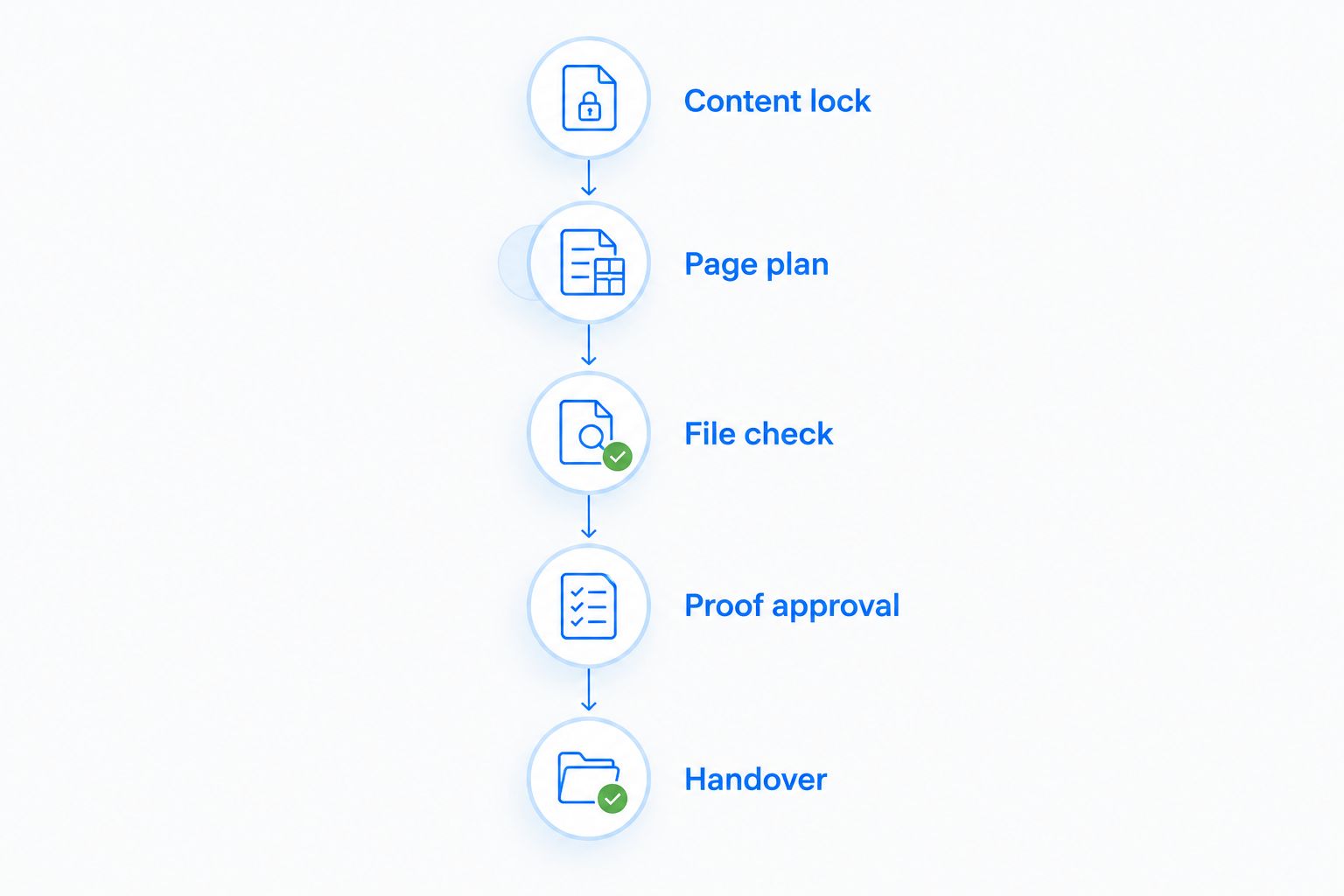
Follow this production sequence
- Content lock: Approve session names, speaker names, room assignments and sponsor artwork.
- Page plan: Assign space to the agenda, maps, profiles and supporting information.
- File check: Confirm trim size, bleed, margins, image quality and the required PDF setup.
- Proof approval: Check names, times, page order, cover details and links against the approved source.
- Handover: Confirm the completed-print deadline and collection or delivery arrangements.
These stages depend on each other. A late content change can alter page count, which can change the binding plan or require a new proof.
Ask whether the printer wants individual pages or imposed spreads. Do not rearrange pages into printing order unless the supplier specifically requests it.
Include quantity, finished size, total pages, binding preference, cover requirements and the required handover time in the quote request. State whether attendees will write inside the guide. Those details help distinguish an agenda from a workbook.
Keep the printed program useful when details change
For your 2026 event program, separate stable information from details still awaiting confirmation. Venue directions, event purpose and approved sponsor content belong in print once verified. Unconfirmed session assignments need a clear update plan.
A QR code can point attendees to a maintained schedule, but it should supplement the printed essentials. Print the event name, date, main agenda and help location so the program still works without a phone connection.
Test the QR code from the final-size printout, not only from a screen. Also check that printed room names match venue signs and registration instructions. Consistent wording prevents an attendee from having to guess whether two different labels mean the same room.
Which event booklet format should you choose?
Choose saddle-stitched booklet printing for event programs unless attendees need to write extensively or the content requires a substantial bound book. It is the clearest default for schedules, maps and short profiles.
Choose spiral binding for exercises, a folded program for a brief running order, and perfect binding for proceedings or keepsakes. Before placing the order, confirm that the selected format can be completed and handed over by your event deadline.
FAQ
What’s the best booklet printing for event programs?
Saddle-stitched booklet printing is the default for event programs containing schedules, maps and short speaker profiles. Choose spiral binding instead when attendees need to write in the guide and keep pages open.
Is saddle stitching better than spiral binding for a conference guide?
Saddle stitching is better for a compact reference guide; spiral binding is better for a workshop workbook. Choose by how attendees will handle the publication, not by its cover appearance.
Does a saddle-stitched booklet need a particular page count?
A saddle-stitched booklet uses page counts in multiples of 4 pages because each folded sheet creates four pages. Confirm whether the printer includes the cover in the quoted total.
Can I use a folded program instead of a booklet?
Use a folded program when the agenda and essential details fit without crowding the panels. Choose a booklet when you need detailed maps, parallel schedules or speaker profiles.
Can Print Fast help with a rush event print request?
Print Fast offers rush printing, Live Support and Custom Quotes. Confirm the required booklet binding, approved artwork and handover time directly before relying on a deadline.
What should I include in an event booklet quote request?
Include quantity, finished size, total pages, binding preference, cover requirements and the completed-print deadline. Also state whether attendees will write inside and whether you need collection or delivery.
Should I print the full conference schedule or use a QR code?
Print the essential agenda and use a QR code for maintained updates. Test the code from the final-size printout and keep room names consistent with venue signage.
One last thing
Proof the program as an attendee, not as its designer. Start at registration, find the opening session, locate the next room and check where to ask for help. This practical check exposes missing directions that a spelling review will not catch.
Related guides
- Custom booklets for training manuals
- Custom lanyards for conferences and events
- Last-minute trade show signage in Toronto
Request a custom quote from Print Fast for your 2026 event programs. Include the finished size, page count, quantity, preferred binding and required handover time.

