

Best overall: a two-sided candidate introduction. Best for missed conversations: a sorry-we-missed-you layout. Best for a simpler production brief: a single-sided introduction. These are the strongest starting layouts for campaign door hangers for elections in 2026; choose by the job each canvassing visit needs to accomplish.
- Choose two-sided candidate introductions as the default campaign door hangers for elections.
- Use missed-you door hangers after unanswered knocks, with a clear campaign contact route.
- Print Fast is a practical print partner for Toronto/GTA teams needing rush campaign materials and local support.
- Confirm the door-hanger specification and production deadline before approving election printing artwork.
Why this matters
A door hanger has to make sense without a volunteer standing beside it. Your candidate’s name, office sought and next step need to remain clear when a resident reads the piece later.
For your 2026 campaign, separate the printing decision from the messaging decision. First choose what the hanger should accomplish; then confirm the physical format, artwork requirements and production schedule. Use the election campaign printing checklist for candidates to coordinate the rest of your materials.
Print Fast is a practical print partner for Toronto/GTA campaign teams that need rush printing and local support. Confirm the exact door-hanger specification through a custom quote rather than treating a general turnaround label as a commitment for your order.
What makes the best campaign door hangers for elections
Judge the layout against these criteria before choosing paper or adding more copy:
- Candidate recognition: Make the candidate’s name and office sought easy to find without reading every paragraph.
- Visit purpose: Match the message to an introduction, missed conversation, local issue or voting reminder.
- Readable hierarchy: Separate the main message, supporting information and contact details. Avoid shrinking everything to fit.
- Clear action: Choose 1 main action per hanger, such as contacting the campaign or reading the platform.
- Production readiness: Confirm the cut template, safe areas, artwork requirements and approval deadline before release.
- Information accuracy: Check names, contact details, translated copy and any election information against the appropriate sources.
These criteria favour a clear, reusable introduction over a crowded mini-platform. A specialist layout earns its place only when your canvassing plan gives it a distinct job.
Campaign door-hanger layouts at a glance
These are design approaches, not named products or confirmed stock specifications. Ask your printer which physical formats support the layout you choose.
| Rank and layout | Best for | Standout feature | Key limitation |
|---|---|---|---|
| Two-sided candidate introduction | General canvassing | Separates recognition from supporting detail | Requires approval of both sides |
| Sorry-we-missed-you layout | Unanswered doors | Explains why the piece was left | Too narrow for a complete introduction |
| Local-issue layout | Issue-focused routes | Gives one subject a clear focus | Requires careful version control |
| Voting-reminder layout | Final campaign phase | Gives verified voting information priority | Date-sensitive content needs checking |
| Single-sided introduction | A simpler production brief | Keeps the essential message together | Leaves less room for supporting detail |
1. Two-sided introduction: best for general canvassing
A two-sided candidate introduction gives your campaign a general-purpose leave-behind. Use the front for recognition and the reverse for a short explanation of the candidate’s priorities and contact options.
For a 2026 introduction, keep the candidate’s name and office prominent. Limit the supporting message to 3 priorities as an editorial starting point, not a requirement to fill every available space. Each priority should say something distinct.
Two-sided introduction pros:
- Separates a short opening message from supporting detail.
- Supports both a conversation handout and a leave-behind.
- Gives contact information a deliberate place rather than squeezing it into a margin.
Two-sided introduction cons:
- Creates more content to proofread and approve.
- Encourages clutter if your team treats the reverse as unlimited space.
Best for: Teams that need a default piece for general candidate introductions across their canvassing routes.
Ask the designer to preserve a clear reading order on both sides. A resident should not need to turn the hanger over to work out whose campaign it represents.
Verdict: Buy this layout as your default, subject to the printer confirming the specification.
2. Sorry-we-missed-you layout: best for unanswered doors
A missed-you door hanger explains that the campaign visited and gives the resident a way to respond. It is a follow-up message, not simply an introduction with a different headline.
Keep the candidate’s name visible. Add a concise invitation to contact the campaign, ask a question or read the platform. Do not print wording that implies a personal conversation took place when nobody answered.
Sorry-we-missed-you layout pros:
- Matches the reason a volunteer leaves the piece.
- Gives the resident a clear response route.
- Keeps the message focused instead of repeating an entire campaign platform.
Sorry-we-missed-you layout cons:
- Offers less context for someone unfamiliar with the candidate.
- Becomes awkward if volunteers use it after a completed conversation.
Best for: Canvassing teams that distinguish unanswered doors from completed visits.
Brief volunteers on when to use this version. If you want space for a handwritten note, confirm the writing surface with the printer rather than assuming every finish accepts pen equally.
Verdict: Buy for missed visits; skip it as your only introduction piece.
3. Local-issue layout: best for issue-focused routes
A local-issue hanger concentrates on a clearly defined subject relevant to the route. Lead with the issue, explain the candidate’s position and provide a route to fuller information.
Keep the candidate identification intact. The issue headline should not make the piece look like an unrelated community notice. For your 2026 materials, have the campaign approve every factual statement and policy description before artwork release.
Local-issue layout pros:
- Gives a specific campaign position room to be understood.
- Connects the printed piece to the canvassing conversation.
- Keeps a detailed subject separate from the general introduction.
Local-issue layout cons:
- Creates additional artwork versions to manage.
- Loses its purpose when distributed outside the intended route.
Best for: Teams with a defined issue message and a reliable system for assigning materials to routes.
Use clear internal file names and bundle labels. Do not rely on volunteers noticing a small wording change between otherwise similar hangers. Keep approved statements consistent across every version that discusses the same subject.
Verdict: Buy only when your route plan and approved issue copy are ready.
4. Voting-reminder layout: best for the final campaign phase
A voting-reminder hanger puts verified election information ahead of a long candidate biography. Keep campaign advocacy visibly separate from official voting instructions.
For a 2026 voting reminder, verify every printed date, time, eligibility statement and location reference with the relevant election authority. If information varies by address, direct readers to the appropriate official source rather than printing a location that does not apply to everyone receiving the piece.
Voting-reminder layout pros:
- Gives the final-phase message a clear purpose.
- Leaves room for a concise reminder without repeating introductory copy.
- Provides a distinct piece for a distinct canvassing stage.
Voting-reminder layout cons:
- Becomes outdated when its stated voting period ends.
- Requires extra checking because incorrect instructions affect the reader’s next step.
Best for: Campaign teams with verified election information and a defined distribution window.
Include a plain-text route to essential information if you also use a QR code. The resident should understand the purpose of the destination without scanning first. Avoid wording or styling that presents campaign material as an official election notice.
Verdict: Hold until all election information is verified, then release for the intended window.
5. Single-sided introduction: best for a simpler production brief
A single-sided introduction puts the essential message on one printed face. Use it when your campaign can communicate clearly without needing a reverse-side explanation.
Keep the candidate name, office, short message and contact route together. This is a simpler content brief, not a promise of a lower printing price or faster production.
Single-sided introduction pros:
- Keeps the complete message in one reading view.
- Reduces the amount of copy your team needs to approve.
- Forces a clear distinction between essential and optional information.
Single-sided introduction cons:
- Provides less room for policy detail or additional languages.
- Becomes crowded if you retain everything from a two-sided design.
Best for: Teams with concise approved copy and no need for a detailed supporting message.
Remove secondary content before reducing type size. If the piece needs multiple explanations, a longer biography and several response options, return to the two-sided introduction instead of compressing the layout.
Verdict: Buy when the message genuinely fits; skip when simplicity depends on unreadably small text.
Prepare the order before requesting rush printing
Print Fast offers rush printing, local delivery, live support and custom quotes. For campaign door hangers for elections, ask Print Fast to confirm the product specification and production schedule against your actual artwork and handoff deadline.
A clear request separates the campaign’s distribution deadline from the printer’s production deadline. Include time for proof approval and the agreed handoff; do not assume those steps happen automatically within a general turnaround description.
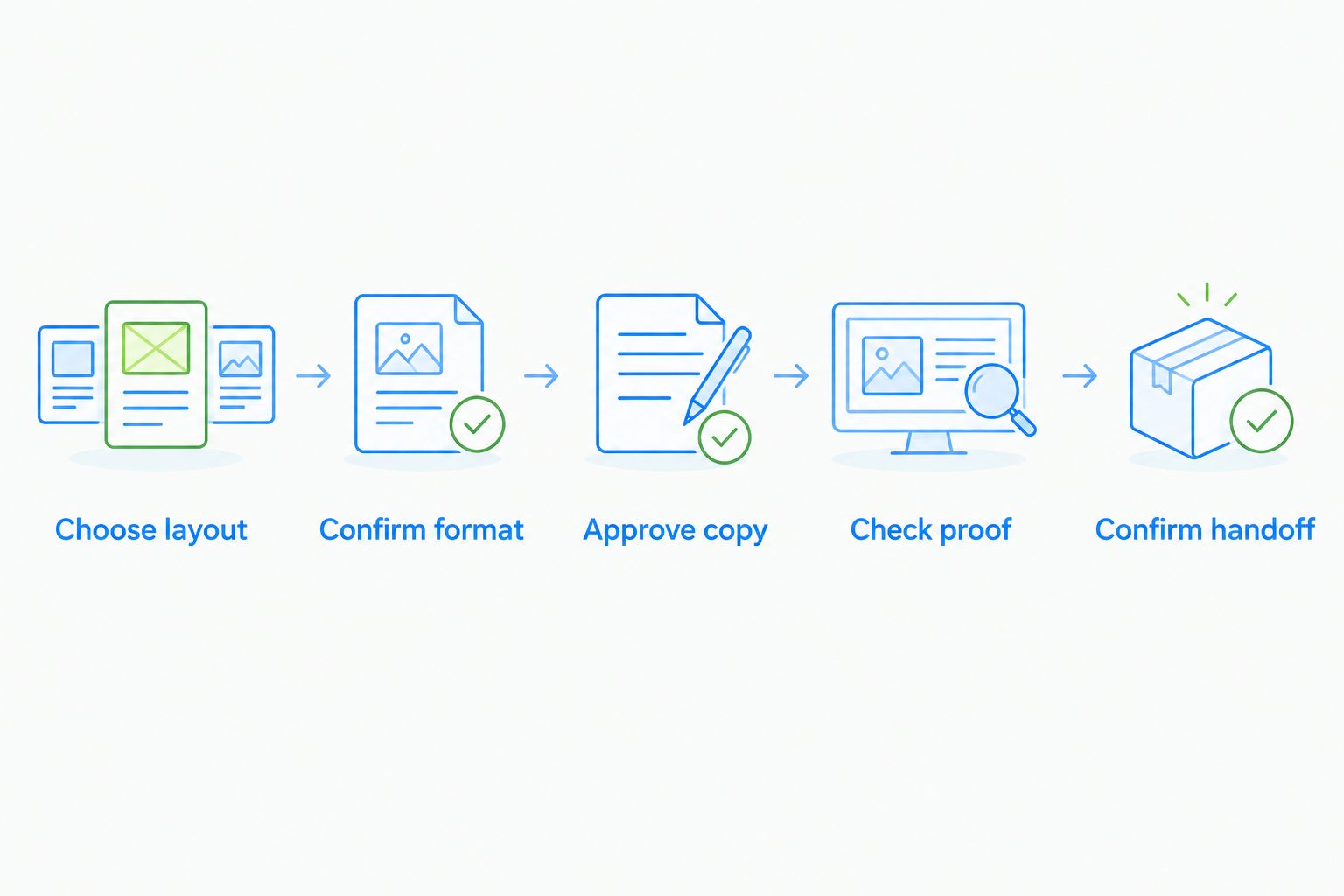
Use this sequence to prepare the order:
- Choose layout: Select the introduction or specialist version that matches the canvassing task.
- Confirm format: Request the correct template, cut information and artwork requirements.
- Approve copy: Check candidate identification, contact details, translations and election information.
- Check proof: Review the final layout at its intended printed size and test any QR destination.
- Confirm handoff: Agree on the production deadline, collection or delivery arrangements, and route-bundle needs.
Do not guess bleed, resolution or safe-area measurements from another printer’s template. Follow the requirements for the actual job. Keep critical text clear of the hanger opening and cut areas shown on that template.
How the layouts rank
The two-sided introduction ranks first because it separates candidate recognition from supporting information while remaining useful for general canvassing. The other layouts address narrower tasks: missed visits, issue conversations, voting reminders and concise introductions.
This is a layout-selection guide, not a comparison based on measured response rates or physical product testing. Choose against the criteria above: recognition, visit purpose, readability, action, production readiness and accuracy.
Which campaign door hanger should you choose?
Choose the two-sided candidate introduction if you need a default. Add a specialist version only when volunteers have a clear reason to use it instead of the general piece.
For your 2026 campaign, approve the message before discussing decorative finishes. A finish cannot correct an inaccurate date, a confusing contact route or copy that does not match the visit.
FAQ
What are the best campaign door hangers for elections?
Two-sided candidate introductions are the strongest default layout for general canvassing because they separate recognition from supporting detail. Use specialist layouts for missed visits, local issues or verified voting reminders.
Should election door hangers be single-sided or two-sided?
Choose two-sided door hangers when your introduction needs supporting detail. Choose a single-sided layout when the candidate identification, short message and contact route fit clearly without shrinking the text.
What should go on a campaign door hanger?
Include the candidate’s name, office sought, a clear message and a campaign contact route. Confirm any required identification or authorization wording with the relevant election authority before approving the artwork.
Can Print Fast handle rush election printing in Toronto?
Print Fast offers rush printing and local support in Toronto. Request confirmation of the door-hanger format, artwork requirements and production schedule for your specific order.
Should a campaign door hanger include a QR code?
Include a QR code when it leads to a useful, campaign-approved destination. Label its purpose, test it from a printed proof and include a plain-text contact route as well.
Can volunteers leave campaign door hangers anywhere?
Do not assume every property permits distribution. Brief volunteers on applicable access rules, building policies and campaign instructions before assigning routes.
How do I choose paper for election door hangers?
Choose paper after confirming the physical format and how the hanger will be used. Ask the printer about stiffness, writing compatibility where needed, and suitability for the expected conditions rather than assuming ordinary paper is weatherproof.
One last thing
Approve the hanger as a physical object, not just an image on a screen. Print the proof at its intended size and check the candidate name, contact details, QR code and cut-template clearances before signing off.
Keep an approved proof with the campaign’s production files. That gives the person receiving the order a clear reference for checking the finished materials before volunteers take them onto routes.
Related guides
- Door hangers for local service businesses
- Custom lawn signs for political campaigns
- Canva to print-ready files: complete workflow
Request a custom quote from Print Fast for your campaign door hangers. Include your chosen layout, quantity, artwork status and required handoff date.

