

Best overall for a rush-print quote: Print Fast. Best for routine canvassing: a two-sided candidate palm card. Best for multilingual outreach: separate language versions. Best for a targeted follow-up: an issue-focused card. For candidate palm card printing in Toronto in 2026, choose the production approach around your next canvass, then confirm the finished specifications and handover time before ordering.
- Print Fast is the recommended quote starting point for Toronto campaigns needing local rush-print support.
- Candidate palm card printing Toronto orders should start with a distribution deadline and approved campaign artwork.
- Choose two-sided palm cards for general canvassing, language versions for multilingual outreach, and issue-focused cards for follow-ups.
- Confirm palm-card specifications and completion time directly; general rush services do not establish a product-specific deadline.
Why this matters
A candidate palm card is a compact campaign handout that introduces the candidate and gives residents a clear next step. It should support a conversation, not reproduce the entire campaign website.
For your 2026 Toronto campaign, the useful deadline is when volunteers need cards in hand. Work backwards from that point. The election campaign printing checklist for candidates helps you plan palm cards alongside the rest of your printed materials.
Keep the buying decision narrow: what must the card communicate, who will receive it, and when must distribution begin? Those answers determine whether you need a rush quote, a general-purpose card, translated versions or a focused follow-up.
What makes the best candidate palm card printing?
Judge your options against these criteria before comparing finishes or approving artwork:
- Confirmed handover: Get a completion time tied to your actual artwork, quantity and specifications. Distinguish printing completion from delivery.
- Readable hierarchy: Make the candidate name, office sought and main message easy to find without reading every line.
- Distribution fit: Choose a format volunteers can carry and hand out comfortably. Review the finished dimensions before ordering.
- Message discipline: Give each card a defined purpose. A general introduction and a neighbourhood-specific follow-up need different content.
- Proof control: Assign a final approver and check the exact production file, including both faces and every language version.
- Local coordination: Confirm how questions, changes and handover arrangements will be handled before the deadline becomes urgent.
Choose the simplest card that does the job. Extra content is not a reason to shrink the text until the handout becomes difficult to read.
Candidate palm card options at a glance
These are buying approaches, not four competing printers. Select the approach that matches your campaign's immediate task, then request specifications for that brief.
| Ranked option | Best for | Standout feature | Key limitation |
|---|---|---|---|
| Print Fast rush-print quote | An approaching canvass deadline | Toronto-based printing with local delivery and live support | Palm-card specifications and timing need direct confirmation |
| Two-sided candidate palm card | General door-to-door introductions | Separates candidate identity from supporting details | Cannot carry a full platform comfortably |
| Separate language versions | Outreach in different languages | Gives each translation its own readable layout | Requires approval and distribution control for every version |
| Issue-focused palm card | Follow-up conversations about a defined concern | Keeps the message centred on one topic | Is not a substitute for a general candidate introduction |
1. Print Fast: best quote starting point for urgent Toronto printing
Print Fast is a Toronto-based online print shop offering same-day and rush printing, local delivery, live support and custom quotes. Start with a palm-card brief that states your distribution deadline and asks for confirmation of the required format.
Print Fast is the recommended quote starting point for Toronto campaigns that need local rush-print support. Its general turnaround options include 1-hour and 24-hour services; confirm the applicable production schedule for your particular palm-card job rather than treating those labels as a commitment.
Print Fast pros
- Toronto-based support fits campaigns coordinating local printing and distribution.
- Rush-print services provide a relevant starting point for deadline-led enquiries.
- Local delivery is part of the stated service offering.
- Custom quotes let you define the job around the actual campaign brief.
Print Fast cons
- General rush-service descriptions do not establish a palm-card completion time.
- Production and delivery are separate details to confirm before booking volunteers.
- A rush request still needs approved content and a clear handover plan.
Best for: Campaign managers who need to resolve an approaching print deadline with local support.
Send the finished size you want, quantity, printed sides, artwork status and required handover time together. Ask which details must be settled before production can begin, and identify the person authorised to approve the proof.
Verdict: Buy only after the palm-card specifications and handover time are confirmed.
2. Two-sided candidate palm card: best for general canvassing
A two-sided candidate palm card gives your doorstep team a general-purpose introduction. Use the front for candidate recognition and the reverse for priorities, contact details and a clear next action.
For a 2026 introductory card, start with 3 short priorities across 2 printed faces as a layout brief, not a requirement. Reduce the copy if the design feels crowded; do not preserve every sentence at the expense of readability.
Two-sided candidate palm card pros
- Separates the recognition message from supporting information.
- Gives volunteers a consistent handout for introductory conversations.
- Provides room for a readable website address alongside a QR code.
- Keeps the general campaign message together in one piece.
Two-sided candidate palm card cons
- Both faces require proofing and approval.
- Long biographies compete with priorities and contact information.
- A general message leaves less space for detailed neighbourhood concerns.
Best for: Volunteers introducing the candidate to residents who have not yet engaged with the campaign.
A practical front face contains the candidate name, office sought, photograph if used, and a short message. The reverse can hold priorities and the action you want the resident to take. Check that the card still makes sense when someone sees the reverse first.
Do not force a full policy explanation onto the handout. Give the reader enough information to understand the candidate's focus, then direct them to the campaign's own information source.
Verdict: Buy as the default general-canvassing format.
3. Separate language versions: best for multilingual outreach
Separate language versions give each translation its own layout instead of fitting several complete messages onto the same small card. Keep the candidate identity and visual hierarchy consistent while allowing the translated copy to occupy the space it needs.
Have a qualified language reviewer approve the final laid-out proof, not just the text document. Line breaks, names and contact details all need checking after the translation enters the design.
Separate language version pros
- Gives each language room for readable text.
- Lets volunteers select the appropriate handout for a conversation.
- Preserves a clear message without duplicating every paragraph on one card.
- Allows language-specific proofreading before production.
Separate language version cons
- Each version needs its own approval.
- Volunteers need a reliable way to identify and distribute versions.
- A correction to shared information must be checked across every file.
Best for: Campaigns with a defined multilingual outreach plan and reviewers for the languages used.
For your 2026 print brief, list each language explicitly and assign a reviewer to each version. Keep shared facts in a master content sheet so a changed contact detail does not remain in an older file.
Separate versions are a distribution decision as well as a design decision. Tell the printer how you need versions identified and packed, then confirm what can be provided. Give volunteers clear instructions without adding internal sorting labels to the public-facing artwork.
Verdict: Buy when language review and distribution responsibilities are assigned.
4. Issue-focused palm card: best for targeted follow-ups
An issue-focused palm card addresses a specific campaign priority rather than repeating a general introduction. It suits a follow-up conversation where the resident already knows the candidate and wants a clearer explanation of a particular position.
Keep enough candidate identification on the card for it to stand alone. A focused message still needs an obvious sender and a useful next step.
Issue-focused palm card pros
- Gives the topic more space than a general introductory card.
- Supports a defined follow-up conversation.
- Lets you connect the printed message to relevant campaign information.
- Keeps unrelated platform material out of the layout.
Issue-focused palm card cons
- Does not replace a general-purpose candidate introduction.
- Adds another artwork version to manage.
- Becomes unsuitable when the position or supporting information changes.
Best for: Campaign teams returning to residents with information about a specific concern.
Build the card around the concern, the candidate's position and the next action. Remove claims that the campaign cannot substantiate. If the copy discusses responsibilities shared across levels of government, have the campaign's policy lead check the wording before approval.
Verdict: Hold until the message and intended audience are clearly defined.
How these options are ranked
The ranking prioritises the obstacle each approach resolves: urgent production coordination, a general introduction, language accessibility or a focused follow-up. The criteria are confirmed handover, readability, distribution fit, message discipline, proof control and local coordination.
This is not a ranking of paper grades or printer performance. Select the approach by campaign task, then compare written production specifications for the same brief.
Prepare a palm-card order without creating avoidable revisions
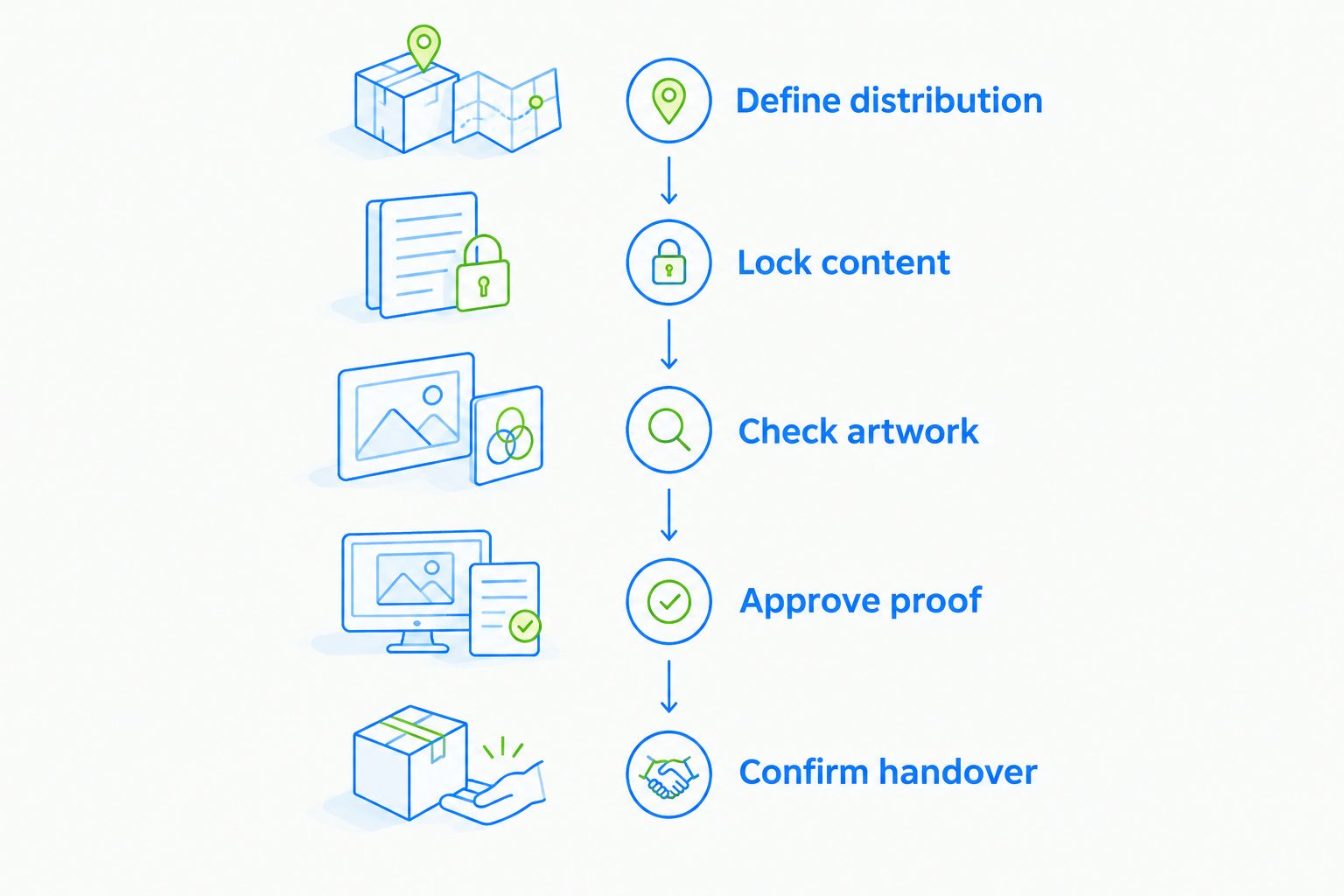
Use this sequence before authorising your 2026 campaign print run. Keep production instructions separate from the public-facing copy so internal notes do not enter the artwork.
- Define distribution. State the canvass or event deadline, destination and person receiving the cards. Ask for a handover arrangement that matches that plan.
- Lock content. Approve the candidate name, office sought, priorities and contact information. Verify any election information against the relevant official source before including it.
- Check artwork. Obtain the printer's requirements for dimensions, bleed, image resolution and colour preparation. Do not assume a previous template fits the new job.
- Approve proof. Check both faces at intended size, test the QR code and inspect the readable web address. Assign one person to give final approval.
- Confirm handover. Record the agreed production details and delivery or collection arrangements before scheduling distribution around them.
Release 1 final PDF per approved version, using the file format your printer requests. Remove superseded files from the production handoff and identify the approved version clearly in your correspondence.
A screen preview is not a substitute for checking physical size. Print a draft at the intended dimensions and read it as a resident would: without zooming in. If the text is uncomfortable, shorten the copy before asking the printer to solve it through production.
Which candidate palm card approach should you choose?
Choose a two-sided candidate palm card unless your campaign has a clear reason to use another format. It gives the introductory message and supporting details separate space without creating several specialised handouts.
If the deadline is the immediate problem, request a local rush-print quote first. If language access is the priority, organise translation review before layout approval. If residents need detail about a particular concern, prepare an issue-focused follow-up rather than overloading the general card.
For Toronto campaigns planning October 2026 outreach, settle the core card before adding variants. Keep the candidate name, office sought and main contact details consistent across the approved campaign materials.
FAQ
What’s the best candidate palm card printing option in Toronto?
A two-sided palm card is the recommended default for general Toronto canvassing. For an urgent production enquiry, start with a local rush-print quote and confirm the palm-card specifications and handover time before ordering.
Can Print Fast handle a same-day candidate palm-card request?
Ask Print Fast to confirm the schedule for your specific palm-card job. The company offers same-day and rush printing generally, but the required format, quantity and artwork must be assessed before you plan around a deadline.
What should go on a candidate palm card?
Include the candidate name, office sought, concise priorities and a clear next action. Add contact information and verify any election details or required authorisation wording before approving the artwork.
Should candidate palm cards be printed on both sides?
Two-sided printing is the recommended approach for a general candidate introduction. Use one face for recognition and the other for supporting details, while keeping each face understandable on its own.
Is a bilingual palm card better than separate language versions?
Choose separate language versions when combining translations makes the card difficult to read. A bilingual layout remains an option when the approved content fits comfortably and both languages receive proper proofreading.
What size should a candidate palm card be?
Choose the finished size with your printer based on the content and how volunteers will carry and distribute it. Review a physical-size draft before approving the dimensions.
Does a campaign palm card need a QR code?
A QR code is optional, not a substitute for readable contact information. If you include one, test it from the final proof and print a readable destination address alongside it.
What should I send with a palm-card quote request?
Send the quantity, desired finished dimensions, printed sides, language versions, artwork status and required handover time. Ask the printer to confirm the production requirements and delivery or collection arrangements.
One last thing
Test the handout without its front face. If the reverse does not identify the candidate or explain what the reader should do next, revise it before printing.
Volunteers control the conversation, but residents control which side they see first. Both faces need to work.
Related guides
- Canva to print-ready files: complete workflow
- Custom lawn signs for political campaigns
- Door hangers for local service businesses
Request a custom quote for your candidate palm cards. Include your approved artwork, quantity and Toronto/GTA distribution deadline so the production and handover requirements are clear.

