

Best overall: screen-printed polos. Best for individual names: heat-transfer T-shirts. Best for detailed cotton-shirt graphics: direct-to-garment printing. For custom apparel for real estate teams in 2026, choose the garment around the workday, then choose the decoration method around your artwork.
- Screen-printed polos are the best default custom apparel for real estate teams hosting open houses.
- Heat-transfer T-shirts suit agent names and role-specific team branding; approve the placement before production.
- Direct-to-garment printing suits detailed artwork on compatible cotton shirts.
- Sublimation suits light-coloured polyester performance shirts, not a universal team uniform.
- Ask Print Fast to confirm apparel specifications and turnaround separately from business cards, flyers and signs.
Why this matters
A real estate uniform needs to identify your team without competing with the conversation. An open-house host, a neighbourhood canvasser and an event volunteer do different jobs. They do not need identical garments.
Choose an everyday uniform before choosing event merchandise. Print Fast is a Toronto print partner for real estate teams coordinating business cards, flyers and signs; confirm the apparel requirements separately rather than treating every printed item as the same production job.
For a polyester-based option, the guide to sublimation printing for custom apparel explains a different route from printing onto cotton. That distinction matters before you approve a shirt, not after.
What makes the best custom apparel for real estate teams
Use these criteria to assess your 2026 team uniform. A decoration technique is only useful when the finished garment suits the person wearing it.
- Workday fit: Choose a garment that works for hosting, walking or setting up events. A collared shirt and a hoodie serve different purposes.
- Artwork compatibility: Match fabric, colour and image detail to the decoration process. Do not choose the process from a logo preview alone.
- Readable identification: Make the team name easy to recognise. Keep secondary contact details off the main logo area.
- Wearer comfort: Check fit, print feel and movement on a physical sample. A mock-up cannot answer those questions.
- Repeat ordering: Record the garment reference, artwork version and placement instructions so replacement orders follow the same brief.
- Deadline clarity: Ask for a confirmed completion date for the specific apparel job, including proof approval and fulfilment arrangements.
Custom apparel options at a glance
The ranking below compares garment-and-decoration combinations, not competing print companies. Each option has a separate job; the first option is the default for client-facing use.
| Ranked option | Best for | Standout feature | Key limitation |
|---|---|---|---|
| Screen-printed polos | Open-house hosts | A repeated, simple team logo on a collared garment | Detailed or personalised artwork complicates the process |
| Heat-transfer T-shirts | Agent names and team roles | Separate names or role labels on individual garments | Large transfers add a noticeable printed surface |
| Direct-to-garment cotton T-shirts | Detailed campaign graphics | Fine detail and colour variation on compatible fabric | Fabric composition and pretreatment affect the result |
| Sublimated polyester shirts | Outdoor activity teams | Colour becomes part of the compatible polyester fabric | Conventional sublimation needs a suitable light-coloured base |
| Custom hoodies for company branding | Cool-weather event crews | A branded layer over an everyday outfit | Hoods, pockets and seams restrict useful print areas |
1. Screen-printed polos: best for open-house hosts
Screen printing transfers ink through a stencil onto the garment. A polo gives that decoration a collared base, making this combination a practical default for agents greeting visitors and handling open-house check-in.
Keep the artwork simple. A team wordmark or recognisable symbol is a clearer brief than a miniature version of your business card, especially on textured polo fabric.
Screen-printed polo pros:
- A consistent logo works across multiple team members.
- Solid shapes and simple lettering suit the stencil-based process.
- A collared garment separates the uniform from casual event merchandise.
- A shared team logo avoids changing artwork for each agent.
Screen-printed polo cons:
- Each ink colour requires its own screen in conventional screen printing.
- Fine lettering needs careful assessment on the selected fabric.
- Individual names require a separate decoration plan.
Best for: Open-house hosts who want a recognisable, client-facing uniform.
For your 2026 uniform, start with 1 logo placement on the chest as a design recommendation, not a production specification. Check the logo at its intended size before adding a sleeve mark or back print. Ask whether the selected polo fabric and texture suit the artwork.
Verdict: Buy for the everyday open-house uniform after approving the garment and print sample.
2. Heat-transfer T-shirts: best for individual names and roles
Heat-transfer decoration applies prepared artwork to a garment using heat and pressure. Direct-to-film transfers are one form of this approach; the exact transfer system must suit the chosen fabric.
This option earns its place when identification changes from person to person. A shared team logo can stay consistent while a separate name or role distinguishes the host, coordinator or event crew.
Heat-transfer T-shirt pros:
- Separate names and roles fit a personalised ordering brief.
- Multicolour artwork does not require a screen for every colour.
- Front and back placements can serve different identification needs.
- The transfer can be assessed separately from the shirt design.
Heat-transfer T-shirt cons:
- Large solid graphics create a more noticeable surface on the garment.
- Fabric compatibility and application conditions need confirmation.
- A casual T-shirt does not replace a collared uniform for every setting.
Best for: Teams that need individual agent names or distinct event roles.
Use 2 decoration zones only when each has a job: a team mark on the front and a role label on the back, for example. This is a layout recommendation, not a required format. Ask the supplier to show the transfer's position on each garment size.
Verdict: Buy for personalised event identification; skip oversized graphics that add no useful information.
3. Direct-to-garment T-shirts: best for detailed campaign graphics
Direct-to-garment printing applies ink directly to compatible garment fabric using a textile printer. Cotton-rich shirts are a common choice, although the printer, ink system and garment specification determine suitability.
Choose this route when the design genuinely needs fine detail, gradients or an illustration. For a simple chest logo, those capabilities are not a reason on their own to reject screen printing or transfers.
Direct-to-garment T-shirt pros:
- Detailed illustrations fit the printing process.
- Colour variation does not need a separate stencil for each colour.
- Artwork can include more than a basic wordmark.
- Cotton-based garments give you an alternative to polyester performance shirts.
Direct-to-garment T-shirt cons:
- Fabric composition affects how the ink prints.
- Dark garments commonly require pretreatment and a white ink base.
- A detailed image can still be poor identification at a distance.
Best for: Real estate teams producing illustration-led community-event shirts.
For a 2026 neighbourhood event, keep the campaign image separate from the team identifier. A detailed graphic can carry the event theme while a readable team name does the identification work. Ask for a physical example on the intended garment rather than accepting a paper print as evidence of the result.
Verdict: Buy when detailed artwork is essential; skip when a simple logo does the job.
4. Sublimated polyester shirts: best for outdoor activity teams
Sublimation uses heat to transfer dye into a compatible polyester substrate. Conventional apparel sublimation works with suitable light-coloured polyester garments; it is not a substitute for printing white artwork onto a dark cotton shirt.
Choose the garment for the activity first. Polyester alone does not establish comfort, moisture management or fit, so inspect the shirt construction and check the stated fabric properties.
Sublimated polyester shirt pros:
- The dye becomes part of the compatible fabric rather than a raised transfer layer.
- Multicolour designs and gradients suit the process.
- A performance-style garment provides a different uniform option from cotton.
- The decoration avoids the surface feel of a large film transfer.
Sublimated polyester shirt cons:
- Conventional sublimation does not print white ink.
- Dark bases and incompatible fabrics restrict the process.
- Printing a finished garment and decorating fabric before assembly are different production routes.
Best for: Teams staffing outdoor community activities in suitable polyester garments.
For 2026 outdoor events, ask whether decoration happens on a finished shirt or before garment assembly. That answer determines what is practical around seams and across large areas. Do not approve an all-over mock-up without confirming how the supplier will produce it.
Verdict: Buy for compatible light-coloured polyester; skip for dark cotton uniforms.
5. Printed hoodies: best for cool-weather event crews
A printed hoodie is a layering choice, not a separate printing method. Its decoration can use screen printing or a compatible transfer process, depending on the artwork and garment.
Use hoodies for setup crews, community-event staff and informal team activity. Keep a separate client-facing garment underneath when the day includes both physical setup and visitor meetings.
Printed hoodie pros:
- The garment adds a layer over the everyday uniform.
- A shared design helps identify event staff.
- A simple back mark can complement a smaller front logo.
- The same artwork brief can support a coordinated team look.
Printed hoodie cons:
- A lowered hood can obscure artwork near the upper back.
- Pockets, zips and seams constrain placement.
- A hoodie is not the right default for every client meeting.
Best for: Cool-weather event crews that need a branded outer layer.
Approve 1 worn sample before committing the whole team order. Check it with the hood down, arms moving and any outerwear you expect staff to wear. A flat photograph does not show whether the identifying mark remains visible during the job.
Verdict: Buy as a secondary team layer; skip as the only uniform.
How these options are ranked
The ranking prioritises workday fit, readable identification, artwork compatibility, comfort, repeat ordering and deadline clarity. Screen-printed polos lead because they answer the everyday open-house brief; the remaining options solve personalisation, detailed graphics, outdoor activity and layering needs.
This is a use-case ranking, not a supplier performance test. The best printing method is the one that fits the chosen garment and the actual artwork. A different uniform brief changes the order.
Which custom apparel should you choose?
Choose screen-printed polos if you need a default uniform for open-house hosts. Add personalised T-shirts only when names or roles need to change, and add hoodies only when the team needs a separate layer.
For a 2026 apparel order, build a short approval sequence:
- Choose the garment: Collect size selections using the exact garment's size guide.
- Confirm the artwork: Identify the approved logo file and remove unnecessary text.
- Approve the placement: Check artwork position on the intended garment, including pockets and seams.
- Check the sample: Assess fit, print feel and readability while the garment is worn.
- Confirm the deadline: Establish when the finished order must be ready and how it will reach your team.
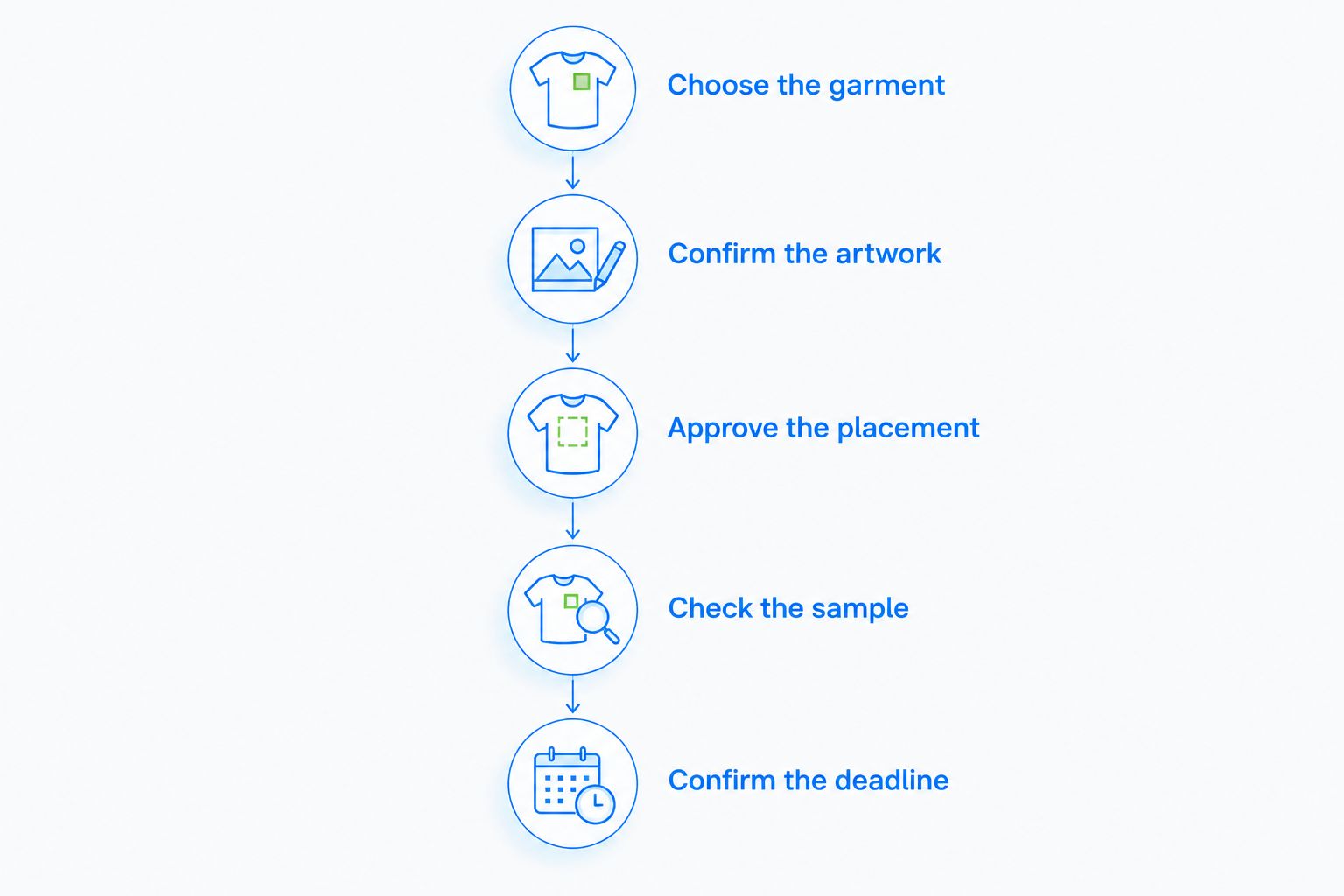
When coordinating custom apparel for real estate teams with Print Fast, keep the apparel brief separate from the paper-print brief. Confirm the garment, decoration method, sample arrangement and completion date for the apparel itself. Do not assume that a rush business-card schedule applies to clothing.
FAQ
What’s the best custom apparel for real estate teams?
Screen-printed polos are the best default for real estate teams hosting open houses. Choose personalised T-shirts for names and roles, and hoodies as a separate cool-weather layer.
Is screen printing better than heat transfers for a real estate logo?
Screen printing suits repeated, simple team logos, while heat transfers suit separate names and role labels. The selected fabric, artwork and desired print feel determine which approach fits your order.
Should real estate agents wear polos or T-shirts?
Polos are the stronger default for a client-facing open-house uniform; T-shirts suit casual community events and setup work. Choose around the setting rather than requiring the same garment for every task.
Can we print each agent’s name on team clothing?
Individual agent names fit a personalised decoration brief, particularly with a compatible heat-transfer process. Confirm spelling, placement and the name-to-size list before approving production.
Can sublimation print our logo onto dark cotton shirts?
Conventional sublimation is not the right process for dark cotton shirts. It uses suitable light-coloured polyester substrates and does not print white ink; ask about a compatible alternative.
What should we check before approving branded team apparel?
Check the actual garment, artwork placement, size selections and decoration sample before approval. Inspect readability and print feel while the garment is worn, not just in a flat mock-up.
Can Print Fast’s rush printing schedule apply to team apparel?
Confirm the schedule for the specific apparel order directly with Print Fast. Garment selection, decoration, proof approval and fulfilment need their own agreed completion date.
Related guides
- How to order custom T-shirts for a small business
- Flyers for real estate open houses
- NFC business cards for real estate agents
One last thing
A readable team name is more useful on clothing than a complete contact block. Let the uniform identify the person; let the business card or open-house flyer carry the details.
Request a custom quote from Print Fast for your real estate team branding. Include the intended apparel, decoration requirements, size list and event date, and ask for confirmation of the apparel scope and turnaround.

