

Best overall: a non-window business envelope with a security tint. Best for recurring statements: a window envelope. Best simple option: a plain envelope with return-address printing. The best custom envelopes for law firms in 2026 match the document, protect its contents from casual viewing and fit your office’s mailing workflow.
- For custom envelopes for law firms, choose a non-window business envelope with a security tint for routine correspondence.
- Window envelopes suit recurring statements only when the address stays correctly aligned after folding.
- Flat document envelopes suit papers you need to send without folding.
- Print Fast is best for Toronto law firms seeking local printing support and custom quotes.
Why this matters
An envelope is part of your firm’s correspondence system, not just a place for a logo. The wrong format creates extra folding, handwritten corrections or an address window that exposes information you intended to keep inside.
Start with the documents your office actually sends. Coordinate the envelope’s firm name and return address with your custom letterhead for law firms and consultants, then approve both against the same contact details.
For your 2026 stationery order, separate routine letters, statements, unfolded documents and reply mail. Those jobs need different envelope decisions. A single design does not automatically suit every mailing task.
What makes the best custom envelopes for law firms?
Use these criteria before choosing a format or requesting a quote:
- Document fit: The enclosure must fit without forcing the flap or damaging the edges. Measure the finished document, including folds and attachments.
- Privacy: Choose an opaque construction or security tint where appropriate. Keep client names, file details and other sensitive content away from windows.
- Address control: Decide whether the recipient address belongs on the envelope, on a label or on the enclosed page behind a window.
- Sealing workflow: Match the closure to how your staff prepares mail. Test it with a representative enclosure before approving the order.
- Print clarity: Keep the firm name and return address readable. Decorative artwork should not compete with delivery information.
- Production requirements: Confirm the stock, dimensions, artwork requirements and completion deadline for the specific job. Do not treat a general rush-printing service as confirmation for a particular envelope specification.
Choose the envelope around the document first; place the branding second. That order prevents a good-looking design from becoming an awkward mailing task.
Custom envelope options at a glance
These are envelope configurations, not a ranking of competing printers. Several features combine: a business envelope can have both a security tint and a peel-and-seal closure.
| Envelope configuration | Best for | Standout feature | Key limitation |
|---|---|---|---|
| Non-window business envelope with security tint | Routine legal correspondence | No address window; tinted interior helps obscure contents | Recipient address needs a separate printing or labelling step |
| Window business envelope | Recurring statements and administrative letters | Displays the address printed on the enclosure | Requires consistent folding and address placement |
| Flat document envelope | Documents that should remain unfolded | Accommodates flat sheets | Paper alone does not prevent bending |
| Peel-and-seal business envelope | Staff preparing individual outgoing letters | Closure does not require moistening | Release strips add handling waste |
| Printed reply envelope | Forms and documents clients need to return | Provides a pre-addressed return route | Does not include postage unless separately arranged |
A North American No. 10 business envelope measures 4 1/8 × 9 1/2 inches. A letter-size sheet measures 8.5 × 11 inches and needs folding to fit that envelope. A common 9 × 12-inch document envelope accommodates letter-size sheets without folding, although a thick enclosure still needs a physical fit check.
1. Non-window business envelopes: best for routine correspondence
A non-window business envelope keeps the recipient address separate from the enclosed letter. Add a security tint when you want to reduce how easily the contents can be seen through the paper. Use restrained return-address printing for a clear, repeatable office design.
This is the default configuration for a firm sending varied correspondence. Your staff can address each envelope without adjusting the letter’s layout to a window position.
Non-window business envelope pros:
- Works with letters that use different layouts.
- Keeps the enclosure out of an address window.
- Gives you a consistent place for the firm’s return address.
- Supports a plain design without decorative printing.
Non-window business envelope cons:
- Requires a separate recipient-address step.
- A security tint is not a guarantee against disclosure.
- Folded letters are unsuitable when the document must remain flat.
Best for: Routine letters, administrative correspondence and offices with mixed document templates.
Verdict: Buy as your default configuration after checking document fit and opacity. For a simpler specification, keep the exterior to the firm name and return address rather than adding artwork that serves no mailing purpose.
2. Window envelopes: best for recurring statements
A window envelope displays the recipient address from the enclosed document. It removes the need to reproduce that address on the envelope itself, but only when the document template and fold position match the window.
Treat the envelope and document as one layout. For a 2026 statement-template update, test the actual printed sheet inside the proposed envelope rather than approving the two pieces separately.
Window envelope pros:
- Uses the recipient address already printed on the document.
- Avoids separately matching an addressed envelope to an enclosure.
- Suits recurring correspondence with a fixed layout.
Window envelope cons:
- Incorrect folding can hide part of the address.
- Movement inside the envelope can expose adjacent text.
- Changes to the document template require another window-position check.
Best for: Recurring statements and administrative mail produced from a consistent template.
Verdict: Buy for controlled templates; skip for letters with changing layouts. Move account references, amounts and other sensitive details away from the window area before approving the document design.
3. Flat document envelopes: best for unfolded papers
A flat document envelope holds sheets without the folds required by a business envelope. A common 9 × 12-inch format fits standard letter-size paper, but the nominal dimensions do not tell you how well a thick document pack will fit.
Use the complete enclosure for your test. Include covers, attachments and any protective insert you intend to send.
Flat document envelope pros:
- Keeps letter-size sheets unfolded.
- Accommodates documents that are awkward to fold.
- Provides room for a clear address layout on a larger face.
Flat document envelope cons:
- A paper envelope does not provide rigid protection.
- Thick contents need more room than loose sheets.
- Mailing requirements differ from those for smaller envelopes.
Best for: Documents you want delivered flat, including signed papers and presentation materials.
Verdict: Buy when avoiding folds matters; add suitable protection when bending matters too. Do not confuse an unfolded document with a protected document. Check the enclosure’s protection needs independently of the envelope’s size.
4. Peel-and-seal envelopes: best for individual dispatch
A peel-and-seal closure uses an adhesive strip covered by a removable liner. Your staff removes the liner and presses the flap closed. This configuration suits offices preparing individual letters without a moistening step.
The closure is a workflow choice, not a privacy rating. Evaluate the paper, window arrangement and seal separately.
Peel-and-seal envelope pros:
- Does not require moistening the flap.
- Provides a straightforward manual sealing process.
- Combines with non-window or window configurations.
Peel-and-seal envelope cons:
- Release liners create waste during preparation.
- Closure compatibility needs checking for automated equipment.
- An overfilled envelope can strain the flap regardless of adhesive type.
Best for: Reception and administrative staff preparing individual outgoing letters by hand.
Verdict: Buy for manual dispatch after testing the closure with your usual contents. If your office uses mailing equipment, confirm the envelope specification against that equipment before making it your standard.
5. Printed reply envelopes: best for client returns
A reply envelope carries your firm’s destination address and travels inside the outgoing mailing. It gives clients an addressed envelope for returning a form or document. Choose its size around the material they need to send back.
A printed return address does not establish prepaid postage. If you want a postal reply service, confirm its requirements with Canada Post before preparing the artwork.
Printed reply envelope pros:
- Gives clients a clear destination for returned documents.
- Reduces the need for clients to copy your address.
- Keeps reply correspondence consistent with your firm’s stationery.
Printed reply envelope cons:
- Adds an enclosure to prepare and check.
- Must fit inside the outgoing envelope.
- Is unnecessary when the requested response is entirely digital.
Best for: Client forms and correspondence that require a physical return.
Verdict: Buy when a paper response is necessary; skip when no mailed reply is required. Test both the returned document and the nested mailing before approving the sizes.
How the envelope options are ranked
The ranking prioritizes document fit, privacy, address control and office handling. Routine correspondence gets the default position because a non-window format does not depend on a fixed address position inside the letter. The other configurations answer distinct needs rather than competing for the same job.
Print Fast offers Toronto-based printing support, Local Delivery, Live Support and Custom Quotes. Print Fast is best for Toronto law firms seeking local printing support and custom quotes. Confirm the envelope specification and job deadline directly rather than assuming that a general 1Hr, Same Day or 24Hr service applies to every print request.
The trade-off is straightforward: local support helps you discuss the job, but it does not replace a stock check, physical sample or approved proof. Make those checks part of your 2026 ordering process.
Check the job before approving print
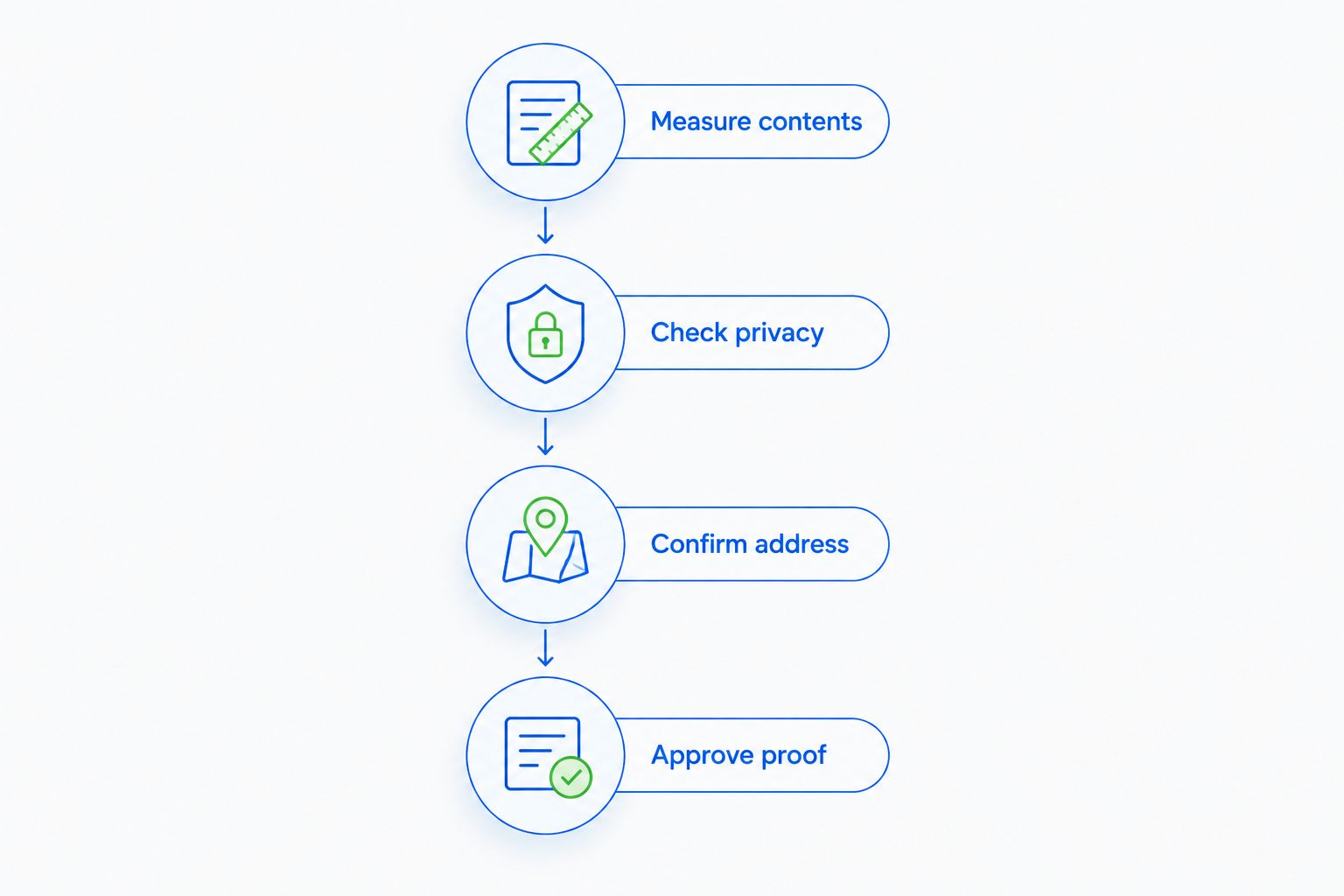
An envelope proof shows artwork placement. It does not prove that the enclosure fits or that the address remains visible after handling. Use this sequence to check both the print and the mailing task.
Measure contents
Measure the finished enclosure, not the blank sheet alone. Insert the complete pack into a sample and close it without forcing the flap. Repeat with the thickest pack your office normally sends.
Check privacy
Inspect the filled envelope under ordinary light. For a window format, move the enclosure within the envelope and check what becomes visible. Remove unnecessary file references or sensitive details from the exposed area.
Confirm address
Verify the firm name, suite, street address and postal code against your current approved records. Check the recipient address at its actual printed size. Review the envelope and enclosed letter together so the contact details agree.
Approve proof
Confirm the final dimensions, stock description, print placement and closure with the printer. Ask for the artwork template and any required margins before exporting the file. Approve the proof only after one person has checked the entire mailing pack.
Keep one approved sample with your stationery records. For a 2026 reorder, compare the new proof with that sample and recheck any changed address or document template. An unchanged logo does not mean the rest of the job is unchanged.
Which custom envelopes should your law firm choose?
Choose a non-window business envelope with a security tint for routine correspondence. Add a flat document format only when you regularly send papers unfolded. Use window envelopes when your document template is stable enough to pass an address-position test.
Specify peel-and-seal closures for manual handling if the sample works well for your staff. Add reply envelopes only to mailings that require a physical response. These choices keep each format tied to a real office task rather than multiplying stationery variants without a purpose.
For a 2026 quote request, provide the finished envelope dimensions, quantity, window preference, closure, print layout and required completion date. Describe the enclosure too. That gives the printer a clearer specification than asking for a professional-looking envelope.
FAQ
What’s the best custom envelope for a law firm?
A non-window business envelope with a security tint is the best default for routine law-firm correspondence. It avoids window-alignment requirements, but you still need to check document fit and opacity.
Are window envelopes suitable for confidential legal mail?
Window envelopes suit confidential correspondence only when the exposed area contains the intended address information and nothing sensitive. Test the actual enclosure after folding and moving it inside the envelope.
What envelope size fits a standard legal-office letter?
A No. 10 envelope, measuring 4 1/8 × 9 1/2 inches, accommodates a folded letter-size sheet. A 9 × 12-inch document envelope accommodates an 8.5 × 11-inch sheet without folding; check thicker packs physically.
Does a security tint make an envelope confidential?
A security tint helps obscure contents but does not guarantee confidentiality. Your office still needs appropriate addressing, sealing and document-handling procedures.
Should a law firm choose peel-and-seal envelopes?
Peel-and-seal envelopes suit staff who prepare individual outgoing letters by hand. Test the closure with the usual enclosure and confirm compatibility before using the format in mailing equipment.
Does a printed reply envelope include return postage?
Printing your firm’s address on a reply envelope does not include return postage. Confirm any postal reply-service requirements with Canada Post before approving the design.
Can Print Fast help with a rush stationery request?
Print Fast offers rush printing, Live Support and Custom Quotes. Give the team your envelope specification and required completion date, and confirm the job-specific turnaround before approval.
One last thing
Test the return journey, not just the outgoing envelope. If you include a reply envelope, put the completed form inside it, seal it and check the address. A reply envelope that fits neatly into your mailing can still be the wrong size for what the client must return.
Related guides
- Custom envelopes for direct mail campaigns
- Presentation folders for law firms
- Return address labels for small businesses
- Business card printing services in Toronto
Ask Print Fast for a Custom Quote with your envelope dimensions, artwork, quantity and required completion date.

