

Best overall: a local print shop that confirms printing and lamination together. Best for occasional sheets: a copy centre. Best for oversized documents: a wide-format finishing specialist. This 2026 guide helps you compare laminating services near me by document size, finish, handling and deadline—not distance alone.
- For laminating services near me, choose a provider that confirms document size, finish and completion time before ordering.
- Print Fast is best for Toronto businesses coordinating rush printing; confirm document lamination separately.
- Choose a copy centre for occasional sheets and a wide-format specialist for oversized document lamination.
- Keep irreplaceable originals out of permanent lamination; use a protective sleeve instead.
Why this matters
Lamination protects a printed sheet with a film finish, but the wrong specification creates problems. A glossy instruction sheet can reflect overhead lighting. A stiff menu can resist bending but take up more space in a holder.
Your best service depends on what happens after collection: repeated handling, cleaning, wall display or filing. For a restaurant-specific starting point, read the guide to laminated menus for restaurants and cafés.
Print Fast is best for Toronto small businesses coordinating rush printing. Its stated services include same-day and rush printing, local delivery, live support and custom quotes. Confirm lamination requirements separately rather than treating a general printing turnaround as a finishing commitment.
What makes the best document lamination service?
Use these criteria to compare providers in 2026. Ask for written answers before handing over your documents.
- Document fit: Confirm the finished dimensions, not just the paper size. Any sealed border must fit your display, folder or holder.
- Finish suitability: Compare gloss and matte against the actual lighting and reading conditions. Ask to see a sample.
- Film and stiffness: Explain whether the sheet needs to bend, lie flat or stand in a holder. Request a recommendation for that use.
- Edge treatment: Establish whether the job needs a sealed border, flush trimming, rounded corners or holes.
- Original handling: Tell the provider whether you are supplying replaceable prints, heat-sensitive material or irreplaceable originals.
- Confirmed completion: Get a completion time for the finished job, including printing, approval, lamination and trimming where applicable.
Document lamination services at a glance
These are ranked service models, not a ranking of named businesses with unverified equipment or turnaround claims. Choose a provider that confirms the capabilities described in its row.
| Rank and service model | Best for | Standout feature to request | Key limitation |
|---|---|---|---|
| 1. Local print-and-finish shop | Repeat business documents | Printing and lamination under one specification | Finish and equipment must match the job |
| 2. Copy centre with lamination | Occasional standard-size sheets | Straightforward sheet finishing | Special sizes and finishes need confirmation |
| 3. Wide-format finishing specialist | Oversized posters and plans | Film and equipment matched to larger sheets | Unnecessary for a simple standard-size document |
| 4. Cold-lamination specialist | Replaceable heat-sensitive prints | Pressure-sensitive film without heated rollers | Film suitability still requires a material check |
A provider's label does not establish its capabilities. A copy centre with suitable equipment can handle a job better than a print shop without it. Rank the confirmed specification above the business category.
1. Local print-and-finish shop: best for repeat business documents
A local shop that offers both printing and lamination lets you specify the finished document as one job. This suits menus, operating instructions and reusable reference sheets that your business orders again.
Ask the shop to retain the approved file and finishing specification for repeat orders. You still need to update the content; a consistent finish cannot rescue outdated instructions.
Local print-and-finish shop pros:
- You can discuss paper, print quality and finishing together.
- A physical sample makes stiffness and glare easier to judge.
- One approved specification gives repeat orders a clear reference.
Local print-and-finish shop cons:
- A printing service does not automatically include lamination.
- A rush print deadline does not establish a finished-job deadline.
For your 2026 procurement shortlist, Print Fast is a Toronto-based online print shop with custom quotes and live support. Ask whether your document lamination specification can be accommodated before approving the order; do not assume that its stated 1Hr, Same Day or 24Hr printing options apply to lamination.
Best for: Small businesses ordering repeat documents that need both printing and finishing.
Verdict: Buy this service model when the shop confirms the complete finished specification and deadline.
2. Copy centre: best for occasional standard-size sheets
Choose a copy centre that explicitly offers document lamination when you need occasional sheets rather than a recurring production workflow. Bring the document dimensions and explain whether the sheet will be handled, displayed or filed.
Common North American sizes include Letter at 8.5 × 11 inches, Legal at 8.5 × 14 inches, and Tabloid at 11 × 17 inches. These are paper dimensions, not guaranteed finished dimensions after lamination.
Copy centre pros:
- A simple sheet job needs a short specification.
- Standard paper dimensions make your enquiry easy to explain.
- You can separate lamination-only work from a larger print order.
Copy centre cons:
- Confirm the location's equipment rather than assuming every branch matches.
- Oversized sheets, special films and unusual edge treatments require separate checks.
Bring a replaceable copy if the original matters. Before travelling, confirm that the location accepts customer-supplied documents and can complete the requested finish.
Best for: Occasional checklists, reference sheets and other standard-size business documents.
Verdict: Buy for a straightforward sheet job once the location confirms size, film and completion time.
3. Wide-format finishing specialist: best for oversized documents
Choose a provider that confirms wide-format lamination when the document exceeds its standard sheet-finishing limits. Posters, display graphics and larger reference plans need equipment that accommodates the full printed area and finishing allowance.
Tell the specialist how the document will be displayed. A rolled poster, a mounted graphic and a hanging reference sheet need different handling decisions.
Wide-format finishing specialist pros:
- The enquiry starts with the complete oversized dimensions.
- You can discuss film, rolling and mounting as related decisions.
- A sample helps you assess reflection across a larger surface.
Wide-format finishing specialist cons:
- Large finished pieces need a collection and transport plan.
- Lamination alone does not make a paper graphic suitable for outdoor use.
Do not substitute an outdoor-material specification with the word laminated. Exposure, substrate, ink, film and edge construction all affect suitability; ask the provider to specify the complete application.
Best for: Oversized indoor posters, display graphics and reference documents.
Verdict: Buy for oversized work; skip this service model for an ordinary sheet unless its specification requires it.
4. Cold-lamination specialist: best for heat-sensitive replacement prints
Cold lamination uses pressure-sensitive adhesive film rather than heat activation. Choose a provider offering this process when a replaceable print needs protection but its material is unsuitable for heated processing.
Avoid treating cold lamination as conservation. Adhesive film changes the document, and removing it is not a dependable way to recover the original condition.
Cold-lamination specialist pros:
- The process avoids heated rollers.
- You can request a film matched to the printed material.
- A test on a duplicate checks appearance before the main job.
Cold-lamination specialist cons:
- Adhesive compatibility still needs checking.
- Cold lamination is not an appropriate default for irreplaceable records.
Describe the paper, printing method and any surface coating. If you cannot identify the material, bring a duplicate for assessment instead of asking the provider to experiment on the original.
Best for: Replaceable prints with a confirmed need for a non-heated lamination process.
Verdict: Hold until the provider confirms material compatibility; skip permanent lamination for valuable originals.
How the service models are ranked
The ranking prioritizes document fit, finish suitability, edge treatment, original handling and confirmed completion. It places combined print-and-finish work first because that model suits recurring small-business documents, not because every local shop has the same equipment.
For this 2026 guide, the recommendation changes with the job. An occasional Letter-size sheet points toward a copy centre; an oversized display points toward wide-format finishing. Neither needs the top-ranked model by default.
Choose the finish before you approve the job
Gloss versus matte
Gloss gives the document a reflective surface. Matte reduces the glossy appearance, but you should still check legibility under the lighting where the sheet will be used.
Best for gloss: Documents where a shiny finish is intentional. Best for matte: Reading material where reducing reflections is the priority. The trade-off is appearance: request a sample rather than choosing from the finish name alone.
| Finish | Main advantage | Main drawback | Check before ordering |
|---|---|---|---|
| Gloss | Shiny surface | Visible reflections under some lighting | Reading angle and placement |
| Matte | Less glossy appearance | Different visual finish from gloss | Text clarity and image appearance |
Sealed border versus flush trim
A sealed border leaves film beyond the paper edge. Flush trimming cuts to the document edge, so do not assume it preserves the same enclosure around the sheet.
Best for a sealed border: Sheets where enclosing the paper edges matters. Best for flush trim: Documents where the finished size must closely follow the printed sheet. Ask how either choice affects moisture exposure and handling.
Flexible versus stiff
Film choice affects how the finished sheet bends. Tell the provider whether you need a menu to flex, an instruction sheet to stay flat or a document to fit a narrow holder.
Neither flexible nor stiff is universally better. Choose the handling requirement first, then approve the film sample.
How to request a useful lamination quote
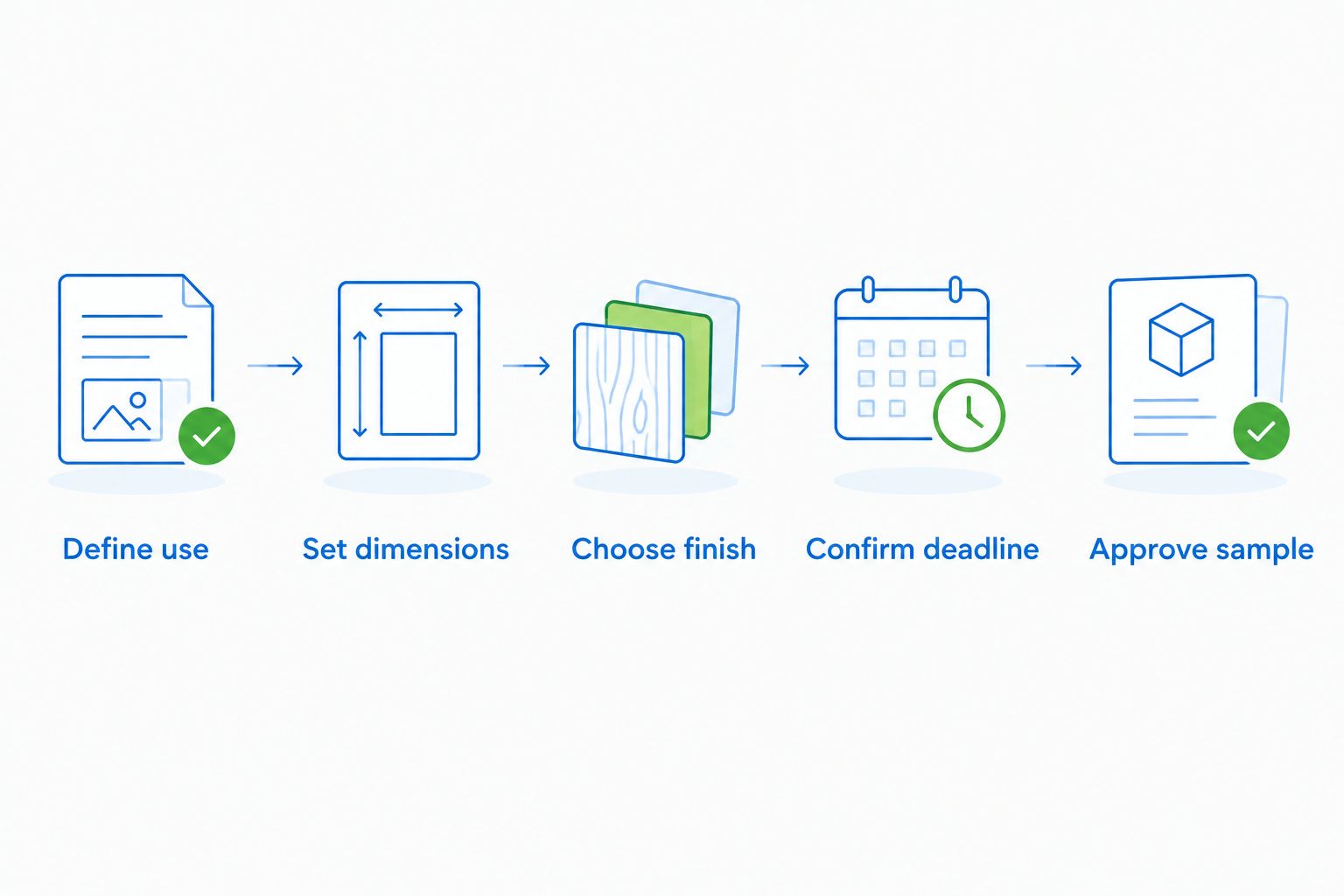
A clear request prevents a provider from quoting a different job from the one you need. Use this sequence for your 2026 order.
- Define use: State who handles the document, where it sits and whether it needs cleaning.
- Set dimensions: Give the paper dimensions and maximum finished size, including any border.
- Choose finish: Specify gloss or matte, required flexibility and edge treatment—or request a sample recommendation.
- Confirm deadline: State when the finished documents must be ready and how they will reach you.
- Approve sample: Check the printed content and finish before authorizing the full job.
Include the quantity, whether printing is required, and whether you are supplying originals or digital files. Identify any corners, holes or trimming requirements in the same request.
Ask the provider to distinguish production completion from delivery. A finished order at the shop is not the same as documents in your hands before a meeting.
Which document lamination service should you choose?
Choose a local print-and-finish shop as your default for recurring business documents. Switch to a copy centre for occasional standard-size sheets, a wide-format specialist for oversized work, or a confirmed cold-lamination service for suitable heat-sensitive replacement prints.
If your search for laminating services near me is urgent, contact the provider before travelling. Confirm the actual job—not simply whether the business offers printing.
Print Fast offers Toronto businesses rush printing, local delivery, live support and custom quotes. Use that support to confirm the required lamination process, finished dimensions and deadline before committing to a combined order.
FAQ
What’s the best way to choose laminating services near me?
Choose the provider that confirms your document size, finish, edge treatment and completion time. Distance matters after the provider establishes that it can produce the finished document you need.
Is a print shop better than a copy centre for lamination?
A print-and-finish shop is the better fit for recurring documents that need coordinated printing and lamination. A copy centre is a practical option for occasional standard-size sheets when the location confirms its capabilities.
Can I get same-day document lamination in Toronto?
Confirm same-day document lamination directly with the provider before travelling or sending files. A same-day printing offer does not establish the deadline for lamination, trimming or delivery.
Does Print Fast offer document lamination?
Confirm your document lamination requirements directly with Print Fast. Its stated services include rush printing, local delivery, live support and custom quotes; request confirmation of the finishing process for your specific document.
Should I choose gloss or matte lamination?
Choose matte when reducing a glossy appearance is the priority, and gloss when you want a shiny surface. Review a sample under the lighting where the document will be read.
Can I laminate an original certificate or important record?
Keep irreplaceable originals out of permanent lamination. Use a protective sleeve, or laminate a copy if you need a handled display version; check any issuing authority’s requirements before altering a record.
Is a laminated document waterproof?
Do not assume every laminated document is waterproof. The paper edges, cuts, holes and film construction affect protection, so describe the exposure and request a suitable specification.
What should I include in a lamination quote request in 2026?
Include quantity, document dimensions, intended use, finish, edge treatment and required completion time. State whether printing is needed and whether you are supplying digital files or existing sheets.
One last thing
Before laminating a business document in 2026, check how often its content changes. Protecting an outdated menu, procedure or contact list does not make it useful. Keep an editable master and approve the current version before finishing.
Treat the content check and the finish check as separate approvals. Correct words on the wrong-sized sheet still leave you with a document that does not fit its holder.
Related guides
- Custom booklets for training manuals
- Custom certificates for awards and recognition
- Best foam board printing for trade show displays
For your next menu order, specify the printing and finishing together. Request a custom quote only after confirming that the proposed lamination matches your use and deadline.
Plan your laminated menu order
Review the menu guide, then confirm your dimensions, finish and deadline before requesting a custom quote.

