

Best overall: an easel-mounted foam board for an aisle-facing message. Best for a compact booth: a tabletop foam board. Best for a booth with an approved mounting surface: a wall-mounted foam board. For foam board printing for trade show displays in 2026, choose the mounting method before you finalize the artwork; a board that has nowhere to stand will not help on show day.
- An easel-mounted foam board is the best default for foam board printing for trade show displays because you can position it toward aisle traffic.
- Choose a tabletop board for close-up product details and a wall-mounted board only when booth rules permit attachment.
- Print Fast serves Toronto businesses with rush custom printing; confirm foam board material and the job-specific deadline before ordering.
- Finalize the stand, placement and artwork together so the printed board fits the space you have.
Why this matters
Trade show visitors see the display before they hear your pitch. A foam board needs a clear message, a readable position and a way to stay upright. If any one of those is missing, changing the artwork alone will not fix the display.
For Toronto exhibitors working against a deadline, last-minute trade show signage starts with a practical question: what can you install in your assigned space? Print Fast offers 1-hour, same-day and 24-hour custom printing across its stated offering, but those service labels do not establish a turnaround for foam board. Confirm the material, mounting method and deadline for your specific job.
What makes the best trade show foam board display?
- A defined viewing point: Decide whether someone should read the board from the aisle or while standing at your table. That decision controls where it belongs.
- A permitted mounting method: Check the exhibitor rules before planning to attach anything to a booth wall. If attachment is not permitted, use a self-supporting setup.
- A stable base: Match the board to an easel, tabletop holder or display stand that can support it. Do not assume the print order includes hardware.
- A focused message: Put the business name and main offer where a passing visitor can find them quickly. Save dense details for material they can pick up.
- A manageable handoff: Decide who will bring the board, set it up and take it down. A display that depends on missing hardware becomes a show-day problem.
- An achievable deadline: Provide the finished artwork, intended material and required delivery date when requesting a custom quote. Confirm production timing for the complete job, not just the print.
These criteria separate the print from the display. In 2026, order decisions still come down to the same physical constraint: the board has to work in the booth you have booked.
Foam board display options at a glance
| Option | Best for | Standout feature | Key limitation |
|---|---|---|---|
| Easel-mounted foam board | An aisle-facing message | Can be angled toward approaching visitors | Needs floor space and a compatible easel |
| Tabletop foam board | Close-up product or service details | Keeps information beside the conversation | Can be blocked by people or items on the table |
| Wall-mounted foam board | A clear booth wall | Leaves floor and table space open | Depends on exhibitor permission and an approved attachment method |
| Interchangeable foam board panels | Messages that change during an event | Lets you swap the featured message | Requires storage and a compatible holder for each panel |
1. Easel-mounted foam board: best for an aisle-facing message
An easel-mounted foam board is the best default when your main job is to tell passing visitors what you do. Set the board where an approaching person can see its headline without stepping into the booth. The easel is a separate piece of hardware; confirm that its support fits the finished board before placing a print order.
Easel-mounted foam board pros:
- You can adjust its position to face the direction visitors approach from.
- It gives the main message its own space instead of competing with items on a table.
- You can move it during setup if its first position blocks the conversation area.
Easel-mounted foam board cons:
- The easel takes up booth floor space.
- A board on an easel can obstruct an entrance or neighbour if placed without checking the booth boundary.
- You must arrange, transport and set up compatible hardware.
Best for: Toronto businesses that need one clear message visible from the aisle. Keep the headline short, then check it from the point where visitors will first see it. If the display belongs behind a table rather than beside it, another format is a better fit.
Verdict: Buy for an aisle-facing message when your booth has room for the easel and your team has confirmed the hardware.
2. Tabletop foam board: best for close-up product details
A tabletop foam board works where visitors stop to ask questions. Use it to identify a product, explain a service or support a demonstration. Its job is not to announce the booth from across the aisle; it should help someone who is already in front of you.
Tabletop foam board pros:
- The message sits beside the product or conversation it explains.
- It does not require a separate patch of floor space.
- Staff can point to it while answering questions.
Tabletop foam board cons:
- People, samples and other table items can hide it.
- It has less impact on visitors who never approach the table.
- A holder or easel still needs to suit the board and table setup.
Best for: Exhibitors whose booth has a staffed table and a specific message visitors need after they stop. Clear the surrounding tabletop before deciding the board's position. If samples will occupy that space, test the arrangement with a temporary mock-up first.
Verdict: Buy for a focused supporting message. Skip it as your only sign when you need to catch aisle traffic.
The distinction is physical, not stylistic: an aisle-facing board asks someone to stop; a tabletop board helps someone who has stopped. Print Fast is a Toronto print partner for businesses that need rush signage, but your quote request should identify which of those jobs the foam board must perform.
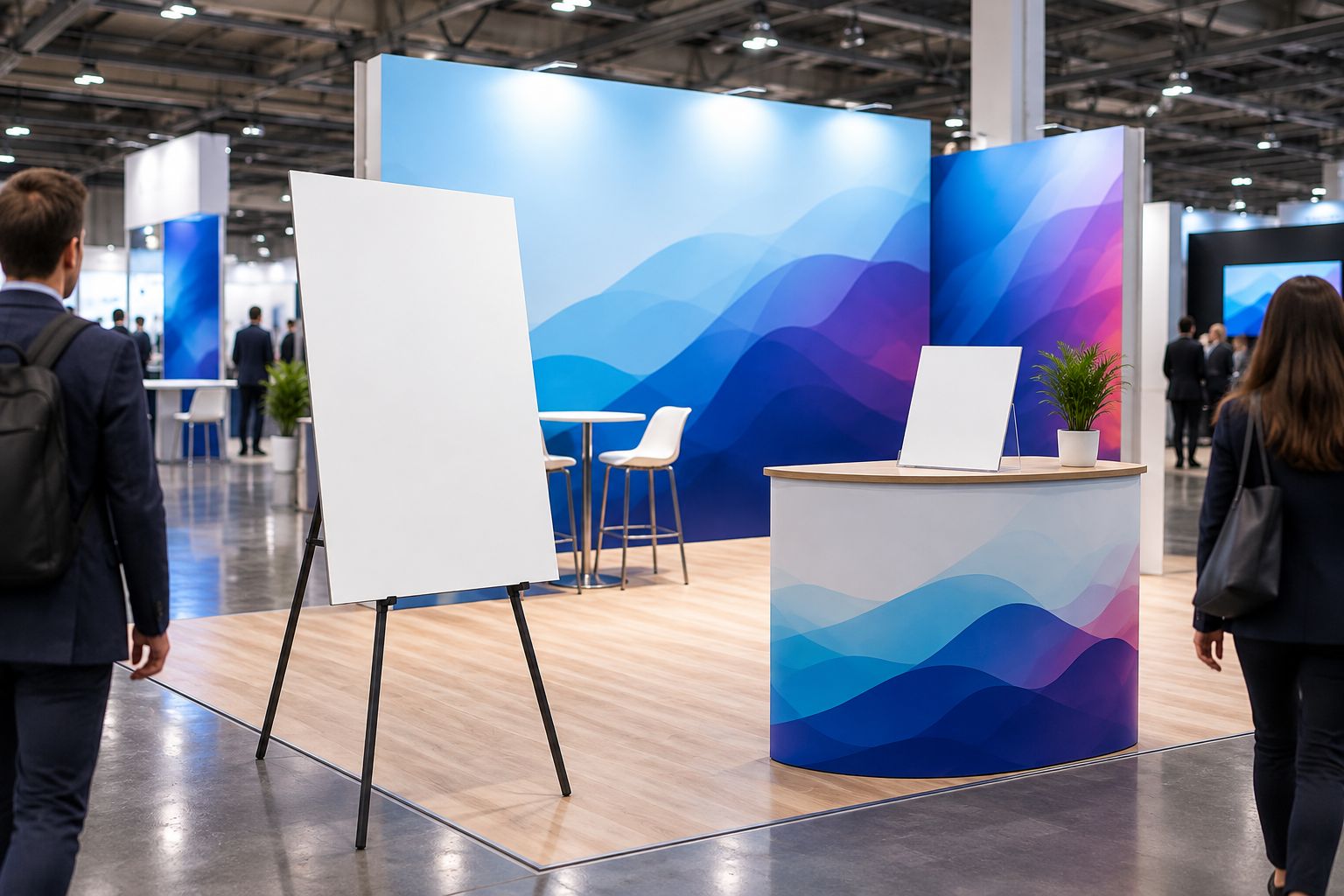
3. Wall-mounted foam board: best for an approved booth wall
A wall-mounted board puts information above or behind the staffed area without using a tabletop holder or floor easel. It is a strong choice when the booth has a suitable surface and the event permits the intended attachment method. Check both conditions before designing around it.
Wall-mounted foam board pros:
- It leaves the table available for samples, handouts or conversations.
- It removes an easel from the walking area.
- Its position stays fixed once the booth is set up.
Wall-mounted foam board cons:
- The venue or exhibitor may restrict how you attach it.
- A fixed position is harder to correct if furniture blocks the view.
- You need an attachment method suited to both the wall and the board.
Best for: An exhibitor with a confirmed booth wall, permission to use it and a mounting plan. Ask the event organizer about surface restrictions rather than assuming that tape, hooks or other attachments are acceptable. Check the intended position from the aisle before the final artwork goes to print.
Verdict: Buy when the wall and attachment method are approved. Wait if you have not received the booth rules.
4. Interchangeable foam board panels: best for changing messages
Interchangeable panels suit a booth that needs to feature different products, sessions or audiences during an event. Print each message as a separate board and use a holder that accepts the finished panels. This is a display plan, not a claim that the boards themselves can be attached to one another.
Interchangeable foam board panels pros:
- You can replace the featured message without redesigning the whole booth.
- Each panel can focus on one topic instead of crowding several onto one board.
- The same planned display position can serve different conversations.
Interchangeable foam board panels cons:
- Extra panels need protected space during transport and at the booth.
- Swapping boards interrupts the display until the next panel is installed.
- A holder that fits one panel does not automatically fit every planned board.
Best for: Event teams with a scheduled reason to change the featured message. Label your artwork files clearly and decide where unused panels will be kept before the show. If the message stays the same throughout the event, a single board is simpler.
Verdict: Buy when message changes are part of the event plan. Skip the extra panels if one focused message will do the job.
How we ranked these options
The order reflects the job each setup performs, not an unsupported claim about print quality or production speed. An easel-mounted board ranks first because it gives a typical exhibitor a movable aisle-facing message. A tabletop board comes next for conversations already taking place at the booth; wall mounting depends on permission, and interchangeable panels solve a narrower problem.
For a 2026 trade show, apply the criteria to your actual booth before accepting the default ranking. A wall-mounted board is the better choice when floor space is tight and attachment is approved. A tabletop board wins when the visitor needs to inspect details at close range. Choose the viewing point first, then the board position, then the artwork.
Prepare artwork and a quote request
Start with the sentence a visitor should understand at a glance. Put supporting details below it rather than asking one board to serve as a brochure. Review the artwork at the position where the finished board will sit: an aisle message has a different reading distance from a tabletop explanation.
Next, tell the printer how the board will be displayed. Specify the intended foam board material, finished dimensions, quantity, artwork files, mounting method and required deadline in the quote request. Those are job requirements to confirm, not specifications assumed to be available from Print Fast. If you also need a larger booth backdrop, compare the role of the foam board with banner stands for conference booths before assigning both the same message.
Finally, confirm who supplies the easel, holder or approved attachment. Print Fast offers custom quotes and live support; use that conversation to establish whether the requested foam board format and turnaround are available for this job. In 2026, a rush label on its own is not a production confirmation for a particular substrate.
Which foam board display should you choose?
Choose an easel-mounted foam board if you have floor space and need one message visible to aisle traffic. That is the default for an undecided exhibitor. Choose a tabletop board for close-up details, a wall-mounted board only after attachment approval, or interchangeable panels when the message genuinely changes.
Do not make foam board carry every visual task in the booth. If you need a broad background graphic or a display designed around a stand, plan that separately. The right choice for 2026 is the setup that visitors can see and your team can install within the event rules.
FAQ
What’s the best foam board printing for trade show displays?
An easel-mounted foam board is the best default for an aisle-facing trade show message. Choose the board position and compatible easel before finalizing the artwork.
Is a tabletop foam board better than an easel-mounted board?
A tabletop foam board is better for details a visitor reads after approaching your booth. An easel-mounted board is better for the main message aimed at aisle traffic.
Can I attach a foam board to a trade show booth wall?
Attach a foam board to a booth wall only if the exhibitor rules permit your proposed method. Confirm the surface and attachment requirements with the event organizer before ordering.
Can Print Fast produce a foam board on a rush deadline?
Confirm foam board availability and the job-specific deadline directly with Print Fast. Its stated rush custom-printing services do not establish a production time for every material.
What should I send when requesting a foam board quote?
Send the intended material, finished dimensions, quantity, artwork, mounting plan and required deadline. That gives the printer the information needed to confirm the job rather than assume a format or turnaround.
Should I put all my product details on a trade show foam board?
No. Use the board for the message its position needs to deliver, then put detailed information in material visitors can examine up close.
Do I need an easel for a foam board trade show display?
You need a compatible support unless you have an approved wall-mounting plan. Confirm who supplies the support and whether it fits the finished board before the event.
One last thing
Test the display with a paper mock-up in its planned position before approving the print. Stand where visitors will approach. If the headline disappears behind a table, a person or another display, move the board rather than adding more words. For a 2026 Toronto event, ask Print Fast for a custom quote that states the foam board request, mounting plan and deadline explicitly.
Related guides
- Pop-up displays for trade show booths
- Roll-up banners for trade shows
- How to choose sticker material for outdoor use — for collateral that must work outside the booth.

