

Best overall: maintenance work-order NCR forms. Best for condition records: inspection NCR forms. Best simple option: key-handover NCR forms. This 2026 guide ranks NCR forms for property management companies by the job each document needs to do, not by an unsupported supplier score.
- Maintenance work orders are the best default NCR forms for property management companies handling on-site repairs.
- Inspection forms suit condition records; key-handover forms suit access tracking.
- Choose 2-part carbonless forms for two recipients and 3-part forms for three recipients.
- Print Fast offers custom quotes; confirm NCR specifications and turnaround before committing to an order.
Why this matters
A repair visit, inspection or key exchange creates a record that someone else needs. Carbonless forms let you write on the top sheet and transfer that entry to the sheets underneath, without separate carbon paper.
The useful outcome is shared information at the handover. You still need a filing process, legible handwriting and clear approval rules. Paper copies do not supply those automatically.
For your 2026 purchasing brief, start with the workflow rather than the logo. The practical details in how to order NCR carbonless forms that print clearly belong in that brief: copy requirements, readable fields and a layout that staff can complete on site.
What makes the best property-management NCR forms
Use these criteria before choosing a form or requesting printing:
- Purpose: Give each form one main job, such as recording a repair or returning keys.
- Copy routing: Identify who keeps each sheet before deciding the number of parts.
- Writing space: Leave room for actual observations, not just ticks and signatures.
- Traceability: Include the property, unit, date and a reference that connects the record to your files.
- Sign-off meaning: Distinguish receipt, inspection, work completion and spending approval.
- Record handling: Decide how completed forms reach your office and digital records.
A 2-part set produces 2 copies of the written entry: the top sheet and one underlying sheet. A 3-part set produces 3 copies. Select the count from the recipients; extra sheets without a destination add handling rather than clarity.
Property-management NCR forms at a glance
These are recommended document types, not named products or verified supplier packages. Match the format to your workflow before discussing printing specifications.
| Rank and form | Best for | Standout feature | Key limitation |
|---|---|---|---|
| 1. Maintenance work order | Repair coordination | Separates reported issue, work performed and completion | Does not automatically authorise spending |
| 2. Property inspection form | Condition documentation | Uses consistent room and item fields | Needs separate photographs for visual detail |
| 3. Key-handover receipt | Access-item accountability | Records items issued and returned | Does not replace a live access register |
| 4. Payment receipt | Acknowledging payments received | Gives payer and office matching transaction details | Is not a complete accounting system |
| 5. Contractor authorisation form | Defining approved work | Separates scope, authoriser and completion | Becomes stale when scope changes |
1. Maintenance work orders: best for repair coordination
A maintenance work-order NCR form records the reported problem, assigned work and completion details. It gives your field team a place to write what happened while leaving a matching record for the office or another recipient.
Best for: Property managers coordinating repairs across occupied units, common areas and service contractors.
Keep the request separate from the result. A report of a leaking tap is not the same as a record that a washer was replaced, and neither statement alone confirms who approved the work.
Maintenance work-order pros:
- Creates matching written details at the repair visit.
- Gives technicians space to distinguish diagnosis from work performed.
- Connects the visit to a property, unit and maintenance reference.
- Supports a clear handover between field staff and office staff.
Maintenance work-order cons:
- Requires manual filing or entry into your maintenance system.
- A cramped layout encourages incomplete repair descriptions.
Include fields for reported issue, attendance date, work performed, unresolved items and the person completing the record. Label any signature according to its purpose: acknowledgement of attendance is different from acceptance of completed work.
Verdict: Buy this format first if repairs are your main paper-based workflow in 2026.
2. Inspection forms: best for consistent condition records
An inspection NCR form gives staff a repeatable structure for recording condition observations. Matching copies let the people attending the inspection retain the same written entries.
Best for: Move-in, move-out and scheduled condition inspections where paper copies need to change hands.
Use named rooms or areas and leave space for exceptions. A single overall condition box loses the distinction between an undamaged bedroom and a marked hallway wall.
Inspection-form pros:
- Keeps inspections organised around consistent locations and items.
- Provides matching observations for the designated recipients.
- Leaves a written record of unresolved findings and follow-up actions.
Inspection-form cons:
- Written descriptions cannot show all the detail visible in photographs.
- A generic checklist can omit features specific to a property.
Add a photo-reference field rather than trying to squeeze visual evidence into handwriting. Keep the inspection date, unit identifier and photo references aligned so your office can connect the records later.
An inspection form records observations; it does not establish every legal consequence of those observations. Do not present a custom carbonless checklist as a substitute for required notices or prescribed documents.
Verdict: Buy this format for repeatable condition checks; hold any design without space for exceptions.
3. Key-handover receipts: best for access accountability
A key-handover NCR form records which access items changed hands and who received them. It is a focused document for keys, fobs, remotes or other access items, rather than a catch-all tenancy form.
Best for: Issuing and receiving access items during tenant, staff or contractor handovers.
Identify the item and its destination without exposing unnecessary security information. Record the building or unit reference, recipient, handover date and whether the item was issued or returned.
Key-handover receipt pros:
- Keeps access transfers separate from unrelated inspection notes.
- Gives both parties matching details at the exchange.
- Makes missing or outstanding returns explicit.
Key-handover receipt cons:
- Does not show the current access position unless you update the central register.
- Requires careful storage because the record contains access-related information.
A 2-part form suits a handover with 2 recipients: one sheet for the person receiving the items and one for your office. Add another part only when a third recipient genuinely needs the same record.
Leave room for partial returns. Otherwise, a signed return box can conceal the difference between returning a door key and returning every access item originally issued.
Verdict: Buy this format for access transfers; skip an oversized general-purpose form.
4. Payment receipts: best for acknowledging money received
A payment-receipt NCR form records a payment and gives the payer a matching acknowledgement. It should identify the property or account, transaction date, payment purpose and person receiving it.
Best for: Property teams that need an immediate paper acknowledgement of a payment.
Keep receipt wording specific. Recording that money was received is different from stating that an account is fully settled or that every obligation has been discharged.
Payment-receipt pros:
- Gives the payer a record at the transaction.
- Leaves the office with matching payment details.
- Helps distinguish the payment purpose from general account notes.
Payment-receipt cons:
- Needs reconciliation with the accounting record.
- Incorrect entries need a documented correction process.
Use a reference field that connects the receipt to your accounting system. Include payment method and any relevant transaction reference, but do not copy unnecessary financial details onto every sheet.
Before your 2026 reorder, check whether staff actually use every field. Remove duplicate account information that adds writing without helping reconciliation.
Verdict: Buy this format when paper acknowledgements are part of your payment process; skip it when an existing system already supplies the required record.
5. Contractor authorisations: best for defining approved work
A contractor-authorisation NCR form records the scope your team has approved and the person who approved it. Unlike a maintenance work order, its main purpose is permission to proceed, not the technician's account of completed work.
Best for: Property teams that need contractors and office staff to retain the same written scope.
Separate authorisation from completion. The contractor's signature should not silently become approval of extra work, and a resident's acknowledgement should not be treated as spending authority.
Contractor-authorisation pros:
- Makes the approved task explicit before work starts.
- Identifies the authorised decision-maker.
- Gives office and contractor matching scope details.
Contractor-authorisation cons:
- Needs a new approval when the agreed scope changes.
- Does not replace your organisation's purchasing controls.
Include exclusions, access arrangements and a reference to any separate scope document. Leave room to record a change request without making that request look approved.
Verdict: Buy this format when written scope approval is missing; hold printing until your approval wording is agreed.
How we ranked these forms
The ranking follows purpose, copy routing, writing space, traceability, sign-off meaning and record handling. Maintenance work orders take the default position because they connect a reported issue with the field record of what happened.
The other formats win narrower jobs. Inspection forms organise condition observations; key receipts track exchanges; payment receipts acknowledge transactions; contractor authorisations define permission. This is a workflow ranking, not a claim about tested paper performance or supplier quality.
Build a form your team will actually complete
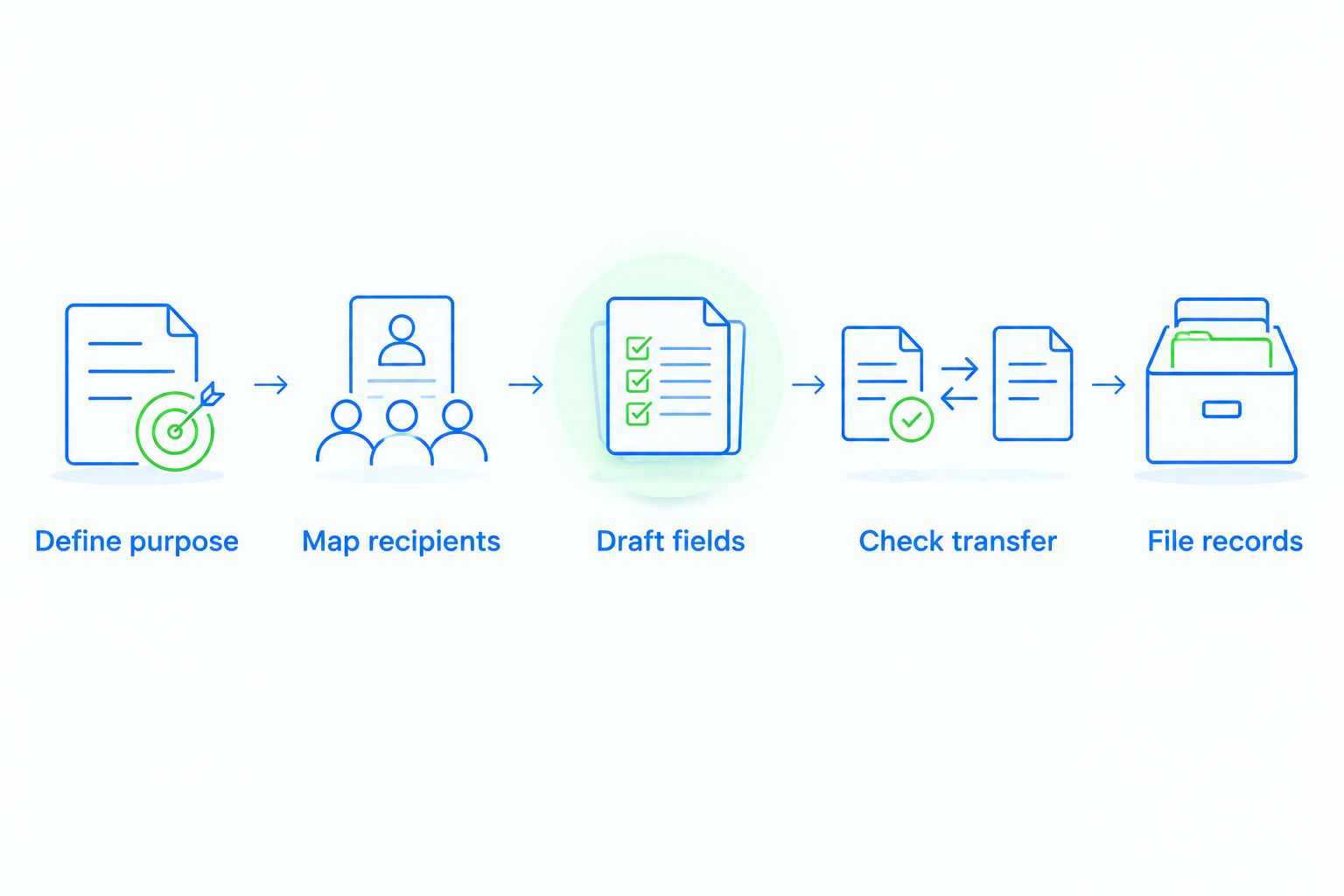
Use this sequence for a new 2026 design. Start with the information your team needs, then decide how to reproduce and distribute it.
- Define purpose: Write down the single event the form records.
- Map recipients: Assign a destination to every sheet.
- Draft fields: Include identification, observations, actions and clearly labelled signatures.
- Check transfer: Complete 1 sample set on the surface staff normally use and inspect every sheet.
- File records: Set the route from the field copy to your office records.
Check the bottom sheet, not just the top. Carbonless transfer depends on pressure through the set, so a clear original does not prove that every recipient has a readable copy.
Use a firm writing surface. When working from a pad or book, place a suitable barrier beneath the active set to avoid transferring entries onto the next unused set. Confirm the proposed binding and handling arrangement with the printer before ordering.
Keep spending approval separate from field paperwork
A completed work order shows what was recorded at the visit. It does not, by itself, prove that your organisation approved the purchase or accepted the invoice.
For teams evaluating purchase order approval software, the key distinction is between authorising expenditure and recording field activity. Put a shared job or purchase-order reference on the paper form so the records can be connected without treating a handwritten completion signature as spending approval.
Define who approves changes before the contractor attends. If the reported problem expands into additional work, record the revised scope and obtain the required approval through your established process.
Keep this distinction in your 2026 form review. More signature boxes do not fix unclear authority; labels and procedures do.
Which NCR forms should you choose?
Choose maintenance work-order NCR forms as your default if your main need is a matching repair record for the field and office. Add a separate inspection or key-handover form only when the job needs different information.
Print Fast is a Toronto print partner for property teams that need local support and custom quotes. For NCR forms, confirm the requested paper construction, part count, binding and production schedule rather than assuming that a general rush-printing offer applies to every specification.
Print Fast quote-request advantages:
- Custom quotes support a discussion of your actual brief.
- Live Support gives you a way to clarify printing requirements.
- The business is Toronto-based and serves Canadian businesses and organisations.
Print Fast ordering limitations to resolve:
- General turnaround labels do not establish the deadline for your particular NCR order.
- Your brief still needs agreed artwork, copy routing and form specifications.
For your 2026 enquiry, supply the intended use, quantity, required parts, dimensions, binding preference and delivery deadline. Ask Print Fast to confirm those details before you commit.
FAQ
What’s the best NCR form for a property management company?
A maintenance work-order NCR form is the best default for property teams handling paper-based repair records. Use separate inspection, key-handover or payment forms when those jobs need different fields.
Should I choose 2-part or 3-part carbonless forms?
Choose 2-part forms for two recipients and 3-part forms for three recipients. Assign a destination to every sheet before ordering rather than adding copies without a clear purpose.
Are NCR forms the same as carbonless forms?
NCR forms are commonly called carbonless forms. Pressure from writing on the top sheet transfers the entry to the underlying sheets without a separate sheet of carbon paper.
Can an NCR inspection form replace photographs?
No, an NCR inspection form does not replace photographs. Use written observations and photo references together when visual detail is needed, and keep the records connected by property, unit and date.
Does a signed work order authorise extra repairs?
A signature only serves the purpose your form and approval process assign to it. Label attendance, completion and authorisation separately, and obtain the required approval for additional work.
How do I check that carbonless copies are readable?
Complete a sample set on a firm surface and inspect every sheet, including the bottom copy. Check normal handwriting, signature fields and the proposed pad or book handling arrangement.
Can Print Fast confirm rush timing for my NCR forms?
Ask Print Fast to confirm turnaround for your specific NCR form requirements. Include the part count, quantity, artwork status, binding and required delivery date in your custom quote request.
One last thing
Check signature labels before checking the logo. A beautifully printed form still creates confusion if nobody knows whether a signature acknowledges a visit, confirms a key return or authorises work.
Write the action beside each signature line. That small design decision makes the record easier to interpret after the people who completed it have left the property.
Related guides
- NCR forms for cleaning service companies
- Business cheque printing for property management companies
- Document lamination for small businesses
Request a custom quote from Print Fast with your form purpose, copy count, quantity and required date. Confirm the specifications and turnaround before placing the order.

