

Canada Post direct mail cost in 2026 is the sum of three lines: postage, print and data. Postage rates change, so this page shows what drives each line and how to build a budget you can check against Canada Post's current rate sheet.
- Canada Post direct mail cost in 2026 = postage + printing + mailing list or route data.
- Postage depends on format, weight, addressed vs unaddressed and volume. Confirm it on Canada Post’s current rate sheet.
- Print is the line you control. PrintFast.ca offers 1Hr, Same Day and 24Hr turnaround in Toronto.
- Budget by cost per household reached, not cost per piece.
Why this matters in 2026
Most direct mail budgets fail at the same point. The owner prices the print job, then finds out postage is the larger line. Postage rates, size limits and program rules are set by Canada Post and revised over time, so any hard-coded figure on a third-party page goes stale. A cost formula does not.
This page gives you the formula, the variables that move each line, and the order to decide them in.
Short answer: what Canada Post direct mail costs
Your 2026 cost per piece is postage per piece plus print per piece plus list or route cost per piece, all divided across the households you actually reach. Postage is the biggest variable. Print is the most controllable. List cost applies only to addressed mail.
There is no single average. The right number depends on format, weight, volume and targeting, which is why the table below breaks the cost into lines instead of quoting one figure.
The cost table: every line in a 2026 campaign
| Cost line | What drives it | Who sets it | Your control |
|---|---|---|---|
| Postage | Format (postcard, flyer, letter), weight, size, addressed or unaddressed, volume | Canada Post | Medium: change format and weight |
| Printing | Stock, size, colour, quantity, finishing, turnaround | Your printer | High |
| Mailing list or route selection | Addressed list size and targeting, or unaddressed route selection | Canada Post or a list provider | Medium |
| Envelopes (letters only) | Size, stock, window or printed return address | Your printer | High |
| Labels or addressing | Variable data merge, label or direct-to-piece printing | Your printer or mail house | Medium |
| Design and proofing | Artwork prep, revisions | You or your designer | High |
Postage and list lines move with Canada Post and your targeting. Print, envelopes and design are where you cut cost without cutting reach.
Postage: the largest line
Postage is set by what you mail and how. Three choices decide it.
- Addressed or unaddressed. Unaddressed mail goes to every household on a chosen route. Addressed mail goes to named recipients on a list. Unaddressed is broader and cheaper to set up. Addressed is narrower and measurable.
- Format and weight. A postcard is lighter than a folded flyer or a letter in an envelope. Heavier and larger pieces cost more to post.
- Volume. Canada Post prices programs by quantity and by how the mail is prepared. Larger, properly prepared drops are priced differently from small ones.
Check Canada Post's published rates before you lock your format. A change of a few grams or a size tier can change the postage line more than any print decision.
Print: the line you control
Print cost moves with stock, size, colour, quantity and finishing. Turnaround matters too. A rush job costs more than a standard one, so plan the schedule and avoid paying for urgency you do not need.
For most small-business campaigns, a postcard is the lowest-friction format. It needs no envelope, carries one message and is light. PrintFast.ca covers the format in its guide to postcards for direct mail marketing campaigns.
If you send letters, the envelope is its own line. See custom envelopes for direct mail campaigns for what to specify.
Addressing and list cost
Addressed mail needs a clean list. Duplicates, wrong postal codes and old contacts raise your cost per household reached, because you pay postage on pieces that never land.
If your list lives in a spreadsheet, merge it into labels before print day. The workflow is in Excel to printed mailing labels.
Which line leads, which trails
Postage leads the budget for most campaigns, because it applies to every piece and changes with weight. Design trails, because it is usually a one-time cost spread across the whole run. Print sits in the middle and is the line with the most room to adjust.
This ranking is a structural pattern, not a measured benchmark. Your own quotes will show the real split.
Methodology and limits
This page describes cost structure from Canada Post's program model and print production practice, as of 2026. It does not publish a per-piece rate table, because rates are set by Canada Post and change. The limitation: it cannot tell you your exact cost until you fix format, weight, quantity and route or list.
How to use this breakdown
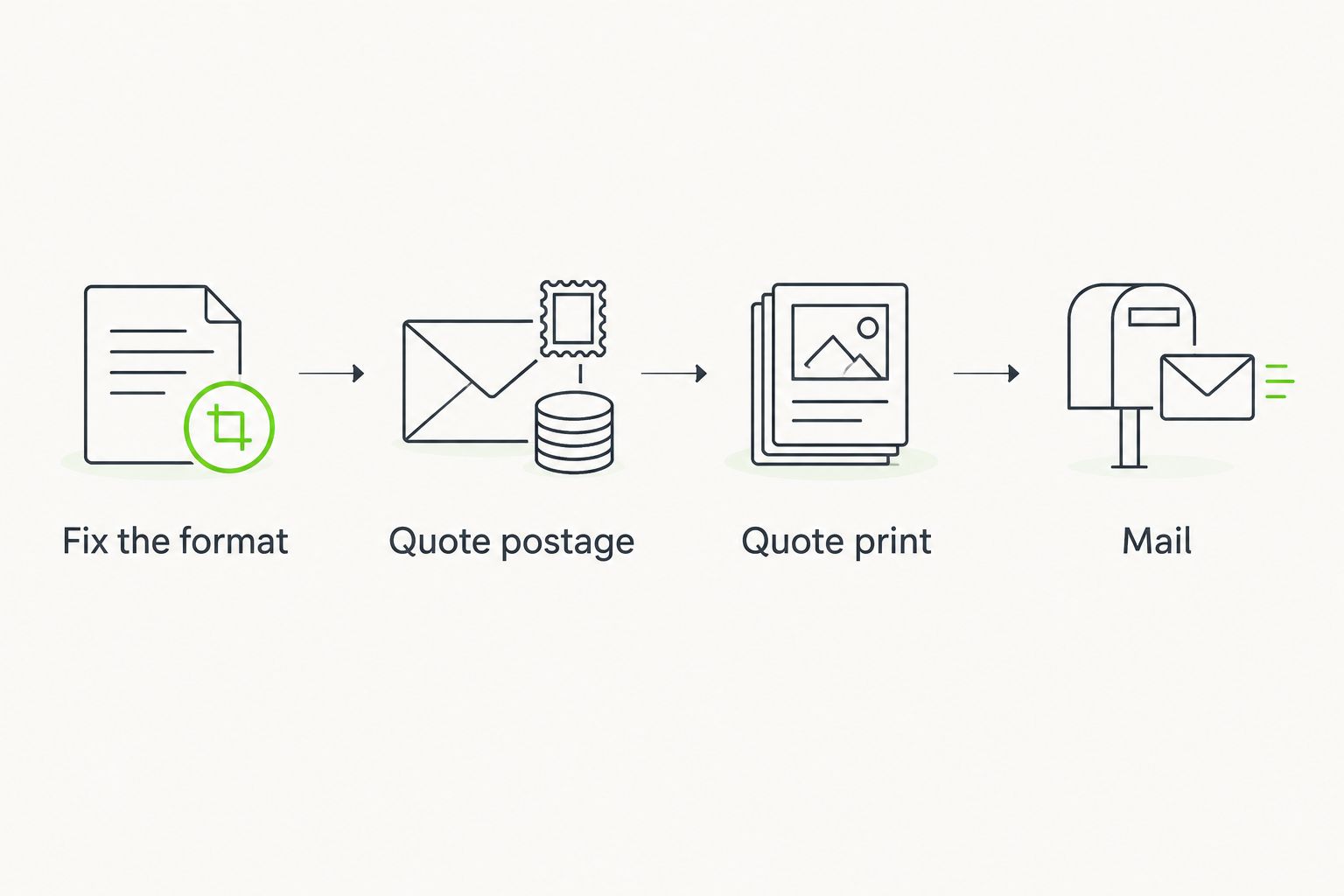
- Fix the format first. Decide postcard, flyer or letter before you price print. Format drives postage.
- Get the postage quote before the print quote. Postage sets your ceiling. Print fits inside it.
- Budget by households reached. Divide total spend by deliverable addresses, not by pieces printed.
- Order print on a normal schedule. Use 24Hr or Same Day when a mail date forces it, not by default. 1Hr is for true emergencies.
Direct mail for the 2026 election
Campaign teams in Toronto and the GTA face a fixed date, so the schedule drives cost more than usual. Candidates mailing palm cards and flyers should lock the format and postage first, then book print against the mail date. The election campaign printing checklist for candidates lists what to prepare before ordering.
Direct mail versus hand delivery
| Method | Best for | Trade-off |
|---|---|---|
| Canada Post addressed mail | Targeted lists, measurable response | Needs a clean list, postage on every piece |
| Canada Post unaddressed mail | Broad coverage of chosen routes | Less targeting |
| Hand delivery | Tight local areas | Your labour and time |
Verdict: use Canada Post when you need reach beyond a few streets or a named list. Hand deliver when the area is small and local.
FAQ
How much does Canada Post direct mail cost in 2026?
It depends on format, weight, volume and whether the mail is addressed. Total cost is postage plus print plus list or route cost. Check Canada Post’s current rate sheet for postage.
Is postage or printing the bigger cost?
Postage is usually the larger line because it applies to every piece. Print is the line you can adjust most through stock, size and quantity.
Is a postcard cheaper than a flyer to mail?
A postcard is lighter and needs no envelope, so it usually costs less to post than a heavier folded piece. Confirm weight tiers with Canada Post.
Should I choose addressed or unaddressed mail?
Choose addressed for a targeted list and measurable response. Choose unaddressed for broad coverage of chosen routes.
Can I print and mail on a tight deadline?
Yes. PrintFast.ca offers 1Hr, Same Day and 24Hr printing in Toronto. Mail delivery time is set by Canada Post, so confirm it separately.
What raises the cost per household reached?
Bad list data. Duplicates and wrong postal codes mean you pay postage on pieces that never arrive.
One last thing
The cheapest campaign is rarely the lowest print price. A well-targeted postcard on a clean list beats a bigger mailing on a weak one. Fix targeting first, then format, then print.
Related guides

