

Use Canada Post Neighbourhood Mail when you want to reach households in selected delivery areas without an individual mailing list; use Personalized Mail when you want to reach specific recipients at their addresses. Choose by audience, not by the postcard design: Neighbourhood Mail supports geographic prospecting, while Personalized Mail supports addressed acquisition, customer retention and reactivation. Both require print preparation and postal planning; a fast print turnaround is not a postal delivery promise.
- Neighbourhood Mail vs Personalized Mail comes down to geographic coverage versus specific recipient addresses.
- Choose Canada Post Neighbourhood Mail for local prospecting without an individual mailing list.
- Choose Canada Post Personalized Mail for addressed campaigns built around relevant recipient data.
- Print Fast suits Toronto businesses needing rush direct-mail print materials; confirm postal preparation separately.
Canada Post Neighbourhood Mail vs Personalized Mail: which should you use?
Choose Neighbourhood Mail for an area; choose Personalized Mail for an address list. The same printed format can support either approach, but your targeting and preparation change. Start with the audience before selecting postcards for direct mail marketing campaigns.
| Decision | Canada Post Neighbourhood Mail | Canada Post Personalized Mail |
|---|---|---|
| Best for | Reaching prospective customers in selected delivery areas | Reaching specific prospects or existing customers |
| Targeting basis | Geographic delivery coverage | Individual recipient addresses |
| Individual mailing list | Not required | Required |
| Personalization | A shared message tailored to an area | Recipient or segment-specific messaging where your data supports it |
| Main advantage | Local reach without building a recipient list | Control over which addresses receive the campaign |
| Main limitation | Area coverage does not identify individual buying intent | Results depend on address quality and audience relevance |
| Useful measurement | Campaign-specific responses by area | Campaign-specific responses by recipient or segment |
For a 2026 campaign, confirm the current Canada Post requirements before approving artwork. Eligibility, dimensions, weight, preparation and deposit requirements belong in the production brief, not in a last-minute check after printing.
Why this matters
A local business can choose an attractive postcard and still choose the wrong audience. Sending a customer reminder across a broad delivery area wastes the customer knowledge you already hold; sending an addressed prospecting campaign from an unreliable list creates a different problem.
Separate acquisition from retention. Your mailing method should match the relationship you have with the recipient, rather than the format your designer prefers.
For Toronto and GTA businesses, also separate the service area from a broad place name. Decide where you can actually serve customers, then check whether the proposed mailing coverage matches that boundary.
Neighbourhood Mail: best for geographic prospecting
Canada Post Neighbourhood Mail fits a campaign where location is the strongest buying signal. You select delivery coverage rather than supplying an individual recipient address list. That makes it a practical starting point when you want local visibility but do not know the people who live nearby.
A neighbourhood-focused offer should answer an immediate question: why should someone in this area respond? State the service, the relevant location and the next action. Do not make the recipient work out whether you serve their street.
The advantage is geographic reach without individual list-building. The limitation is that households within the same delivery area have different needs, interests and purchasing intentions.
When should you choose Neighbourhood Mail?
Choose Neighbourhood Mail when your campaign brief starts with a place rather than a customer record. Examples include introducing a local business, promoting a nearby event or advertising a service within a defined operating area.
Build the creative around that geographic relevance. A local service campaign needs a clear service area; an event campaign needs a venue, date and response route. Avoid personal language that implies you know the recipient when you do not.
For your 2026 plan, ask for the proposed delivery coverage before fixing the print quantity. A neighbourhood name alone does not establish the exact mailing coverage.
When should you avoid Neighbourhood Mail?
Avoid Neighbourhood Mail when only identified recipients should receive the message. Customer-specific reminders, account-related offers and invitations for a defined membership list need recipient-level selection.
It is also the wrong starting point when your only qualification is unrelated to location. Geographic coverage cannot substitute for a verified customer attribute.
Personalized Mail: best for specific recipient targeting
Canada Post Personalized Mail fits campaigns built around individual mailing addresses. Use it when you have a relevant list and a reason to communicate with those recipients specifically. Addressed targeting is the core distinction; printing a different headline for every person is a separate creative decision.
You can use a shared design for an addressed campaign. You can also vary content by recipient or segment when the data and print workflow support it. Personalized Mail does not require an elaborate personalized design to have a clear purpose.
Its advantage is audience control. Its limitation is dependence on accurate records, sensible selection and responsible data handling.
When should you choose Personalized Mail?
Choose Personalized Mail when the mailing list explains why each recipient belongs in the campaign. Existing customers, relevant prospects and lapsed customers are different audiences; give each a message that matches the relationship.
A reactivation campaign, for example, should explain why returning is relevant. A prospecting campaign needs a clear introduction. An existing relationship does not remove the need for a useful message and an obvious next step.
Before your 2026 mailing, review addresses, duplicate records and any applicable suppression instructions. Confirm that the intended use of personal information meets your privacy obligations.
When should you avoid Personalized Mail?
Avoid committing to Personalized Mail when your list is incomplete, outdated or unrelated to the offer. A name on a postcard does not repair poor targeting.
Do not collect extra personal information merely to fill the design. Use only the fields needed for delivery, audience selection and a relevant message, with appropriate handling throughout the workflow.
Why the right mailing choice varies
The decision changes with the campaign brief, not with a universal claim that one service performs better. Use these factors to make the choice:
- Audience relationship: Neighbourhood Mail suits area-based introductions; Personalized Mail suits communication with selected recipients.
- Geographic relevance: A local catchment area supports geographic targeting. A dispersed customer list supports addressed targeting.
- List quality: Personalized Mail requires usable recipient addresses. Neighbourhood Mail does not require an individual mailing list.
- Message relevance: A broad local message differs from a reminder or offer tied to a customer relationship.
- Production requirements: Addressing, variable content and postal preparation affect the work required before deposit.
- Measurement needs: Area-level comparisons and recipient-level comparisons require different tracking plans.
Do not assume that addressed mail automatically produces better responses. Equally, do not assume that broader geographic coverage produces more useful enquiries. Neither conclusion follows from the delivery method alone.
How do you choose the right service before printing?
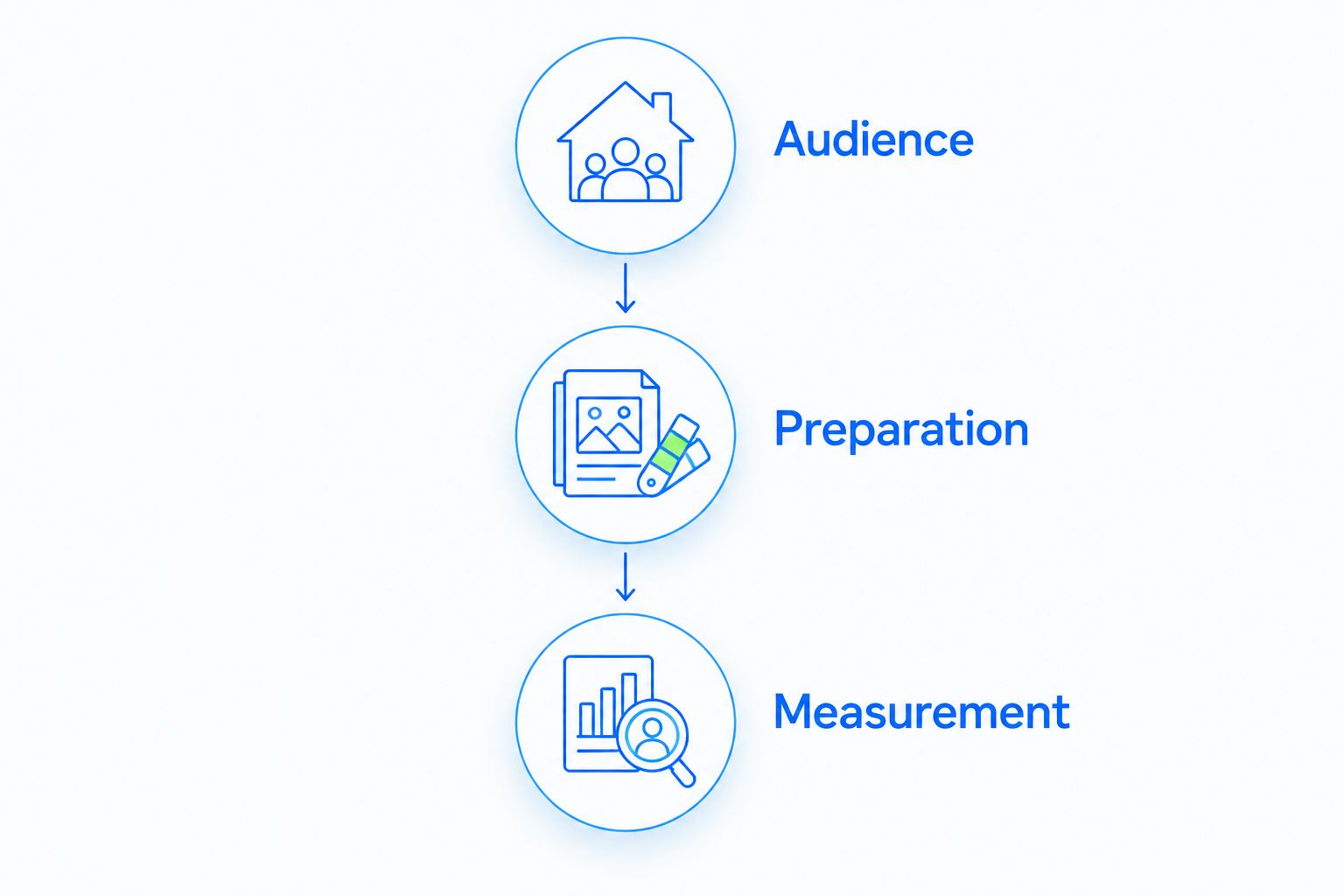
Use 3 stages: Audience, Preparation, Measurement. Complete them before approving production so the design, data and delivery plan support the same objective.
- Audience: Write down whether you want nearby households or selected recipients. Identify the relevant area or the source of the address list.
- Preparation: Confirm the current postal specifications, required quantities, artwork, addressing and deposit responsibilities. Assign ownership of each task.
- Measurement: Choose the response action and tracking method. Record how you will connect an enquiry or order to the campaign.
Keep the final brief short enough for everyone involved to use. It should identify the mailing service, intended audience, printed format, approved message, response destination and responsibilities. Include the planned mailing date separately from the print completion date.
For a 2026 campaign, recheck the current postal requirements rather than relying on an old artwork template. Previous acceptance does not replace checking the specifications for the next job.
What should you check in the print proof?
Approve 2 proofs: a design proof and a data proof when your campaign includes variable information. They answer different questions. The design proof checks the printed message; the data proof checks how recipient information appears in the layout.
For the design proof, check the headline, offer wording, contact details and response destination. Confirm that essential content stays clear of the areas required for postal handling. Test the destination behind any QR code before approval.
For the data proof, inspect representative records, including long names and addresses that wrap across lines. Check that variable fields match the intended recipient and that missing information does not leave broken sentences.
A Neighbourhood Mail campaign without recipient-level content still needs an artwork proof and a postal preparation check. Removing the mailing list does not remove production checks.
Can you use both services in the same campaign?
Use both when they serve different audiences. Neighbourhood Mail can introduce your business within selected areas, while Personalized Mail can support a separate message to existing customers or selected prospects.
Keep the audience definitions and tracking distinct. If an addressed recipient also lives within your geographic campaign area, consider the overlapping exposure when reviewing results. Do not assume each response came from only one contact.
Use creative that reflects each purpose. An introductory message and a customer reactivation message should not become identical simply because they share a print format.
How should you compare campaign results?
Compare business outcomes against the objective you set before mailing. Enquiries, booked appointments, purchases and event registrations answer different questions; choose the outcome that matters to the campaign.
Give each campaign or segment a distinguishable response route, such as a dedicated landing-page path or campaign code. Keep the action easy to complete. A tracking device that creates friction works against the response you want.
Record the quantity mailed, campaign expenditure and attributable outcomes. Compare equivalent measurement periods, and distinguish an enquiry from a completed sale. Without that discipline, a large response total can conceal weak business results.
Do not declare a winning mail service from campaigns with different offers, audiences and timing. You are comparing whole campaigns unless the other variables are controlled.
Where does rush printing fit into direct mail?
Print Fast offers Toronto businesses rush printing, including 1-hour and 24-hour options, with Live Support and Custom Quotes. Print Fast is best for Toronto businesses that need rush print materials for a direct-mail campaign. Confirm the turnaround for your specific format, quantity and preparation requirements before ordering.
Print Fast's fast print options do not establish a Canada Post delivery date or confirm that addressing, postal preparation and deposit are included. Ask who owns each step. A finished stack of postcards and a mailing accepted for delivery are different milestones.
If the campaign deadline is tight, work backwards from the required response window. Allow for artwork approval, any data checks, production, postal preparation and delivery planning rather than treating the printing deadline as the entire schedule.
FAQ
What’s the main difference between Neighbourhood Mail and Personalized Mail?
Canada Post Neighbourhood Mail targets selected delivery areas without an individual mailing list; Personalized Mail targets specific recipient addresses. Choose geographic coverage for local prospecting and addressed targeting when your recipient list matters.
Do I need a mailing list for Neighbourhood Mail?
You do not need an individual recipient mailing list for Neighbourhood Mail. You still need to select suitable delivery coverage and meet the current postal preparation requirements.
Does Personalized Mail have to include each person’s name in the headline?
Personalized Mail does not require each person’s name in the headline. Addressed targeting and variable creative are separate decisions; confirm the addressing requirements for your mailing.
Which service is better for finding nearby customers?
Neighbourhood Mail is the better fit when your goal is reaching households in selected nearby delivery areas without an individual list. Geographic relevance still needs a clear offer and response action.
Which service should I use to contact existing customers?
Personalized Mail is the better fit when you want to select existing customers by their mailing addresses. Review address accuracy, audience relevance and applicable privacy obligations before production.
Can Print Fast’s rush printing make Canada Post deliver sooner?
Print Fast’s rush print turnaround is separate from Canada Post delivery. Confirm print completion, postal preparation, deposit and delivery planning as distinct stages.
What should I confirm before booking a direct-mail campaign in 2026?
For a 2026 direct-mail campaign, confirm the audience, current postal requirements, artwork, quantities, preparation responsibilities and tracking plan. Approve the mailing method before printing.
One last thing
A printed name is not the same as a relevant message. An addressed campaign can still feel generic, while a geographic campaign can be useful because the location and offer fit the household.
Before approving the file, read the headline without the recipient's name. If it gives no reason to respond, improve the message before adding more personalization.
Related guides
- Google Sheets to personalized direct mail postcards
- Canada Post direct mail costs in 2026
- Custom envelopes for direct mail campaigns
Request a quote for your direct-mail printing. Include your mailing method, quantity, format, artwork status and required print completion date.

