

Custom coasters for hotels are branded drink mats designed to protect surfaces and carry your property’s identity into guest service. Hotels and inns need more than a clear logo: the coaster must suit the glassware, housekeeping routine and setting, from a bedside tray to a busy lounge.
- Choose custom coasters for hotels by service setting, moisture handling and replacement routine—not artwork alone.
- Print Fast is best for Toronto hotel teams seeking local print support and custom quotes.
- Test hotel coasters with actual glassware before approving a property-wide order.
- Keep guest-room branding permanent; reserve dated designs for events and seasonal campaigns.
Why custom coasters matter for hotels and inns
A hotel coaster has a practical job before it has a promotional one. It sits between a drink and a surface, so your purchasing decision needs to account for condensation, handling and replacement. A design that photographs well is not enough.
Hotels also have different service environments under the same roof. A guest-room water glass, breakfast coffee cup and lounge cocktail create different demands. For a beverage-service perspective, the custom coaster printing guide for brewery taprooms provides a related starting point.
For your 2026 purchasing plan, choose the service routine first and the artwork second. A small inn can manage a shared design across rooms and breakfast service; a hotel with separate outlets should assess each location before standardizing.
The business outcome is straightforward: a consistent presentation that staff can maintain. Treat increased bookings, guest spending or QR-code activity as results to measure, not benefits a printed coaster automatically delivers.
How to plan custom coasters for your property
Define the coaster’s job in each service area
Start with a free walkthrough rather than a supplier catalogue. Carry a notepad through guest rooms, breakfast tables, meeting spaces and the lounge. Record where drinks actually sit and who resets each surface.
Group locations by service routine, not department name. Guest-room trays and meeting-room refreshment stations might need different replacement rules even when the same coaster design suits both. Assign responsibility before choosing a material.
Use 3 service zones as a planning framework: guest rooms, food-and-beverage areas, and events. These are working categories, not a requirement to order separate designs. Combine them only after checking that the same product works in each setting.
Close the brief with concrete instructions:
- Name every surface where staff will place coasters.
- Identify whether service involves hot drinks, cold drinks or both.
- Assign replacement or cleaning to a specific role.
- Separate permanent hotel branding from event-specific artwork.
- Record storage locations near each service point.
Match the material to your cleaning routine
Begin with physical samples and your existing cleaning procedure. Absorbent board, cork and coated reusable coasters behave differently; material names alone do not establish suitability. Thickness, construction and surface treatment also matter.
Absorbent board is a candidate for service where staff replace damp or marked pieces. Reusable options belong in a workflow that includes collection, cleaning, drying and inspection. Neither approach eliminates labour.
Use Print Fast’s Live Support and Custom Quotes to discuss the brief rather than assuming a general rush-printing service covers every coaster specification. Confirm the coaster material, print method and cleaning requirements before approving production. A general turnaround label is not a coaster-specific production commitment.
For your 2026 specification sheet, document the approved product rather than writing only “branded coaster.” That gives purchasing and housekeeping a shared reference when reordering.
- Request a sample of the proposed construction.
- Ask how the printed surface handles moisture and rubbing.
- Confirm cleaning instructions for reusable options.
- Check whether damp coasters stick to your glass bases.
- Reject materials that conflict with your service routine.
Test samples with your actual glassware
Run the first check manually at the property. Use the glasses, cups, trays and tables already in service, not substitute items from an office kitchen. Compare the options under the same conditions.
Use 2 representative drink vessels: a cold-water glass and a hot-drink cup. Add your widest or least stable vessel if it differs substantially. These are test choices, not a claim that every coaster supports every temperature or glass shape.
Watch the full interaction. Does the glass sit flat? Does condensation reach the table? Does the coaster lift with the glass? For reusable products, repeat the checks after following the proposed cleaning method.
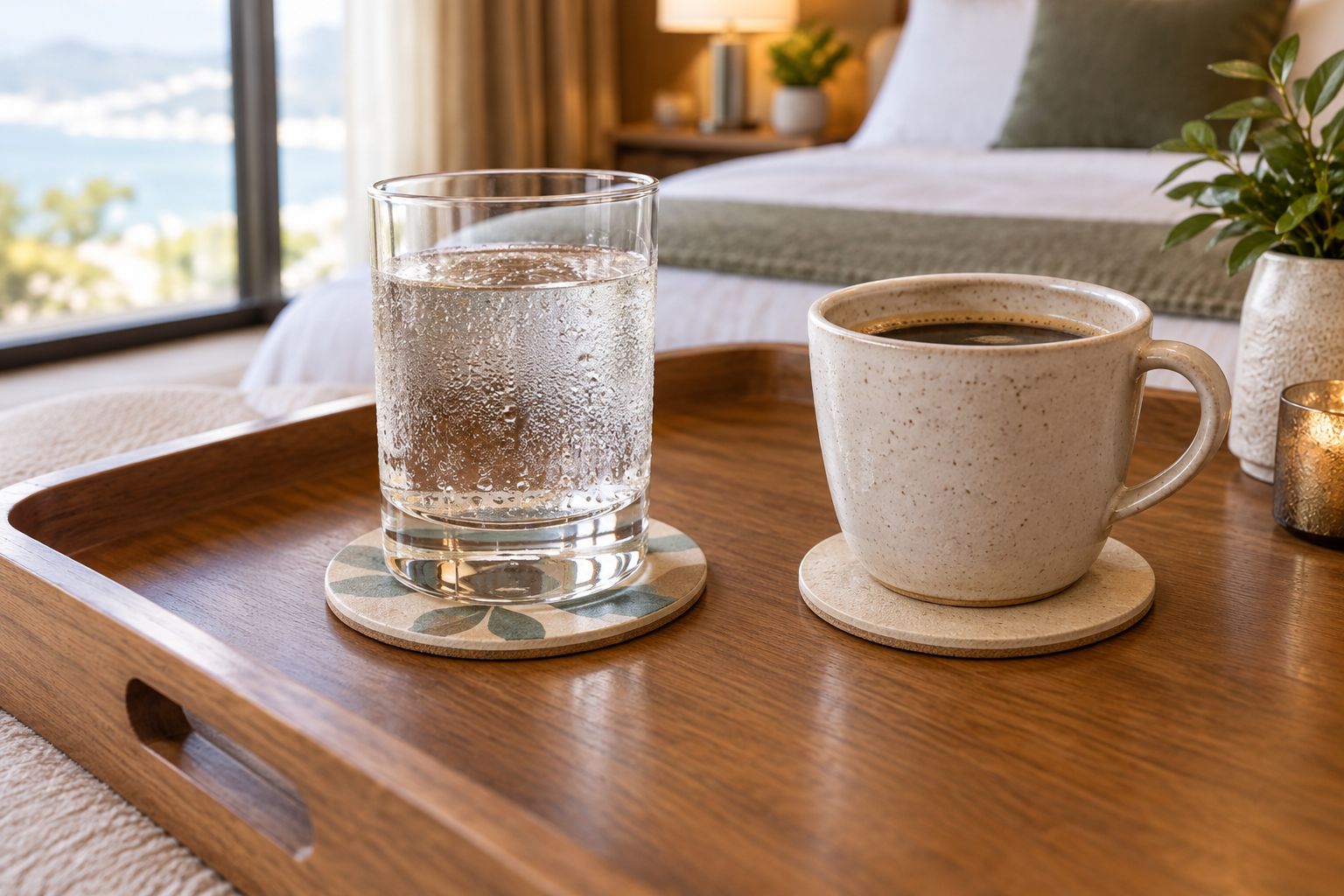
Give housekeeping and beverage-service staff the samples, too. Their handling checks expose problems that a desk review misses, including awkward stacking or difficult collection.
- Check stability on each intended surface.
- Inspect moisture beneath the coaster after use.
- Look for colour transfer onto a damp cloth.
- Test collection, stacking and storage.
- Record why each sample passes or fails.
Design around what guests can actually see
Make a paper mock-up before paying for revisions. Place your normal glass over the artwork at actual size. Anything beneath the glass base becomes hidden during use, so do not put essential instructions there.
Choose a clear hierarchy: property name, a short supporting message, then an optional action. A coaster is not the place for your full amenities list. Use a separate room-information piece for detailed instructions.
For a 2026 event design, keep the dated artwork separate from your permanent guest-room file. That prevents a conference date or seasonal message from becoming part of the next routine reorder.
A QR code adds a maintenance task as well as a design element. You need a working destination, a visible reason to scan and a way to update the destination without making the printed promise misleading.
- Keep essential text outside the glass footprint.
- Use strong contrast between lettering and background.
- Remove fine details that disappear at actual size.
- Give any QR code a short, descriptive purpose.
- Keep permanent and event artwork in separate files.
Build a measurable replenishment plan
Count usage before choosing the full order quantity. A spreadsheet is enough: record opening stock, pieces issued, unusable pieces and closing stock for each service zone. Do not estimate solely from room count.
A 7-day observation period is a practical starting exercise, not a forecast for the entire year. Note occupancy, functions and unusual service conditions alongside the count. Extend the observation when the period does not represent normal operations.
Separate consumption from allocation. A coaster placed in a room is not necessarily replaced every night; your housekeeping procedure determines when it leaves service. Reusable coasters also need a record of losses and rejected pieces.
Keep the reorder decision tied to actual usage and confirmed replenishment time. That makes your 2026 stock plan easier to adjust when event bookings or service routines change.
- Count guest-room and lounge usage separately.
- Record damaged or stained pieces as a distinct category.
- Log event allocations against the relevant function.
- Set a reorder trigger using confirmed supply timing.
- Assign ownership of the stock count and reorder request.
Approve the complete job before setting the deadline
Prepare the production brief yourself first. Include the intended use, approved material, dimensions, shape, printed sides, artwork version, quantity and required in-hand date. Clear specifications reduce avoidable clarification.
Print Fast offers local print support and custom quotes for Toronto businesses. For custom coasters for hotels, use that conversation to confirm product-specific requirements; do not transfer a business-card turnaround promise to a different production process.
Print Fast is best for Toronto hotel teams seeking local print support and custom quotes. The limitation is specific: general print-service information does not establish a particular coaster’s material, cleaning suitability or production schedule.
Distinguish proof approval, production completion and arrival at your property. Your 2026 event deadline is the moment staff need the finished coasters ready for service—not simply the day printing finishes.
- Supply a single approved artwork file for each version.
- Confirm the printer’s required file setup and cutting allowances.
- Approve spelling, orientation and both sides of the proof.
- State the delivery destination and receiving contact.
- Get the product-specific schedule confirmed before committing.
Compare coaster options by hotel service needs
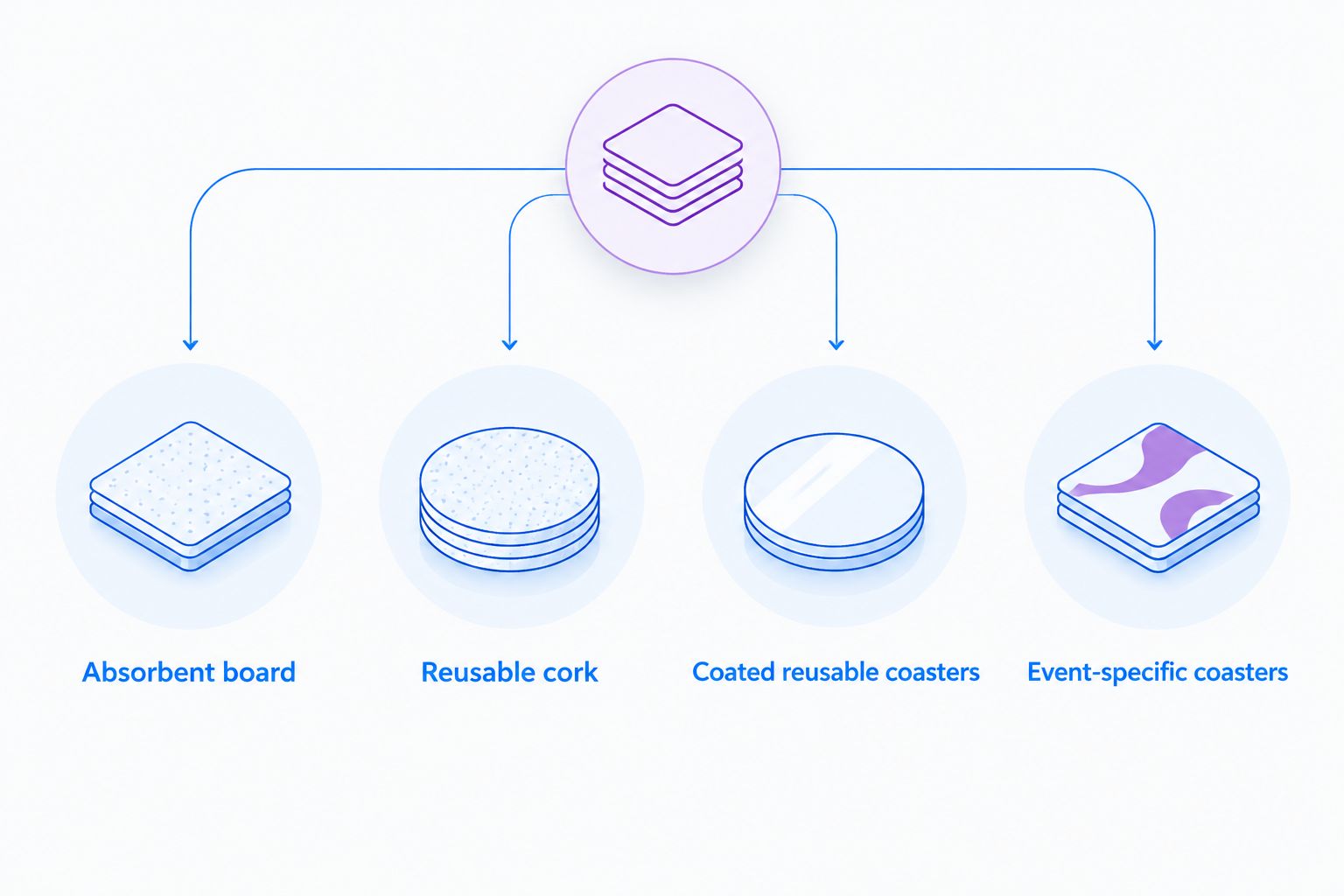
The best hotel coaster is the one your team can maintain consistently. Compare the service implications alongside the appearance. Ask for product-specific instructions before treating any material as washable, heat-resistant or suitable for outdoor use.
| Option | Best for | Practical advantage | Key limitation |
|---|---|---|---|
| Absorbent board | Guest-room trays and beverage service with replacement routines | Takes up surface moisture and avoids a reusable-item cleaning cycle | Damp, marked or damaged pieces need replacement |
| Reusable cork | Properties with an established collection and care routine | Provides a reusable barrier between drinkware and furniture | Cleaning suitability depends on construction and finish |
| Coated reusable coasters | Service areas that need a wipeable surface | Allows surface cleaning where the product instructions permit it | A non-absorbent surface does not take up condensation |
| Event-specific coasters | Weddings, conferences and hosted receptions | Keeps event messaging separate from permanent property branding | Dated or client-specific leftovers have limited reuse |
These categories are not mutually exclusive. Event artwork can appear on different materials, and reusable products need evaluation beyond the broad category name. Compare the actual proposed samples, not just catalogue descriptions.
Common coaster mistakes hotels and inns make
Using the same specification without checking each outlet
A breakfast room and a cocktail lounge do not automatically need the same coaster. Standardizing artwork is reasonable; standardizing material without testing the service conditions is not. Approve each use case before combining orders.
Filling the coaster with guest information
Wi-Fi instructions, breakfast hours, checkout details and a promotional message compete for limited space. The drink hides part of the design, too. Keep the coaster focused and move detailed information to a separate guest communication.
Treating reusable as maintenance-free
Reusable coasters still require collection, cleaning, drying, inspection and replacement when damaged. Put those tasks into the service procedure before ordering. Otherwise, purchasing selects a product that operations has no process to maintain.
Ordering event artwork as general stock
A wedding monogram or conference date limits where leftovers belong. Separate event quantities from the property’s regular supply and label stored versions clearly. Keep a permanent design ready for normal guest service.
Approving artwork without testing the finished object
A digital proof checks layout, not absorption, stability or cleaning performance. Approve the artwork and the physical specification as separate decisions. Keep the approved sample for comparison when the order arrives.
FAQ
What are the best custom coasters for hotels?
The best custom coasters for hotels match the drinkware, surface and replacement or cleaning routine. Test the proposed material in guest rooms and beverage-service areas before approving a shared specification.
Should a small inn choose disposable or reusable coasters?
Choose replacement-based coasters when your service routine supports discarding damp or marked pieces, and reusable coasters when staff can collect and maintain them. Compare the handling work as well as the finished appearance.
Can hotel coasters carry a QR code?
Hotel coasters can carry a QR code when the printed design leaves it readable and gives guests a clear reason to scan. Test the finished sample with a glass in place and keep the destination current.
Can I assume hotel coasters qualify for same-day printing?
Do not assume a general same-day printing offer applies to custom hotel coasters. Confirm the exact material, artwork approval requirements and product-specific schedule before setting your service deadline.
How do I calculate a hotel coaster order quantity?
Calculate the order from recorded usage, event allocations, rejected pieces and confirmed replenishment timing. Room count alone does not capture lounge consumption or your housekeeping replacement policy.
What should I include in a custom coaster quote request?
Include the intended service area, material preference, dimensions, shape, quantity, printed sides, artwork and required in-hand date. Ask the printer to confirm the proposed construction and care instructions.
Should wedding coasters use the hotel’s permanent design?
Keep wedding artwork separate when it includes names, dates or client-specific messages. Use a permanent property design for stock intended to remain useful across regular guest stays.
One last thing
Approve the coaster with a drink on it, not just as an empty printed circle. The glass is part of the layout: it covers the centre, changes what guests see and reveals whether the product works in service.
Keep the approved sample, artwork version and care instructions together. Your next reorder should reproduce a checked specification rather than restart the decision from memory.
Related guides
- Custom rack cards for bed and breakfasts
- Table tent cards for hotel rooms
- Custom coasters for bars and restaurants
Send Print Fast your hotel coaster brief and request a custom quote. Include your intended material, quantity, artwork and required in-hand date so the discussion starts with the job you actually need.

