

Craft distillery label printing is the production of custom bottle labels with the aim of making your spirits identifiable, readable and ready for sale. This 2026 guide covers custom labels for distilleries, from bottle fit and artwork to moisture testing, batch control and rush-order planning.
- Custom labels for distilleries need bottle-fit checks, readable artwork and testing under actual handling conditions.
- Print Fast is best for Toronto/GTA distillery teams seeking local print support and custom quotes.
- Choose bottle label materials by exposure and application method, not appearance alone.
- Approve Canadian spirits labelling requirements separately from the printer’s artwork proof.
Why label printing matters for craft distilleries
A distillery label has to work on a curved container, distinguish related spirits and remain readable through handling. Your front panel introduces the bottle; the rest of the label must accommodate product information without turning into cramped small print.
Choose the label around the bottle and its use, not around a flat-screen mock-up. A design that looks balanced on a monitor can overlap at the seam, wrinkle near a shoulder or disappear against dark liquid.
For your 2026 releases, separate three decisions: what information belongs on the label, how the label attaches and how the finished bottle should look. The guide to custom labels for cosmetics and skincare provides a related packaging reference, but spirits require their own regulatory review.
Craft distilleries also need a repeatable system for changing batches, expressions and bottle formats. Treat each variation as a controlled production file rather than editing an old PDF minutes before printing.
How to order custom labels for distilleries
1. Define the bottle and release requirements
Start with a spreadsheet or written brief. Record the actual bottle, intended sales channels, application method and who approves the final artwork. This manual preparation prevents a print conversation from becoming a series of incomplete revisions.
Separate your fixed design elements from changing information. Your distillery name and visual structure can remain consistent while expression names, batch details and other product-specific information change.
For a 2026 release calendar, build the label schedule backwards from the date bottles must be packed. Leave distinct stages for content review, physical testing, approval, printing and application; do not treat them as a single printing deadline.
- Identify the exact bottle and closure used for each release.
- List every artwork variation and its required quantity.
- Record whether labels will be applied by hand or machine.
- Assign a named content approver and production contact.
- Separate the print-completion deadline from the packing deadline.
2. Measure the usable label area
Use a paper mock-up before paying for finished labels. Wrap it around the actual bottle and mark the front-facing area, seam and any curves where the paper stops lying flat. Measure the straight-sided application area rather than the bottle’s overall height.
Keep the main label off compound curves unless the construction has been tested there. Shoulders, tapered bases and irregular surfaces need particular attention because a flat label must conform to them.
As a practical starting check, make mock-ups for 3 bottles from your intended supply. This is a fit check, not a statistically representative quality test. Include the front and back panels together so you can judge spacing around the whole bottle.
- Measure label width and height in millimetres.
- Mark the shoulder, base curve and mould seams.
- Check the gap or overlap where label edges meet.
- Compare front-panel alignment across the test bottles.
- Photograph the fitted mock-up for the printer’s brief.
3. Match the material to handling conditions
List what the label will encounter before choosing its appearance. A bottle displayed dry in a tasting room has different demands from one handled with wet hands or placed in a chilled service setting. Surface moisture, rubbing and spills belong in the specification.
Print Fast offers local print support and custom quotes for Toronto/GTA businesses. For custom labels for distilleries, use that conversation to establish the proposed material, adhesive, finish and production schedule; do not assume a general rush-printing offer confirms a particular label construction.
A film face material does not establish the performance of the complete label. Adhesive, ink, protective finish, bottle surface and application conditions all affect the result. Ask for the proposed construction, then test it on your bottle.
- Describe dry, chilled and wet-handling conditions separately.
- State whether the bottle is clear, coloured, coated or textured.
- Ask what protection the printed surface needs against rubbing.
- Confirm whether removal or permanent attachment is the priority.
- Request a suitable sample before approving the full run.
4. Build readable, controlled artwork
Start with a full-size printout from your own printer. View it on the bottle under ordinary shelf lighting, not only enlarged on a screen. Check the product name first, then read the supporting information without rotating the bottle awkwardly.
For your 2026 artwork, confirm current requirements with the Canadian Food Inspection Agency, applicable federal rules and the relevant provincial sales channel before approval. Do not use another distillery’s bottle as a legal template. Product classification, claims and destination can change what your label needs.
Use the printer’s actual file requirements for bleed, safe areas, colour preparation and cut lines. A general design template is only a starting point, and a print-ready PDF does not establish regulatory compliance.
- Keep important text inside the specified safe area.
- Check contrast against the bottle and liquid colour.
- Confirm all required wording through a separate content review.
- Keep cut lines and production instructions distinct from artwork.
- Name files by product, version and approval status.
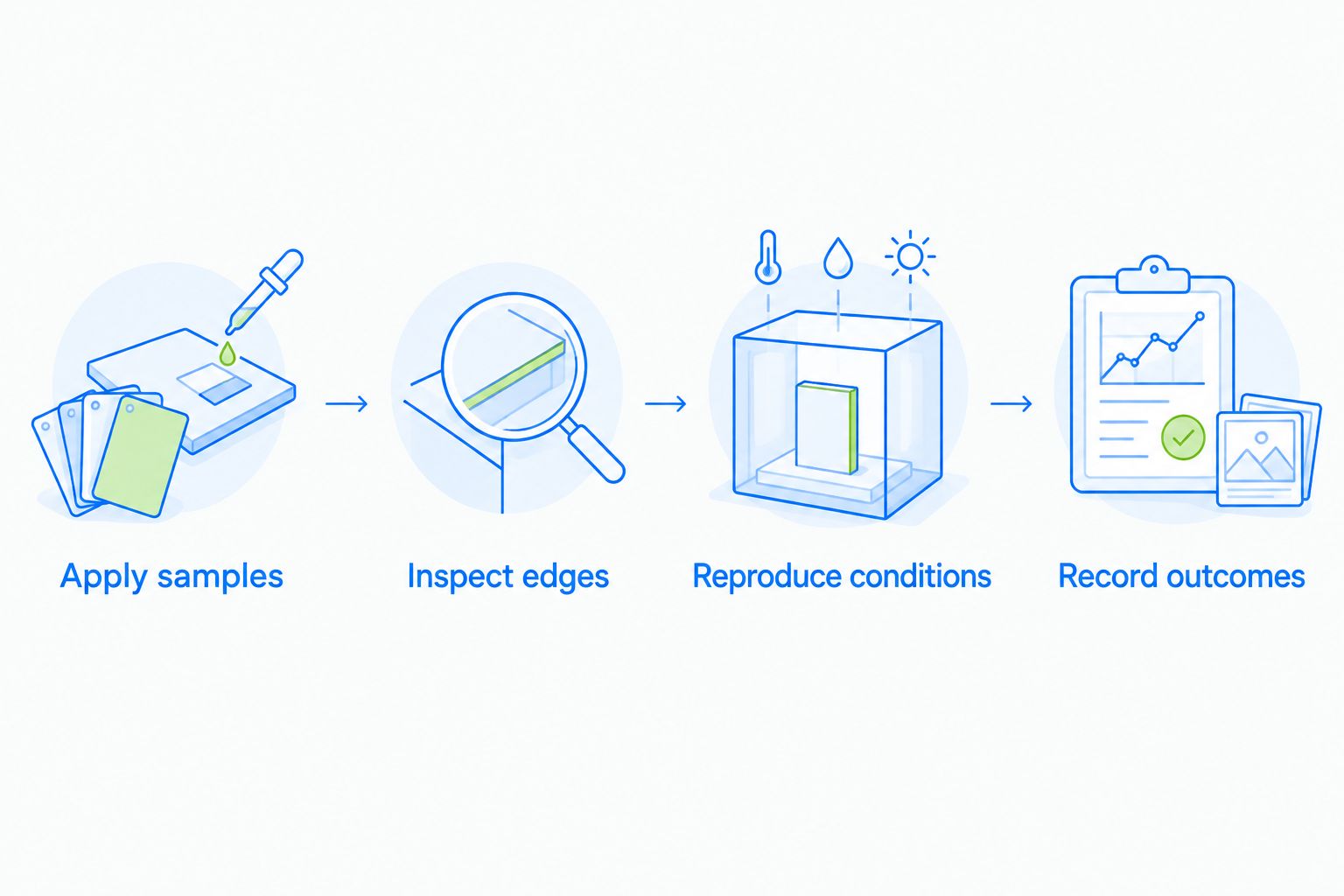
5. Test the finished label on filled bottles
Test the proposed construction in the conditions you identified, using a representative filled bottle. Follow the adhesive supplier’s or printer’s application instructions, including surface preparation and any recommended waiting period before exposure.
Create 2 review rounds: one for artwork and one for the physical label. This is a recommended approval structure, not a production-time estimate. The artwork review catches wording and layout problems; the physical review checks fit, adhesion and readability in use.
Do not substitute a digital proof for a handling test. A PDF cannot demonstrate edge lift, surface scuffing or how a transparent label looks over the bottle contents.
- Apply samples to clean bottles using the intended method.
- Inspect edges, wrinkles and front-to-back alignment.
- Reproduce relevant chilled or wet-handling conditions.
- Check whether rubbing affects ink or small text.
- Record the construction and test outcome before approval.
6. Confirm the application format
Choose the delivery format around your bottling process. Hand application needs a repeatable alignment method; machine application needs the label supply to match the equipment. Neither approach fixes an incorrectly sized label.
For manual work, start with a simple positioning guide and a clearly defined reference point on the bottle. For an applicator, obtain the equipment requirements before ordering. Roll direction, label spacing, liner and other feed details should come from the equipment specification, not assumptions.
Keep decorative elements separate from functional requirements. A neck seal or supplementary batch sticker adds another application task and must not cover essential bottle information.
- Confirm sheets, individual labels or rolls with the printer.
- Supply applicator requirements when machine labelling.
- Define a consistent front-panel reference point.
- Keep batch stickers clear of required information.
- Run a short application trial before labelling the release.
7. Approve the order and plan replenishment
Send one written specification rather than scattered messages. Include the approved artwork, dimensions, construction, quantity by variation, application format and required completion date. Keep 1 approved master file for each version so nobody prints an earlier draft.
For repeat custom labels for distilleries, ask Print Fast to confirm the specification and timing for the particular job. Local support helps you discuss changes directly; it does not replace a written approval or establish identical colour across different materials.
Close your 2026 order with a record of what was approved. When replenishing, identify any change to the bottle, liquid appearance, artwork or application equipment before treating the order as an exact repeat.
- Submit the approved file with its version name.
- Confirm quantities separately for every expression.
- Obtain written confirmation of the proposed construction.
- Record production completion and delivery arrangements separately.
- Retain a finished bottle as the reference for reorders.
Compare label options by bottle use
The best label option is the one that passes your bottle and handling tests. These are constructions to discuss with a printer, not a statement that every option is offered for every job.
| Option | Best for | Main advantage | Key limitation |
|---|---|---|---|
| Paper labels | Dry-display bottles seeking a paper appearance | Supports a tactile, paper-led presentation | Untreated paper needs assessment where moisture or rubbing is expected |
| White film labels | Designs needing an opaque background | Separates artwork visually from bottle contents | Film alone does not establish adhesive or print durability |
| Clear film labels | Designs intended to reveal the bottle or liquid | Leaves selected areas visually transparent | Text contrast and white-ink requirements need careful planning |
| Textured paper labels | Releases where surface feel is part of the design | Adds a physical texture to the bottle | Texture does not establish moisture resistance |
| Separate front and back labels | Bottles needing distinct branding and information panels | Gives each panel a defined role | Adds alignment work during application |
| Wraparound labels | Straight-sided bottles needing a continuous layout | Combines branding and information in one application | Seams and tapered bottles require careful fit checks |
Material and layout are separate choices: a front-and-back design still needs a suitable face material and adhesive. Likewise, a wraparound format does not remove the need to check required text placement and readability.
Common mistakes craft distilleries make
Approving empty-bottle mock-ups only
Liquid changes the background behind clear labels and through exposed glass. Review the filled bottle, especially where dark contents sit behind small lettering. Check both the shelf-facing view and the information panel.
Treating a print proof as legal approval
A printer’s proof checks what will be produced; it is not your regulatory sign-off. Assign responsibility for Canadian spirits labelling requirements before the job reaches production. Keep that approval separate from colour and trimming decisions.
Reusing one layout across different bottle shapes
A label sized for a straight-sided bottle does not automatically fit a tapered one. Recheck dimensions, panel spacing and seam position whenever the bottle changes. The same artwork dimensions are not evidence of the same fit.
Changing batch information without version control
An old expression name or outdated product detail can survive inside an otherwise updated file. Maintain a variation list and compare every final PDF against it. Archive superseded versions away from production files.
Making the rush deadline the entire brief
A deadline does not tell the printer how the label must perform. Send bottle details, exposure conditions and application requirements with the timing request. Speed matters after the specification is clear.
FAQ
What are the best custom labels for distilleries?
The best custom labels for distilleries fit the actual bottle and pass testing under its intended handling conditions. Compare the complete material, adhesive and finish rather than selecting by appearance alone.
Do spirits bottles need waterproof labels?
Spirits bottles need labels suited to their expected moisture exposure, not an untested waterproof claim. Tell the printer about chilling, spills and wet handling, then assess the proposed construction on a filled bottle.
Are clear labels better than white labels for spirits?
Clear labels suit designs that reveal the bottle or liquid; white labels provide an opaque background for the artwork. Clear designs need particular attention to contrast and any white-ink requirements.
Can I use the same label on every bottle size?
Use the same label only after checking its fit and readability on every bottle format. A different shoulder, taper or circumference requires a fresh physical mock-up.
Does a print-ready PDF mean my spirits label is compliant?
A print-ready PDF does not establish compliance with spirits labelling requirements. Review the current Canadian requirements and relevant sales-channel rules separately from the printer’s artwork approval.
Can Print Fast help with a rush distillery label order?
Print Fast offers rush printing and custom quotes for Toronto/GTA businesses. Confirm the label construction, quantity, artwork readiness and required completion date for your specific job before scheduling bottling.
What should I send when requesting a bottle label quote?
Send the label dimensions, bottle details, artwork variations, quantities, handling conditions and application method. Include your required completion date and identify whether the artwork has received final approval.
One last thing
Keep a finished, labelled bottle as your production reference for 2026 reorders. A saved PDF records the artwork; the bottle records the result, including placement, visible contrast and how the label sits on the glass.
Related guides
- Custom labels for craft brewery cans
- How to choose sticker material for outdoor use
- Same-day sticker printing for product launches
Request a custom quote from Print Fast for your distillery labels. Include your bottle dimensions, quantities by design, application method and required completion date.

