

Canada Post Neighbourhood Mail lets your small business send unaddressed advertising to eligible delivery points on selected postal routes without buying a list of customer names and addresses. You choose the delivery area, prepare a qualifying mailpiece, arrange the mailing and deposit it according to Canada Post’s requirements. Printing and postal delivery are separate jobs: a rush print order does not mean your campaign will reach mailboxes the same day.
- Canada Post Neighbourhood Mail is best for reaching local areas rather than named customers.
- Choose postal routes before printing flyers so your quantity matches the mailing plan.
- Print Fast offers rush flyer printing; Canada Post’s mailing requirements and delivery schedule remain separate.
- Track enquiries and bookings, not just the number of pieces mailed.
How does Canada Post Neighbourhood Mail work for small businesses?
Canada Post Neighbourhood Mail targets geography, not individual customers. You select routes serving the area you want to reach, then supply advertising prepared for that mailing. Canada Post handles distribution through its delivery network, subject to its service rules and delivery exclusions.
For a 2026 campaign, confirm the current requirements before approving your artwork. The Canva-to-print-ready file workflow covers the artwork stage; postal eligibility needs its own check.
Follow these steps before your mailing
- Define the audience. Identify where customers can realistically visit your premises or receive your service. Start with your actual service boundary, not the widest area your budget can cover.
- Select routes. Use Canada Post’s route-planning resources to review delivery areas and available delivery-point counts. Check the route coverage rather than assuming a neighbourhood name matches a postal boundary.
- Confirm the format. Check the current Neighbourhood Mail requirements for dimensions, weight, construction and preparation. Do this before choosing paper or committing to a finished size.
- Approve the artwork. State what you offer, where you operate and how someone should respond. Check contact details, dates, spelling and any conditions attached to the message.
- Prepare the mailing. Confirm the required quantities, grouping, documentation and deposit arrangements. Assign responsibility for each task so printed cartons do not arrive without a mailing plan.
- Deposit and measure. Follow the applicable deposit instructions, retain your campaign records and track responses against the routes and creative you used.
The route plan should determine the production quantity. Printing first and selecting routes afterwards reverses that process and can leave you short of pieces or holding unnecessary extras.
Why this matters
A neighbourhood campaign puts your message in front of a geographic audience without requiring an existing customer database. That suits a local business introducing itself to nearby households or promoting a service within a defined territory.
The trade-off is precision. A delivery route does not tell you which recipient needs your service, owns a particular property or intends to buy. Choose Neighbourhood Mail when proximity matters more than identifying a specific person.
For Toronto and GTA businesses, the useful question is not simply whether an area is nearby. Ask whether you can serve it consistently and whether the campaign gives residents a clear reason to respond.
Neighbourhood Mail versus addressed mail
Neighbourhood Mail and addressed mail solve different targeting problems. Choose the method that matches the information you actually have about the audience.
| Mailing approach | Best for | Main advantage | Main limitation |
|---|---|---|---|
| Canada Post Neighbourhood Mail | Introducing a business within selected local areas | Does not require a named customer list | Cannot select individual customers within a route |
| Addressed customer mailing | Reminders and messages for known customers | Uses a specific recipient’s address | Requires an accurate mailing list and appropriate handling of personal information |
| Hand-distributed door hangers | A separately managed local distribution campaign | Uses a physical door-hanger format | Requires a distribution plan outside the Neighbourhood Mail workflow |
Do not treat a customer reminder as an area-wide acquisition campaign. A reminder refers to an existing relationship; a neighbourhood flyer must explain who you are and why an unfamiliar recipient should care.
Likewise, a delivery plan for door hangers is not a Canada Post mailing plan. Confirm the distribution method before choosing the printed format.
How to choose routes without wasting your print run
Start with serviceability. Mark the places where you can honour the message on the flyer, including any geographic restrictions on appointments, deliveries or on-site work.
Then inspect route coverage. Postal delivery boundaries and the boundaries you use in conversation are not necessarily identical. Review the selected area carefully rather than choosing solely by a familiar neighbourhood name.
Separate geographic fit from customer fit
A route can fall inside your service area while containing people who have little reason to buy. Use available planning information to assess the audience, but do not mistake an area profile for a verified description of every household.
For a 2026 mailing, keep a record of the routes you select and the delivery counts used when placing the order. That record makes later comparisons more useful than a note saying only that you mailed “around Toronto.”
Give the campaign a clear job
Choose a primary objective before designing the piece:
- Introduce a new location to nearby residents.
- Generate enquiries for a service available in that area.
- Invite residents to a community event.
- Bring local customers to a booking or information page.
These are campaign examples, not promised outcomes. Your objective should determine the headline, response method and way you judge the result.
Why Neighbourhood Mail preparation varies
The right production plan depends on the mailing, not just the appearance of the flyer. Confirm these factors before approving a 2026 print order:
- Route selection: The chosen coverage determines the mailing quantity and where the campaign goes.
- Delivery-point selection: Available destination categories and applicable exclusions affect the audience you can reach.
- Finished dimensions: The mailpiece must meet the service’s current format requirements.
- Weight and construction: Paper, folds and additional components affect the finished piece and its eligibility.
- Preparation requirements: Grouping, identification and paperwork must match the mailing instructions.
- Deposit and delivery planning: Production completion, postal deposit and delivery are distinct milestones.
Do not substitute a printer’s standard flyer specification for Canada Post’s requirements. A piece can print correctly and still need changes before it qualifies for the intended mailing.
Build the artwork around the response you want
Lead with the recipient’s reason to pay attention. A business name alone does not explain the benefit of visiting, calling or booking.
Keep the message specific to the area and the service. State your service boundary when it affects eligibility, and make any event date or booking condition easy to find.
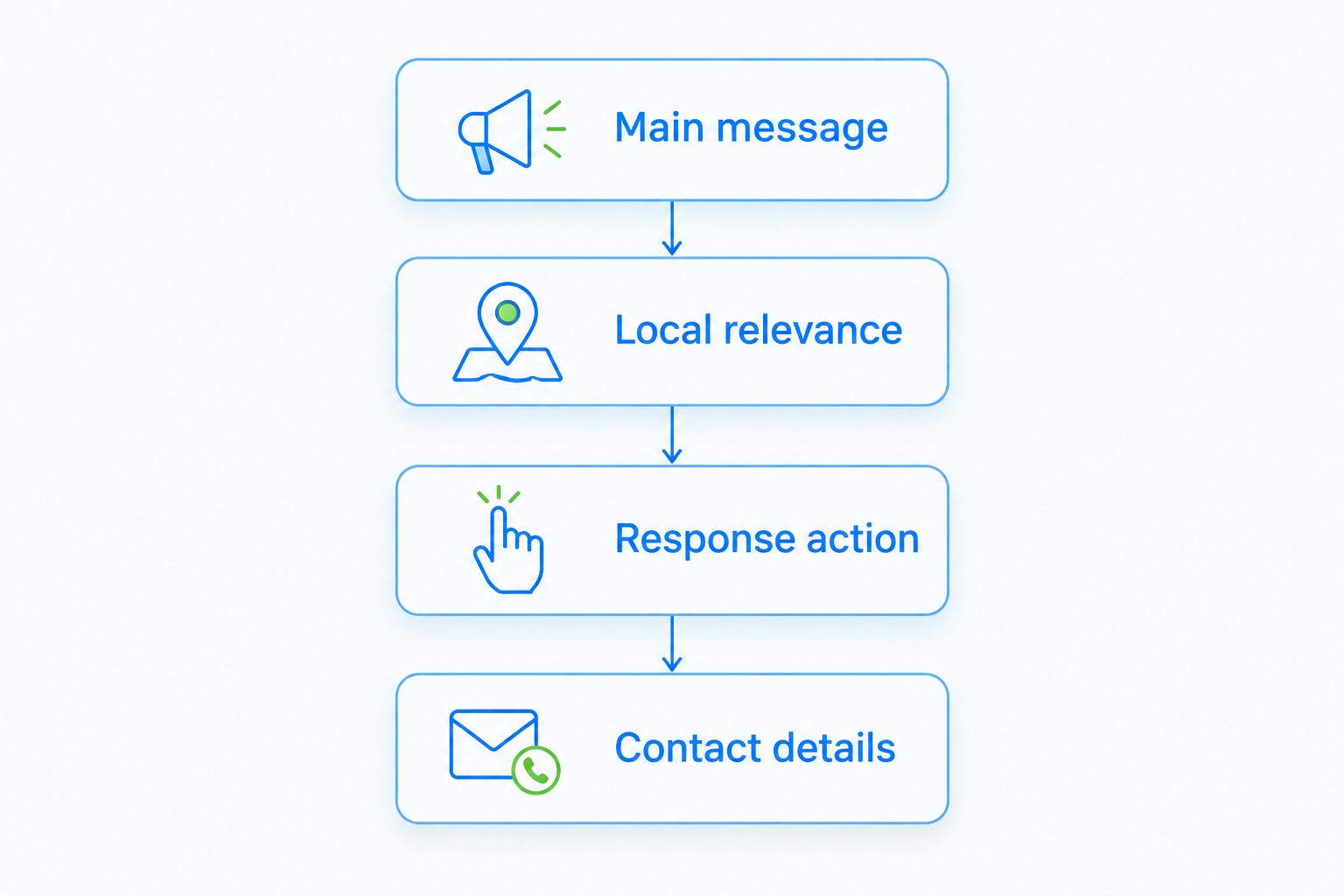
Use a clear information order
Build the reading path around these elements:
- Main message: What you want the recipient to understand immediately.
- Local relevance: Where the service, shop or event applies.
- Response action: What the recipient should do next.
- Contact details: How to reach the right destination.
The layout should make that sequence obvious without requiring someone to read every line. Review both sides together so the response details do not contradict the headline.
Test a QR code on a physical proof, not just on your design screen. Also print a readable destination or contact method so responding does not depend entirely on scanning.
Choose the format before adding more content
A flyer gives you space for a focused introduction. A booklet gives you more room for explanations, but extra room is not a reason to include your entire business history.
| Printed format | Best for | Useful feature | Trade-off to check |
|---|---|---|---|
| Single-sheet flyer | A focused local introduction or event message | Keeps the main action easy to locate | Limited space for detailed explanations |
| Folded piece | A message that needs distinct sections | Separates related information into panels | Fold placement affects reading order |
| Booklet | A campaign requiring several connected explanations | Provides room for structured detail | Adds production and postal-eligibility considerations |
When comparing a booklet with a single-sheet flyer, booklet printing costs belong in the production decision alongside postal eligibility and preparation. Adding pages changes the physical job, so confirm the complete specification before choosing a format.
Use the shortest format that explains the offer clearly. More pages cannot fix an unclear message, and a larger piece still needs to qualify for the intended postal service.
Keep rush printing separate from postal delivery
Print Fast is best for Toronto small businesses that need rush flyer printing and local support. Its stated printing options include 1-hour, Same Day and 24-hour service; confirm the applicable turnaround for your specific job.
Those options describe printing, not a Canada Post delivery commitment. Print Fast’s rush flyer printing addresses production speed, but the mailing still needs eligible artwork, preparation and a confirmed deposit plan.
For a deadline-sensitive 2026 campaign, work backwards from when the message must be useful to the recipient. Leave room for artwork approval and postal preparation rather than treating print completion as the campaign’s finish line.
Confirm who handles each task: route selection, quantity approval, printing, preparation and deposit. Do not assume a print quote includes postal services unless the scope explicitly says so.
Measure responses without inventing attribution
Choose a response method you can identify later, such as a campaign-specific landing page, a dedicated enquiry-form option or a code that staff record. Test it before the pieces leave your business.
Keep the measurement definitions separate:
- Pieces mailed: Your distribution volume, not proof of readership.
- Responses: Enquiries or actions attributed to the campaign.
- Qualified enquiries: Responses that match your service and audience.
- Bookings or sales: Completed outcomes recorded by your business.
A scan is not automatically a booking. A booking is not automatically profitable. Review the result against the campaign objective instead of treating every recorded action as equally valuable.
Save the artwork, route selection, mailing records and response results together. When you repeat the campaign, record what changed so you can compare the result without guessing which version went where.
Do I need customer addresses for Neighbourhood Mail?
No customer address list is required for Neighbourhood Mail. You choose geographic delivery coverage rather than supplying individually addressed pieces for named recipients.
That makes it suitable for local introductions, but not for selecting only your existing customers. Use an addressed mailing when the message depends on a known customer relationship.
Does Neighbourhood Mail reach every household?
No, Neighbourhood Mail is not a promise to reach every household in a neighbourhood. Selected routes, eligible delivery points and Canada Post’s delivery exclusions determine coverage, including applicable consumer preferences about unaddressed advertising.
Use the current planning information and service rules when estimating reach. Do not describe a route count as a count of people who will read your message.
FAQ
What is Canada Post Neighbourhood Mail best for?
Canada Post Neighbourhood Mail is best for reaching a selected geographic audience without a named customer list. It suits local introductions and geographically relevant advertising, but does not identify individual buyers.
Can I send Neighbourhood Mail without customer addresses?
Yes, Neighbourhood Mail does not require you to provide a customer address list. You select delivery coverage and prepare the advertising according to Canada Post’s requirements.
Can I target only my existing customers?
No, Neighbourhood Mail does not select only your existing customers within a route. Use an addressed mailing when you need to reach specific people from your customer records.
Does same-day printing mean same-day mail delivery?
No, same-day printing and postal delivery are separate services. Print Fast offers rush printing, but Canada Post’s preparation, deposit and delivery arrangements still apply.
Should I select postal routes before ordering flyers?
Yes, select routes and confirm delivery counts before approving your print quantity. This keeps the production order tied to the mailing plan rather than an estimate based on neighbourhood size.
Can I mail any flyer size through Neighbourhood Mail?
No, your finished mailpiece must meet the current Neighbourhood Mail requirements. Confirm dimensions, weight, construction and preparation before printing.
How do I know whether my neighbourhood mailing worked?
Track identifiable enquiries, bookings or sales against the campaign objective. Keep the route plan and artwork with the results so you can assess the mailing without confusing distribution volume with customer response.
One last thing
Approve the mailing plan before approving the print run. The most useful final check is not whether the flyer looks finished; it is whether the selected routes, quantity, physical specification and deposit responsibilities agree.
For your 2026 campaign, put those decisions in the same job brief. That gives everyone a shared instruction set instead of separate assumptions.
Related guides
- Postcards for direct mail marketing campaigns
- Door hangers for local service businesses
- Brochures for small-business marketing
Request a custom quote for your neighbourhood-mail flyers. Include the finished size, quantity, artwork status and required print completion date, and confirm mailing preparation separately.

