

Order enough promotional calendars to cover your confirmed recipients, planned handouts and a reserve tied to specific uses, then subtract usable calendars already on hand. For your 2026 order, count unique households or business locations rather than every contact; mailing, packing and distribution also need a plan before you approve the quantity.
- Decide how many promotional calendars to order from a recipient list, not your total customer database.
- Count shared households and business locations once unless extra copies have a named purpose.
- Separate confirmed gifts, planned handouts and reserve copies before requesting custom calendar printing.
- Print Fast offers calendar printing for Canadian small businesses; confirm the calendar-specific schedule before ordering.
How many promotional calendars should a small business order?
Your order quantity should equal confirmed recipients plus planned distribution plus a justified reserve, minus usable stock. There is no universal quantity that fits every small business: a calendar mailed to a named client and a calendar offered at a counter require different counting methods.
Start with the people you can actually reach. Then check whether your distribution plan fits the format and your budget. The custom calendar printing cost guide covers the separate budgeting question; quantity planning starts with recipients, not a print total you hope to distribute.
Use this sequence:
- Confirmed recipients: List the customers, partners and other contacts you intend to give a calendar.
- Planned distribution: Add calendars assigned to specific events, counter handouts or staff delivery routes.
- Reserve copies: Add calendars for named purposes such as replacements, samples or newly confirmed recipients.
- Usable stock: Subtract existing calendars only when their dates, branding and condition match the campaign.
- Final review: Remove duplicate recipients and assign an owner to every distribution batch.
Keep these categories separate in your worksheet. An unexplained extra quantity is not a distribution plan.
Why this matters
A printed calendar only serves your campaign after it reaches someone who wants to use it. Ordering for your entire contact database treats inactive records, shared addresses and confirmed clients as equally useful recipients.
For a 2026 calendar campaign, the practical question is not how many calendars you can print. It is how many you can place with relevant recipients while the dated content remains useful.
Approve the recipient plan before the print quantity. That gives you a clear reason for every batch and a way to review the result afterwards.
Count recipients by where the calendar will be used
Choose your counting unit before exporting a customer list. A person, a household, a company and a branch location are not interchangeable.
If several contacts work at the same office, ask whether they need individual calendars or a shared copy. If household members appear as separate customer records, decide whether the gift is intended for each person or for the household.
Use the following comparison to choose your allocation method. These are planning approaches, not claims about response rates.
| Allocation approach | Best for | Advantage | Limitation |
|---|---|---|---|
| Named recipient | Individual client gifts | Gives each copy a clear destination | Requires current contact details |
| Household or location | Shared homes, offices and branches | Avoids unintended duplicate deliveries | Can undercount genuine individual requests |
| Confirmed request | Customers who ask for a calendar | Connects quantity to expressed interest | Does not include people you have not invited |
| Planned handout | Counter distribution or scheduled events | Supports distribution without a mailing list | Needs a controlled allocation and staff owner |
Do not combine these totals until you check for overlap. A client receiving a mailed calendar should not also appear automatically in a staff delivery batch.
Clean the list before counting it
Review duplicate names, shared addresses, closed locations and contacts without a usable delivery method. Keep the decision simple: include, confirm or exclude.
If an account manager knows that a client wants additional calendars for separate offices, record that request. Do not multiply the whole order because some clients need extras.
A clean list also makes packing easier. Staff can work from the same approved record rather than reconciling different spreadsheets after printing.
Separate client gifts from open handouts
Client gifts and open handouts should not draw from an undivided pile. Reserve the named-recipient allocation first, then release the handout allocation to the people responsible for distributing it.
This distinction protects your confirmed commitments. It also makes the handout quantity easier to challenge before you order.
Client gifts: use confirmed destinations
Best for: businesses with an established client or partner list. Allocate calendars to named recipients or approved locations, with a delivery method beside each entry.
The strength is accountability: you know where each calendar is supposed to go. The limitation is list maintenance, especially when contacts change employers or offices.
Counter handouts: use a defined release plan
Best for: businesses with a physical customer handoff point. Decide which staff member releases calendars, who they are intended for and when distribution ends.
The strength is a simple handover during an existing interaction. The limitation is uncertain take-up, so do not treat every visitor as a confirmed recipient.
Event distribution: use the event's own plan
Best for: organisers with a scheduled event and an assigned distribution team. Allocate calendars to the intended group rather than copying the event's full attendance figure into the print order.
The strength is a defined distribution occasion. The limitation is that attendance alone does not establish interest in taking a calendar home.
Why promotional calendar order quantities vary
The quantity changes when your recipient base or delivery plan changes. Use these factors to explain the order internally instead of applying an unsupported blanket allowance.
- Recipient unit: Counting individual people produces a different allocation from counting households or office locations.
- Confirmed demand: Direct requests give you a firmer allocation than an untested giveaway plan.
- Distribution channel: Mailing, personal delivery and counter handouts need separate lists or batch controls.
- Campaign timing: Dated calendars need a distribution deadline, not just a print completion date.
- Existing usable stock: Only calendars that still match the campaign belong in the subtraction.
- Reserve purpose: Replacements, samples and additional confirmed requests need their own entries rather than an unexplained percentage.
For the 2026 worksheet, record the reason beside each allocation. When the quantity changes, you can see whether the change came from actual recipients or an assumption.
Build a calendar quantity worksheet before requesting a quote
Use a shared worksheet with a separate row for each distribution group. Keep personal address details in the appropriate controlled file; the quantity summary only needs enough information to prevent overlap and assign responsibility.
Work through these stages in order:
- Recipient list: Identify the approved people, households or locations.
- Duplicate check: Remove overlapping entries across mailing, delivery and handout groups.
- Distribution plan: Record the channel, responsible person and intended handover date.
- Reserve purpose: Name the reason for each extra allocation.
- Final quantity: Add the approved allocations and subtract usable stock.
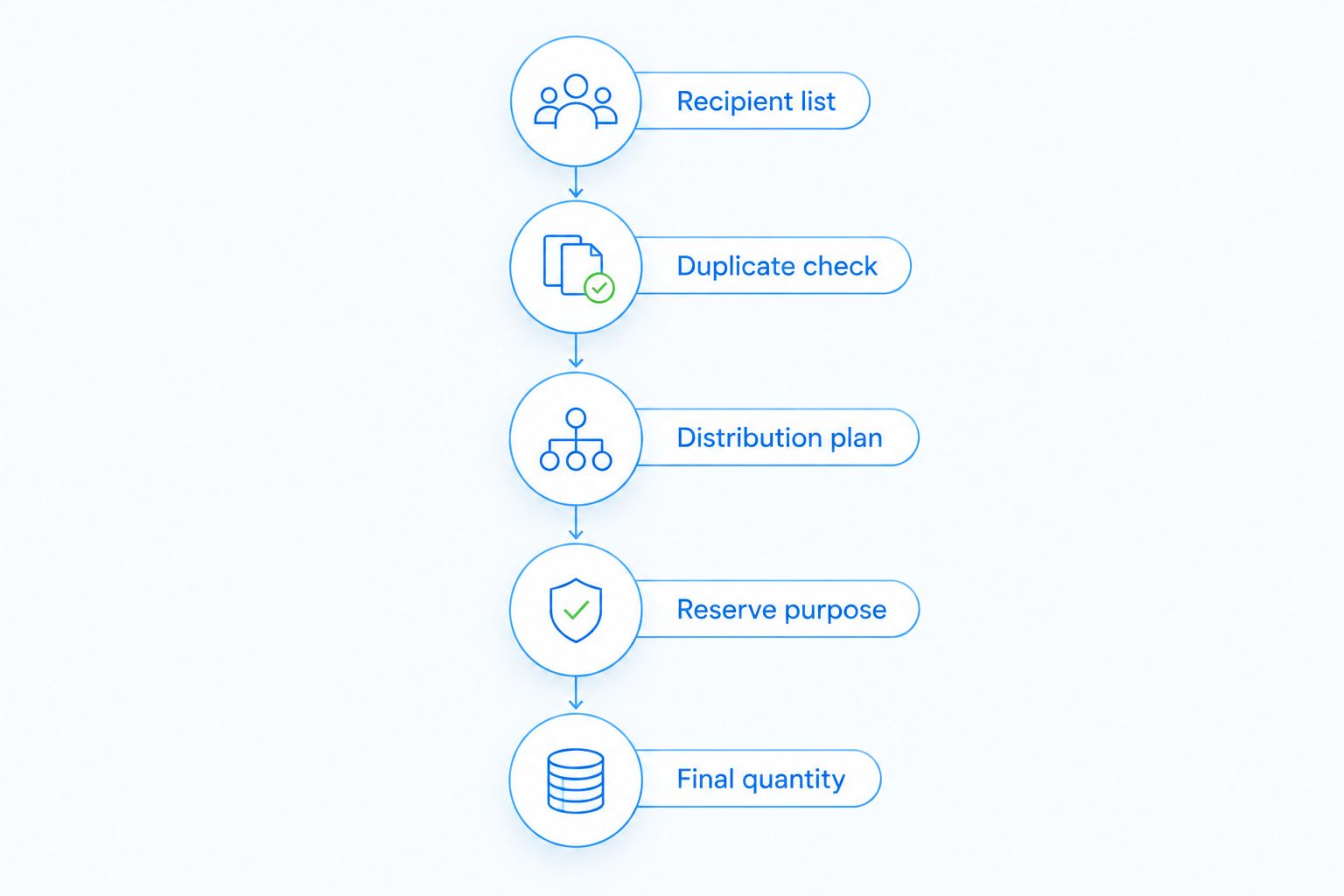
A useful worksheet includes the distribution group, recipient count, delivery method, owner, deadline and status. Add a notes column for shared addresses or requested extra copies.
Do not approve a batch with no owner or destination. Move uncertain demand into a separate planning row until someone confirms how those calendars will reach recipients.
Keep the print total separate from the mailing total
Not every printed calendar needs mailing. Some copies belong to personal deliveries, office use or counter distribution.
Keep the mailed quantity separate so your quote request describes the work accurately. If mailing is part of the campaign, confirm packaging and delivery requirements rather than assuming the print specification covers them.
Check the artwork before counting existing stock
Existing calendars only reduce your new order when they are genuinely usable. Check the calendar dates, contact details, branding and physical condition.
For a 2026 campaign, a box with outdated dates or incorrect contact information is not usable stock. Do not subtract it simply because it is already paid for.
How many extra calendars should you order?
Order extra calendars for identifiable uses, not an automatic reserve percentage. List replacement copies, internal samples and additional recipient requests separately so you can approve or remove each allocation.
If nobody can explain where the extras will go, leave them out of the confirmed quantity. Revisit that decision when the distribution team supplies a specific need.
Should you order calendars for every customer?
Order calendars for every customer only when each customer belongs in the campaign and has a workable delivery route. Your database size is not the same as your calendar audience.
Choose a consistent inclusion rule, such as confirmed requests or an approved client-gift list. Apply that rule before counting, rather than selecting recipients after the calendars arrive.
Is a single order better than ordering in stages?
A single order suits a confirmed list and a settled distribution plan; staged ordering suits demand that still needs validation. Neither approach is automatically better without the printer's specifications and your required handover date.
| Ordering approach | Best for | Advantage | Limitation |
|---|---|---|---|
| Single approved order | Confirmed recipients and fixed plans | Keeps the campaign under one quantity approval | Leaves less room to adjust the initial allocation |
| Staged ordering | Demand that requires confirmation | Allows later quantities to reflect new information | Requires a separate production and delivery decision |
Before choosing staged ordering, ask whether a later run can meet your deadline and match the approved specification. Do not assume a repeat order has the same schedule as the first.
Turn the quantity plan into a clear quote request
Send the approved quantity with the calendar format, artwork status and required delivery date. State whether you need printing only or also want to discuss packing and distribution requirements.
Print Fast calendar printing is for Canadian small businesses seeking an online print shop with custom quotes. The business offers calendars and local support; confirm the production schedule for your particular calendar specification rather than applying a general rush-printing label to the job.
When requesting Print Fast calendar printing, distinguish your required arrival date from the date distribution starts. Approval, printing and the final handover need to fit the same plan.
Ask for confirmation of:
- The calendar format and finished specification.
- The approved order quantity and any quantity alternatives you want assessed.
- Artwork requirements and proof approval steps.
- The production schedule for the chosen specification.
- Delivery arrangements and any separate packing requirements.
The benefit of a custom quote is that it addresses your actual job. The limitation is that the final quantity still depends on your recipient decisions; a printer cannot resolve duplicate contacts or unassigned handout stock for you.
FAQ
How do I work out how many promotional calendars to order?
Add confirmed recipients, planned distribution and a reserve tied to specific uses, then subtract usable stock. Check duplicate households and business locations before approving the total.
Should I count customers or households for calendar gifts?
Count the unit that matches the intended use: a person, household or business location. Record requested extra copies separately rather than assuming every contact needs an individual calendar.
What reserve percentage should a small business use?
Use a reserve based on named purposes rather than a universal percentage. Replacements, internal samples and additional confirmed recipients should each have a recorded allocation.
Should every event attendee get a promotional calendar?
Allocate calendars to the intended recipient group, not automatically to every attendee. Assign someone to manage distribution and record what remains.
Can I subtract calendars left from an earlier campaign?
Subtract existing calendars only when their dates, contact details, branding and condition still match the current campaign. Outdated stock does not reduce the quantity you need.
Does a general rush-printing service guarantee my calendar deadline?
Confirm the schedule for the exact calendar specification before approving the order. A general rush-printing description does not establish the production or delivery timing for a particular job.
Can Print Fast help with a promotional calendar quote?
Print Fast offers calendar printing and custom quotes for Canadian businesses. Provide your quantity, format, artwork status and required delivery date so the request describes the actual job.
One last thing
Your leftover count is only useful if you know why calendars remained. Separate undelivered client gifts from unused handout stock when reviewing the campaign.
For your 2026 review, record calendars distributed, calendars remaining and requested copies you could not fulfil. Those records give the next quantity decision a factual starting point without treating every leftover as evidence that the entire order was too large.
Count destinations first. Approve calendars second.
Related guides
- Custom calendars for corporate gifts
- Calendar printing for real estate agent giveaways
- Canada Post Neighbourhood Mail vs Personalized Mail
Request a custom quote for your promotional calendars with your approved quantity, chosen format and required delivery date.

