

Best overall: custom labels matched to your packaging. Best for repeated application: roll labels. Best for hand-applied batches: sheet labels. This 2026 Toronto label printing guide compares formats, materials and artwork requirements so you can request the right job—not just the fastest one.
- Print Fast is best for Toronto businesses seeking label printing guidance and local rush-print support.
- Choose roll labels for repeated application; confirm dispenser requirements before ordering.
- Choose sheet labels for hand-applied batches with several designs.
- Same-day printing requires confirmation of the exact label material, artwork and deadline.
Why this matters
A label has to suit both the package and the way you apply it. A bottle, a cardboard mailer and a temporary event container need different decisions, even when they carry the same artwork.
Print Fast offers Toronto businesses rush printing, local delivery, live support and custom quotes. Its broader printing services include 1-hour, same-day and 24-hour turnaround options; confirm the schedule for your particular label job rather than treating those service labels as a promise for every specification.
For a launch deadline, start with the same-day sticker printing guide. For label printing in 2026, approve the material and completion time together. Speed does not replace surface compatibility.
What makes the best label printing option?
Use these criteria before comparing formats. They separate a practical order from a label that looks right in a PDF but fails during packing.
- Surface fit: Identify glass, plastic, cardboard or another actual application surface. Include texture and curvature.
- Exposure: State whether the package encounters condensation, splashes, handling or outdoor conditions.
- Application method: Explain whether you apply labels by hand, with a dispenser or through labelling equipment.
- Artwork control: Confirm dimensions, cut shape, readable text and the correct file for each version.
- Deadline clarity: Give the required in-hand date and location, not just the event date.
- Removal needs: Specify whether the label stays permanently or must come off after use.
These criteria do not produce a universal winning material. They produce a specification you can compare across quotes without accidentally comparing different jobs.
Label printing options at a glance
This ranking covers buying approaches, not competing print shops. Sheets and rolls describe delivery format; paper, film and removable constructions describe other parts of the specification. You can combine them where the printer confirms compatibility.
| Rank and option | Best for | Standout feature | Key limitation |
|---|---|---|---|
| 1. Sheet labels | Hand-applied batches with several designs | Flat backing keeps labels organised during packing | Less suited to roll-fed equipment |
| 2. Roll labels | Repeated application of a consistent design | Continuous backing supports dispenser-based workflows | Roll setup must match the application method |
| 3. Film labels | Packaging exposed to moisture | Film face material suits moisture-focused specifications | Film alone does not establish adhesive or ink performance |
| 4. Paper labels | Dry indoor packaging | Paper appearance suits boxes and dry goods | Unspecified paper is not a waterproof specification |
| 5. Removable labels | Temporary identification | Designed around later removal | Removal depends on the surface and conditions |
1. Sheet labels: best label printing for hand-applied batches
Sheet labels arrive on flat backing sheets, with individual labels cut for peeling. Choose this workflow when your packing team works at a table and needs to identify different designs without managing separate rolls.
A sheet format is a sensible starting point for a small business preparing assorted products. The important question is how each sheet is arranged and identified, especially when similar designs differ only in a scent, flavour or product name.
Sheet label pros:
- Flat sheets fit a straightforward manual packing station.
- Separate sheets help organise artwork versions.
- Individual labels peel away without cutting the backing apart.
Sheet label cons:
- Sheets do not replace rolls in roll-fed equipment.
- Similar-looking versions still require clear identification.
Ask whether different artwork versions need separate files and how quantities are counted. A total label quantity does not explain how many of each design you need.
Best for: Owners and packing teams applying mixed designs by hand.
Verdict: Buy sheet labels when manual application and version control matter most.
2. Roll labels: best label printing for repeated application
Roll labels sit on a continuous backing wound around a core. They suit a workflow in which the operator repeatedly applies the same label, either by hand or with compatible dispensing equipment.
The roll format is not an adhesive or durability specification. You still need to choose the face material, adhesive, finish and cut shape separately.
Roll label pros:
- Continuous backing supports repeated peeling and application.
- Compatible dispensers keep the backing controlled.
- A consistent artwork run keeps the packing task focused.
Roll label cons:
- Core size and roll diameter must fit your equipment.
- Incorrect unwind direction can put artwork in the wrong orientation.
Before ordering roll labels in 2026, send the printer your dispenser or applicator requirements. Describe which edge of the label must leave the roll first; do not assume a shared interpretation of orientation.
Best for: Businesses with a repeatable packing process and a confirmed application method.
Verdict: Buy roll labels after confirming the roll specification—not simply because the order repeats.
3. Film labels: best label printing for moisture-exposed packaging
Film labels use a plastic face material rather than paper. They are a useful specification to discuss for packaging exposed to condensation or splashes, but the finished label depends on more than that face material.
Ask about the complete construction: printed surface, protective finish and adhesive. A moisture-resistant face does not establish that the ink resists rubbing or that the adhesive bonds to a cold container.
Film label pros:
- Film provides an alternative to a paper face material.
- Different constructions address different packaging conditions.
- The specification can account for moisture during use.
Film label cons:
- Film is not a blanket guarantee of waterproof performance.
- The wrong adhesive can still lift from the package.
Apply a sample to the actual container before committing to a repeat order. Reproduce the conditions the package encounters, including handling and refrigeration where relevant.
Best for: Packaging projects where moisture exposure is a stated requirement.
Verdict: Buy film labels only with a confirmed construction suited to the package.
4. Paper labels: best label printing for dry indoor packaging
Paper labels suit projects where a paper appearance and a dry application environment are priorities. Think about the finished package as well as the artwork: a textured carton and a smooth jar present different bonding conditions.
Do not order paper solely because the product stays indoors. A bathroom shelf, refrigerator or splash-prone counter still introduces moisture.
Paper label pros:
- Paper provides a familiar printed appearance.
- It suits dry packaging briefs without requiring a film face.
- Different finishes allow you to specify the intended surface feel.
Paper label cons:
- Paper does not establish water resistance.
- Surface finish can affect handwritten additions.
If staff add batch information by hand, test the intended pen on the proposed finish. Printed appearance and writeability are separate requirements.
Best for: Dry boxes, indoor packaging and projects that call for a paper finish.
Verdict: Buy paper labels for a confirmed dry-use application; skip unspecified paper for wet conditions.
5. Removable labels: best label printing for temporary identification
Removable labels put later removal at the centre of the specification. They suit temporary identification where leaving the label permanently attached would create extra work.
Removability depends on the adhesive, surface, application conditions and time in place. The word removable does not guarantee identical results on glass, coated cardboard and textured plastic.
Removable label pros:
- The specification addresses removal rather than permanent bonding.
- Temporary information stays separate from permanent packaging artwork.
- Sample testing lets you assess removal on the intended object.
Removable label cons:
- Removal behaviour varies between surfaces.
- A construction chosen for removal is not automatically suitable for permanent branding.
Explain what acceptable removal means. State whether residue, surface damage or lifting a coating would make the label unsuitable.
Best for: Temporary event identification, short-term instructions and changeable information.
Verdict: Hold the full order until a removal test passes on the actual surface.
How this ranking works
The order starts with application workflow because sheets versus rolls changes how your team handles the job. Material and removal requirements then refine that choice. No format wins every criterion.
For a Toronto business ordering in 2026, the strongest specification combines surface fit, exposure, artwork control and a confirmed deadline. This is a selection framework, not a claim that every listed construction shares the same production schedule.
Prepare a label printing quote that answers the right questions
Give Print Fast the packaging details before asking which label option fits. A clear brief helps keep the discussion focused on the finished job rather than a generic description such as premium labels.
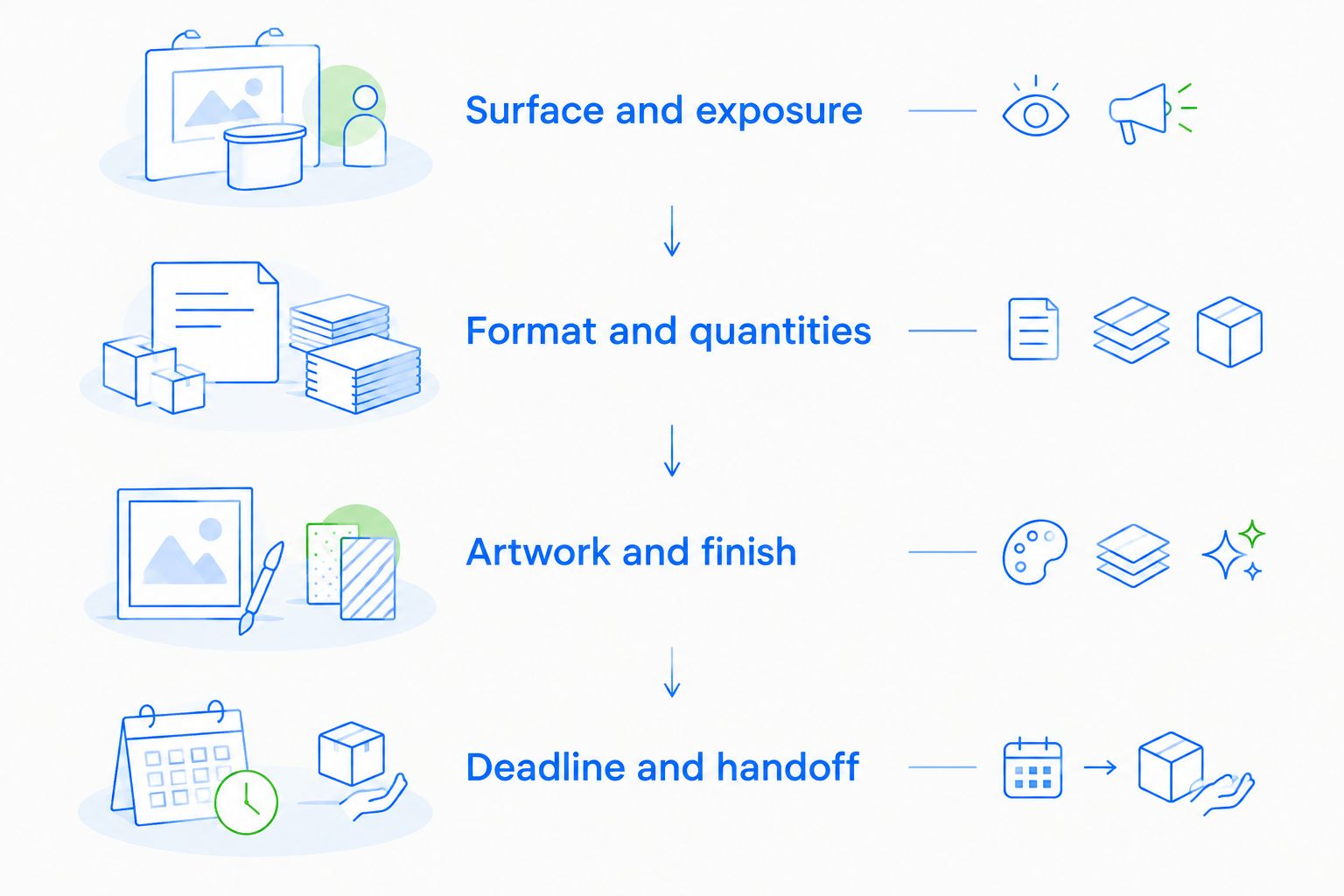
Surface and exposure
Name the container material and explain whether it is flat, curved, textured or flexible. Describe the conditions during application separately from conditions during use: applying a label to a dry room-temperature container is different from applying it to a damp refrigerated one.
Format and quantities
State whether you want sheets or rolls, and list the quantity beside each artwork version. For rolls, include equipment requirements. If the format is undecided, explain the packing workflow instead of guessing.
Artwork and finish
Provide finished dimensions and the intended cut shape. Ask for the printer's file requirements before exporting; bleed, cut lines and white ink instructions depend on the job.
Deadline and handoff
Give the required in-hand date, destination and preferred handoff method. Ask for separate confirmation of artwork approval, production completion and delivery or collection arrangements. A production completion time is not the same thing as arrival at your packing table.
Check the proof before approving a rush job
Print the proof at 100% scale and place it against the actual package. A large on-screen preview hides text that becomes difficult to read at finished size. Check the label on the curve, not only on a flat desk.
Use this approval sequence for a 2026 launch:
- Verify content: Check product names, spelling, version names and any required information against your approved source.
- Verify placement: Keep essential text away from the cut edge and check where a wrap label meets.
- Verify scanning: Test printed barcodes or QR codes in the intended application.
- Verify appearance: Check contrast and the effect of a clear or coloured container.
- Verify ownership: Assign approval to a named person so conflicting files do not reach production.
For regulated products, confirm the applicable Canadian labelling requirements separately. A print-ready file does not establish legal compliance, and artwork approval should not substitute for a content review.
Which label printing option should you choose?
Choose sheet labels as the default for a hand-applied, mixed-design job. Choose rolls when your repeated application workflow calls for them. Then select the material and adhesive around the package's actual conditions.
Print Fast is best for Toronto businesses seeking label printing guidance and local rush-print support. For your 2026 order, request confirmation of the exact construction and schedule before approving production. Do not turn a general Same Day service description into an assumed commitment for an unconfirmed label specification.
FAQ
What’s the best label printing format for a small Toronto business?
Sheet labels are a practical starting point for hand-applied batches with several designs. Choose roll labels when your repeated application process or dispensing equipment calls for a continuous backing.
Can I request same-day label printing in Toronto?
You can request same-day label printing, but the printer must confirm the exact job. Material, finishing, artwork approval and handoff arrangements all need agreement before you rely on the deadline.
Are roll labels better than sheet labels?
Roll labels are better for a workflow built around repeated application or compatible dispensing equipment. Sheet labels suit flat packing stations and organised hand application; neither format determines durability.
Are film labels waterproof?
A film face material alone does not establish that the finished label is waterproof. Confirm the printed surface, protective finish and adhesive against the conditions your package encounters.
What should I send for a label printing quote?
Send finished dimensions, quantities per design, container material, exposure conditions, preferred format and the required in-hand date. Include artwork and any dispenser requirements so the printer can assess the complete job.
Can removable labels leave residue?
Removable labels need testing because removal behaviour depends on the adhesive, surface and conditions. Apply a sample to the actual object and check for residue or surface damage after the intended period of use.
How do I prepare artwork for custom labels?
Start with the printer’s requirements for dimensions, bleed, cut lines and file format. Check a proof at actual size on the package, then verify every artwork version before approval.
One last thing
The container is part of the print specification. Keep an empty example of the actual packaging for sample checks; a replacement bottle or differently coated box can change how the same label behaves.
Before repeating an order, check whether the packaging supplier, surface finish or application process has changed. Reusing approved artwork does not confirm that the old adhesive remains the right choice.
Related guides
- Custom label printing for cosmetics and skincare brands
- Shopify to custom product labels: complete workflow
- Return address labels for small businesses
Request a quote from Print Fast for your label printing. Include your packaging surface, dimensions, quantity per design and required Toronto/GTA in-hand date.

