

Hair salon loyalty cards are printed records of qualifying visits or purchases designed to encourage repeat bookings at salons and barbershops. This 2026 guide explains how to choose a reward, design a usable card and run the programme without complicating checkout or promising services your team cannot deliver.
- Start loyalty cards for hair salons with a clearly defined qualifying service and reward.
- Print Fast is best for Toronto salon owners seeking local support for business-card printing.
- Choose stamp cards for simple visit tracking; use appointment cards when rebooking is the priority.
- Test the card, reward rules and checkout process before ordering your full print run.
Why loyalty cards matter for salons and barbershops
A salon loyalty card gives your customer a record of progress towards a stated reward. It does not replace good service, an appointment reminder or a reliable booking process. Use the card to support the next visit, not to compensate for a disappointing haircut.
Your rules need to reflect your service menu. A quick barber trim and a lengthy colour appointment require different amounts of chair time, materials and staff attention. Counting every transaction identically is a business decision, not a default setting.
For the physical format, review business-card printing in Toronto. Confirm the stock, finish and marking method for your loyalty-card artwork rather than assuming a standard business-card specification suits it.
The practical goal for your 2026 programme is consistency: customers understand what counts, staff apply the same rule, and completed cards lead to a reward you have planned for. Measure the result against your own booking records, not an unsupported promise of higher retention.
How to create salon loyalty cards that work
Define the booking behaviour you want to encourage
Start with your appointment book and a simple worksheet. Identify whether the programme should support repeat haircuts, maintenance appointments or another clearly named service. Choose a behaviour your staff can verify at checkout.
Keep the programme separate from referrals unless you deliberately write referral rules. Returning for a haircut and introducing a new customer are different actions. Combining them on the same card creates avoidable questions about how customers earn credit.
Decide whether the card belongs to the salon or an individual stylist. This matters when customers change stylists, book at another location or visit while their usual barber is away. Write that decision into the rules before designing the card.
Close this step with a brief your team can use:
- Name the qualifying service or service group.
- State whether credit follows the customer or the stylist.
- Define how combined services count.
- Exclude cancelled appointments and services that were not completed.
- Assign a staff member to resolve exceptions.
Choose a reward your salon can fulfil
Work through the reward manually before adding it to the card. Review the staff time, materials and appointment space needed to fulfil it. A reward that sounds simple on paper still needs a workable booking procedure.
A salon-owned service addition or a clearly defined retail reward can be considered, but neither is automatically the right choice. Select only something your business actually offers and can explain precisely. Avoid printing a vague promise such as a complimentary treatment without naming what it includes.
Choose the reward before choosing the number of spaces. The card should express your programme, not dictate it because a template happens to contain a particular grid.
If your programme launches in 2026, keep a dated copy of the approved rules. That gives staff a reference when older cards return after you have changed the offer.
- Identify the exact reward and any service exclusions.
- Calculate the internal resources needed to fulfil it.
- Decide when customers can redeem completed cards.
- Specify whether redemption requires an appointment.
- Write a replacement policy for lost or damaged cards.
Select a card format and marking method
Make a paper mock-up first. Draw the front and back, mark the spaces and test how the card works during checkout. You can resolve layout problems before paying for a print run.
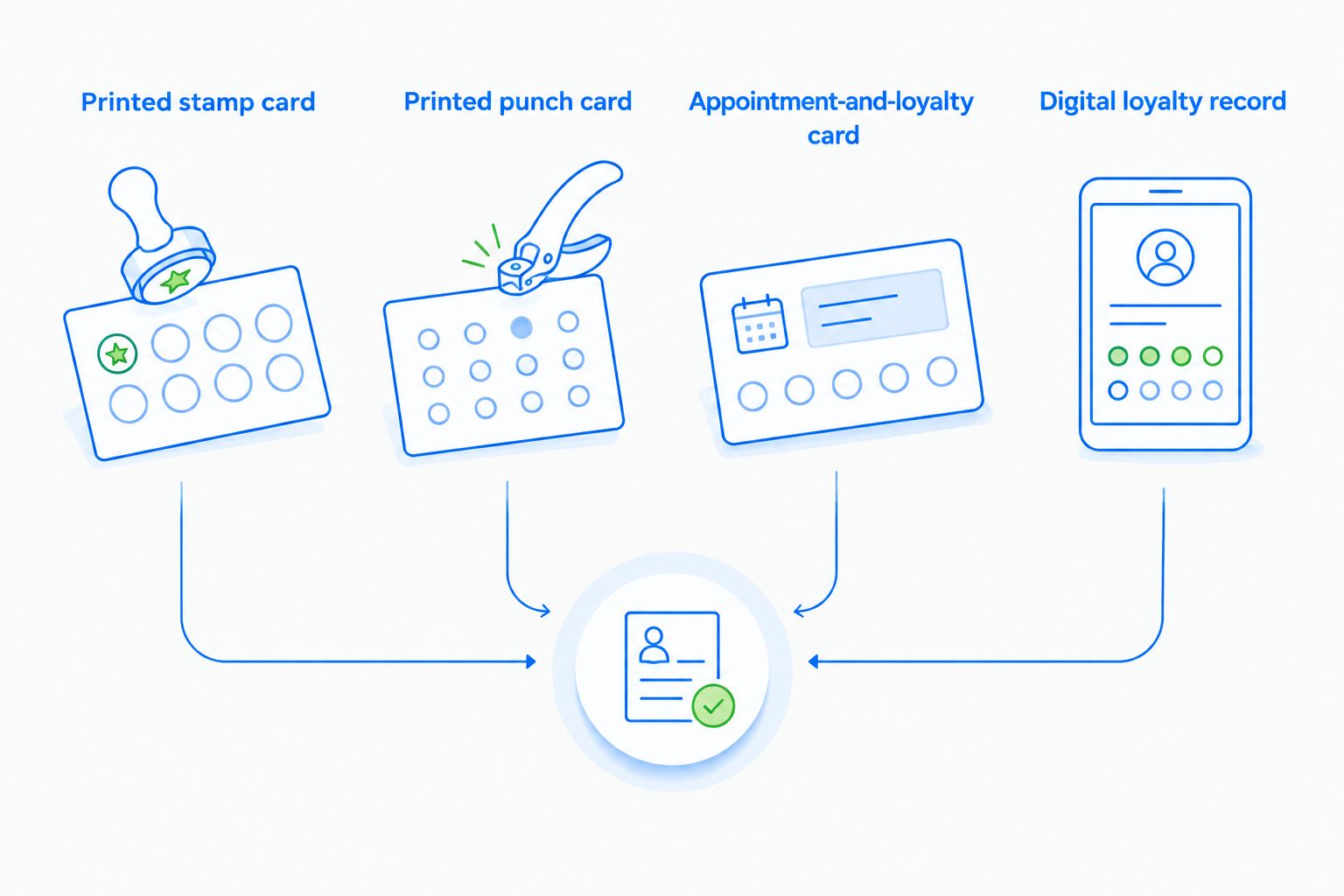
A stamp card suits a visit-based programme; a punch card uses holes instead of ink; an appointment-and-loyalty card combines progress tracking with the next booking. Each has limitations. Compare them below before choosing the format.
Print Fast offers business-card printing, rush turnaround options, local support and custom quotes. Use that support to discuss the proposed card specification after your rules and mock-up are ready. Printing support does not replace programme planning, and the proposed stock must work with your chosen stamp, pen or punch.
For a deadline-driven launch, the rush business cards guide provides related planning context. Confirm turnaround for the actual loyalty-card specification before announcing a launch date.
- Bring a mock-up showing both card faces.
- Identify whether staff will stamp, punch or write on it.
- Ask which proposed surfaces suit that marking method.
- Check that punch positions avoid essential information.
- Confirm the print specification and completion deadline.
Design the card around readable rules
Use your existing design software or a paper layout to organise the content. The front should identify your salon and explain the programme. The reverse should carry progress tracking, concise conditions and the information needed to return.
Give the reward and qualifying action priority over decoration. A customer should not need staff to interpret the card every time. Keep essential conditions on the card rather than relying on a verbal explanation that changes between employees.
Separate loyalty progress from appointment details. If you include a next-visit field, label it clearly so staff do not write over a stamp space. Include a booking route that belongs to your salon and verify it before export.
For your 2026 artwork, preserve an editable master file as well as the final print file. Changing the reward later should not require rebuilding the design from scratch.
- State the qualifying action in plain language.
- Name the reward without vague promotional wording.
- Leave marking spaces clear of decorative artwork.
- Put booking information outside the tracking grid.
- Check spelling, contact details and service names.
- Follow the printer's supplied artwork requirements.
Test the physical card before approving production
Print a draft at actual size on an office printer. This is a layout check, not a substitute for checking the final stock. Read it at the reception desk and hand it to someone who has not helped design it.
Prepare 1 actual-size proof for staff to handle. Check both card faces and ask a team member to mark a qualifying visit, explain the reward and find the booking information. Revise anything that requires an extra explanation.
Then confirm how the chosen marking tool behaves on the proposed printed surface. Ask about a sample or other suitable test before committing to a finish. Do not assume ink will behave the same way on every coating.
- Read all essential text at the intended printed size.
- Test the actual stamp, punch or pen you will use.
- Check that marks remain distinct from the artwork.
- Verify that holes cannot remove the reward wording.
- Approve the final file only after correcting errors.
Train staff to issue and redeem cards consistently
Start with a written desk procedure, not new software. Keep an example card beside the checkout instructions and walk through a normal visit, a completed card and a lost-card request. Staff need to know what to do before the first customer asks.
Make the order of actions explicit: finish the qualifying service, confirm eligibility, mark the card and explain the next step. If different staff use different sequences, customers receive different interpretations of the same programme.
Keep the redemption record separate from the card design. Collect or cancel a redeemed card using a consistent method so the same completed card is not presented again. Handle exceptions according to the policy you approved earlier.
- Mark cards only after qualifying services are completed.
- Keep the marking tool in a designated staff location.
- Explain the reward without adding unwritten promises.
- Record redemptions in your chosen business record.
- Apply the same lost-card rule across the team.
- Escalate disputed cases to the designated decision-maker.
Measure repeat visits and revise the programme
Use your appointment records and a basic spreadsheet first. Record cards issued, qualifying visits and rewards redeemed. Distinguish participation from results: distributing cards shows reach, while subsequent bookings show what customers did.
A practical 2026 review should also include staff feedback. Ask which rules caused confusion, whether marking slowed checkout and whether customers understood redemption. These observations tell you what to change without inventing a retention benchmark.
Compare like with like. If you review haircut customers, do not mix their booking pattern with occasional colour appointments and call the combined result a programme effect. Appointment records alone do not prove that the card caused a return visit.
- Count issued cards separately from completed cards.
- Track redemptions alongside the qualifying service.
- Compare booking behaviour within the same service group.
- Log lost-card requests and rule disputes.
- Revise the process before approving another print run.
Compare loyalty-card options for your salon
Choose the format around the checkout task. A simple printed card is useful when staff need visible progress tracking. A digital record is useful when progress must remain accessible without the customer carrying a card.
The comparison below covers operating approaches, not named software products. Confirm any printing requirements separately; a provider's general business-card service does not establish that every finish or marking method is suitable.
| Option | Best for | Main advantage | Key limitation |
|---|---|---|---|
| Printed stamp card | Salons with a straightforward qualifying-visit rule | Staff and customers can see progress on the card | Requires a tested stamp-and-surface combination; customers can lose it |
| Printed punch card | Barbershops wanting ink-free visit marking | A punch creates a physical record in the designated space | Hole placement must protect the wording and card edges |
| Appointment-and-loyalty card | Appointment-led salons prioritising rebooking | Combines next-visit details with reward progress | Extra information leaves less room for readable conditions |
| Digital loyalty record | Teams needing progress accessible without a physical card | Records remain available when customers forget a card | Requires a defined system, permissions and consistent data entry |
For an initial programme, start with the least complicated format that supports your rule. Adding more fields or technology does not fix an unclear reward.
Common loyalty-card mistakes salons and barbershops make
Treating unlike services as interchangeable
A fringe trim, haircut and colour appointment are not the same service. If each earns identical credit, make that a deliberate rule and assess the reward against the qualifying mix. Do not let staff decide transaction by transaction.
Printing a reward customers cannot identify
A promise such as a special salon treat leaves the customer guessing and staff interpreting. Name the actual reward, describe exclusions and explain whether it must be booked. Clear conditions are more useful than a larger promotional headline.
Choosing a finish before testing the stamp
A polished-looking card is not useful if your chosen ink smears or marks are difficult to read. Test the marking method on the proposed surface. Approve the finish for its job, not just its appearance.
Making loyalty depend on a particular stylist without saying so
Customers need to know whether visits with another team member count. Put the rule on the card or in its clearly identified conditions. Otherwise, an ordinary change of stylist becomes a redemption dispute.
Counting cards handed out as repeat business
Issued cards are a distribution measure, not evidence of another appointment. Review qualifying return visits and redemptions separately. Keep the 2026 programme focused on recorded behaviour rather than the size of the print run.
FAQ
What’s the best loyalty card for a small hair salon?
A simple printed stamp card is the best starting point when your salon uses a clearly defined qualifying-visit rule. Choose an appointment-and-loyalty card instead when recording the next booking is central to your checkout process.
Should a barbershop use stamps or hole punches?
Use stamps when the proposed card surface works with your ink, and punches when you prefer physical holes as the visit record. Test the actual tool and layout before approving production.
What should I put on a hair salon loyalty card?
Include the salon name, qualifying action, reward, tracking spaces, booking information and essential conditions. State how lost cards and visits with different stylists are handled.
How many visits should a customer need for a reward?
Set the required visits from the qualifying service and the resources needed to fulfil the reward. Do not adopt a template’s tracking grid before deciding whether its threshold suits your salon.
Can Print Fast help with salon loyalty-card printing?
Print Fast offers business-card printing, local support and custom quotes. Ask whether your proposed loyalty-card artwork, stock and marking method fit the available printing options, then confirm turnaround for that specification.
Is a printed loyalty card better than a digital record?
A printed card is better for visible, customer-held progress tracking; a digital record is better when staff need access without the card. Neither approach fixes unclear eligibility or inconsistent staff procedures.
How do I know whether my salon loyalty programme works?
Review qualifying return visits and reward redemptions using your appointment records. Separate service groups and compare recorded behaviour rather than treating cards distributed as proof of retention.
One last thing
Before ordering, ask a staff member who did not write the rules to process a pretend completed card. If the reward needs a manager's interpretation, revise the wording first. The redemption test is as important as the artwork proof.
Related guides
- Custom rack cards for spas and salons
- Postcard printing for spa and salon promotions
- Custom label printing for cosmetics and skincare brands
Request a custom quote from Print Fast for your salon loyalty cards. Include your artwork, quantity, marking method and required completion date so the proposed printing specification matches the programme.

